


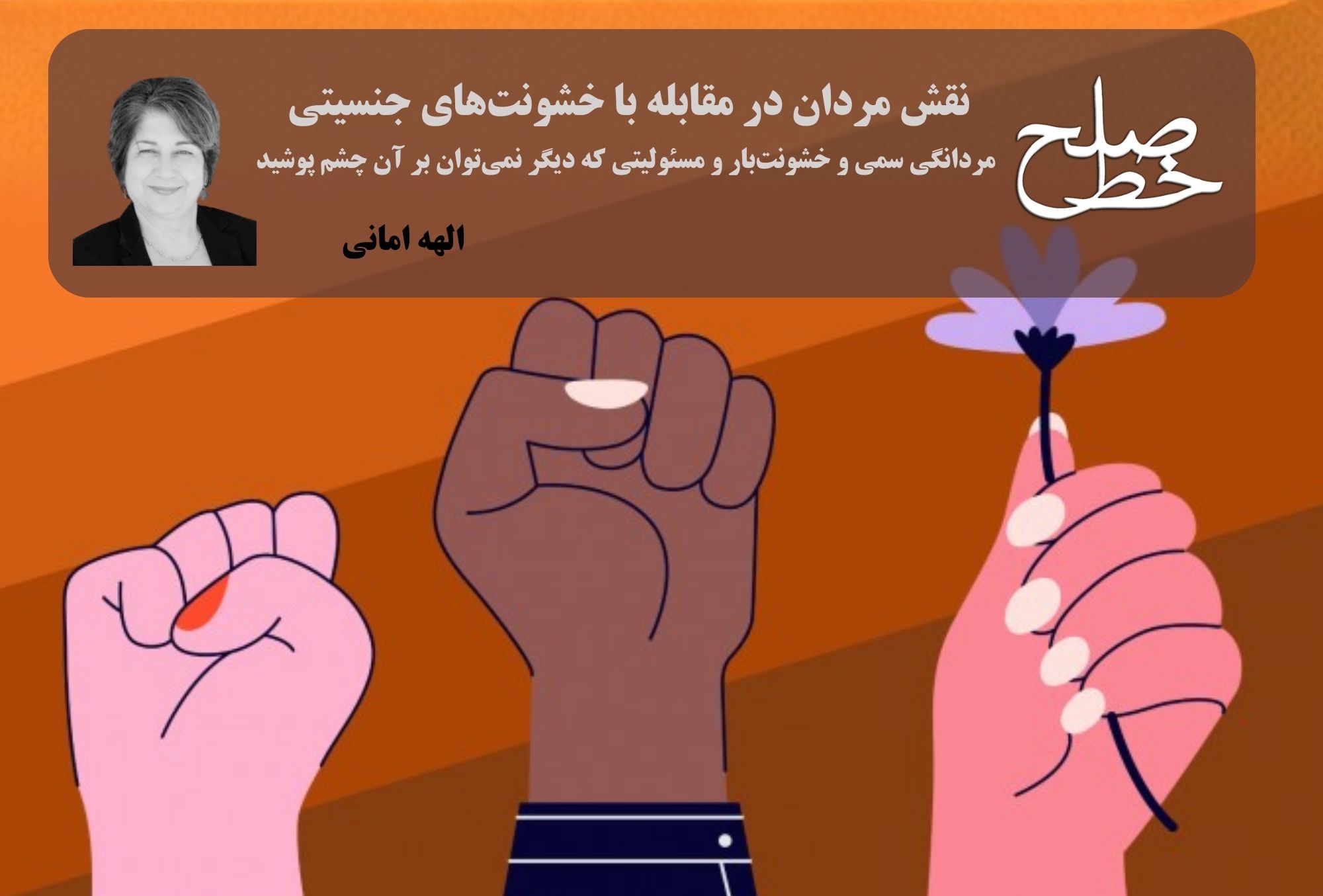
The role of men in confronting gender-based violence/ Elahe Amani
The annual international campaign “16 Days of Activism Against Gender-Based Violence”, entitled “16 Orange Days”, ended on December 10, coinciding with International Human Rights Day. Although public awareness of violence against women has increased during the 34 years of the global campaign, the path to ending this violence remains long and complex. Violence against women is not limited to the private or public physical space; today, women also experience harassment, threats and violence in cyberspace and digital spaces on a large scale. Therefore, the slogan and main focus of the International Day for the Elimination of Violence against Women in 2025 was sexual and gender-based violence in cyberspace. The spread of new forms of violence makes the need for serious legal, social and cultural responses in this area more evident than ever.
The 16 Days of Activism against Sexual and Gender-Based Violence is a global campaign founded in 1991 by activists from the Center for Women’s Global Leadership (CWGL). The deliberate and purposeful linking of November 25, the International Day for the Elimination of Violence against Women, and December 10, Human Rights Day, places violence against women within the human rights framework and emphasizes that this violence is not a personal issue, but a structural and systematic violation of fundamental human rights, a violation that requires government accountability, social solidarity and sustained action. This period, rooted in the history of resistance, was chosen in memory of the Mirabel sisters, three sisters who were killed by the Dominican Republic’s dictatorial regime in 1960, and whose assassination became a lasting symbol of resistance to political and gender-based violence. Inspired by this legacy, this campaign was launched at Rutgers University to highlight violence against women as a human rights issue and to put effective pressure on governments to prevent it, protect victims, and end impunity for perpetrators.
Today, the campaign has become one of the largest global movements for gender justice. Thousands of organizations and civil society networks in more than 180 countries participate in the Sixteen Days of Activism. The United Nations, through its UNITE initiative, has also officially supported the campaign and chosen the color orange as a symbol of a future free of violence for women and girls. Each year, the campaign focuses on a specific theme, addressing emerging or less visible forms of violence. In this regard, given the persistence of violence against women and the alarming increase in online violence, the theme for 2025 was “Digital Violence.”
The reality is that gender-based violence is both a cause and a consequence of gender inequality; therefore, men, as one half of society, have a moral and social responsibility to confront it. This responsibility goes beyond verbal condemnations and requires fundamental actions such as rethinking models of masculinity, challenging norms that generate violence, avoiding silence and complicity, holding peers and institutions accountable, and consciously standing in solidarity with feminist movements. The active participation of men plays a decisive role in dismantling patriarchal structures that, by normalizing violence, create a serious obstacle to the realization of gender equality.
Finally, the 16 Days of Activism is a reminder that violence against women is not only a clear violation of human rights, but also a symbol of the violation of the rights of half of society, and can only be resolved through collective action. Ending gender-based violence requires strengthening local action, expanding global solidarity, and holding governments accountable in the three areas of prevention, protection of survivors, and justice. Achieving a world free of violence is only possible through shared responsibility across gender lines.
Women’s oppression, gender inequalities and patriarchal relations are not individual or women-only issues, but structural and social issues rooted in institutions, cultural norms and power relations. Although women are at the forefront of confronting gender-based violence – both as those who suffer the most and as pioneers of change – achieving sustainable transformation is not possible without the active participation of men, the other half of society.
During the fifty-eighth session of the United Nations General Assembly (2003–2004), the Commission on the Status of Women requested the Secretary-General to undertake a comprehensive study on all forms and manifestations of violence against women, as identified in the Beijing Declaration and Platform for Action and Women 2000: Gender Equality, Development and Peace for the Twenty-First Century. It was also considered necessary to open a discussion on the role of men in combating violence against women, in order to provide a basis for recommendations and strategies to combat this violence.
Following this decision, the HeForShe campaign was launched in 2014 by UN Women with the aim of engaging men and boys as activists and advocates for gender equality. The campaign played a symbolic and mobilizing role in engaging men in dialogue and action on gender equality; however, its effectiveness has also faced serious limitations and important criticisms, which will be examined in another place.
Gender-based violence is perhaps the most widespread and socially accepted form of human rights violation. There is a direct link between this type of violence, gender equality and public health. Traditionally, discussions on gender-based violence have focused on men’s violence against women and the need to support and assist women who have been subjected to violence.
The role of men in violence and their potential to confront it has been less discussed, an approach that is now undergoing a transformation. As the gender equality movement has moved beyond an exclusive focus on women and recognized the need to include men, a similar shift in the approach to understanding and confronting violence is evident. Recent research on the role of men in confronting sexual and gender-based violence is an attempt to change the way men and women are viewed as interconnected parts of a gender system.
The most obvious argument for the need for such a change is that helping women victims will not, in itself, stop men from committing violence; rather, we must work with boys and men to stop violence. A significant number of politicians, NGOs, and researchers in the world and in Iran acknowledge this fact. However, it must be admitted that we still have a long way to go. The most promising trends and challenges ahead to eliminate violence and explain the role of men in this area are as follows:
– Knowledge about the extent and consequences of male violence is increasing internationally. At the same time, taboos around acknowledging violence are decreasing, and violence in intimate relationships with partners or spouses is receiving greater public attention. This trend has led to increased awareness of the need for men to participate in combating violence against women.
In California, men convicted of domestic violence or subject to a domestic violence court order are typically required to participate in and successfully complete a court-approved “Breach Intervention Program” (BIP). Often informally referred to as “domestic violence school,” these programs are a form of re-education or mandatory training. The goal of these programs is to address the root causes of violent behavior, teach personal responsibility, and prevent future violence. The author of this note was responsible for organizing and facilitating these workshops for men in the 1990s.
– Treatments and interventions specifically for men are increasingly showing that it is possible to change violent behavior in men. This fact has highlighted the importance of working with men and has led to a more optimistic approach in this area.
– The growing body of research on male violence has provided new insights into its causes. In addition to the long-standing “power relations” of patriarchy, there is now a growing focus on men’s experiences of violence in childhood and the apparent link between these factors and social, economic, and age-related variables. This approach has shifted the debate from the general proposition that “all men are potentially violent” to a more realistic understanding that most men never use violence against their partners and that violence is usually tied to specific individual and social contexts.
– Recent research suggests that violence by women against men in intimate relationships—whether spouses or partners—is more widespread than previously thought; although this type of violence is not comparable in scope or in emotional and physical consequences to violence by men against women. However, awareness of this fact helps to reduce gender polarization and increase male participation. In this regard, there is evidence that men are just as vulnerable to violence by men as women, and that men who experience severe violence suffer psychological trauma in much the same way as abused women; although it is clear that this type of violence is mainly perpetrated by men against men.
Key roles of men in addressing sexual and gender-based violence
– Challenging harmful and toxic masculinities: Actively confronting gender roles that link masculinity with dominance, control, and violence, and instead promoting healthy, egalitarian, and non-violent models.
– Breaking the Silence and Being an Ally: Taking a clear stand against sexist jokes, harassment, and all forms of violence in all settings—from the home and workplace to public spaces and social media—is critical. Men can become effective advocates by exposing abusive behavior, challenging perpetrators, and supporting survivors.
– Institutionalizing equality in the family: By modeling equal relationships, sharing equitably in household responsibilities, and supporting women’s rights and agency, men can stop the cycle of violence within the family.
– Educating peers and future generations: Using social networks, personal relationships, and individual influence to challenge discriminatory beliefs and attitudes, as well as role models for boys and young men, are key tools for building culture.
– Support structural and institutional reforms: Men can help bring about lasting change at the macro level by demanding the abolition of discriminatory laws, monitoring the implementation of preventive policies against sexual and gender-based violence, and supporting women’s rights organizations and movements.
Challenges and obstacles to men’s role in confronting sexual and gender-based violence
– Deep-rooted patriarchal power relations: Patriarchal systems and beliefs that emphasize male superiority limit women’s power and fuel the persistence and spread of sexual and gender-based violence.
– Traditional male support for violence against women in the family sphere: Many men consider male relatives to be their main supporters. By confining violence within the family, this approach reproduces domination while undermining legal and civil solutions, such as what is abundantly seen in honor killings.
– Legal gaps and implementation challenges: In many countries, although laws exist to combat violence, weak implementation and the existence of legal loopholes and caveats seriously reduce their effectiveness.
In sum, the role of men as active agents of change creates the conditions for dismantling the cultural and structural barriers that reproduce violence. This participation is not only for the realization of women’s rights, but also a prerequisite for achieving more just, safe, and humane societies.
Iran and the Vicious Cycle of Toxic Masculinity
Despite the restrictions on civil society activity in Iran’s political structure, the “16 Days of Activism Against Gender-Based Violence” campaign has received widespread coverage in analytical articles, media, and social networks in Iran in 2025. This widespread reception and coverage in the context of society reflects the increase in public awareness and the weakening of taboos on reporting on all types of violence—including sexual assault—a cultural shift that has taken hold even in the absence of legal changes.
It is clear that from a legal perspective, laws in any society should be a tool to protect justice, guarantee human rights, and advance the equality of citizens, and even go a step beyond the current state of society. However, in Iran, especially in the area of family law and regulations related to sexual and gender-based violence, the existing legal framework not only fails to respond to the lived realities of women, but also becomes a factor in perpetuating insecurity and physical and psychological harm, acting as a tight garment on the stature of Iranian society and women’s demands.
The lack of comprehensive, comprehensive, and independent research on sexual and gender-based violence in contemporary Iranian history is itself indicative of the lack of political will to systematically confront this structural problem. In such a context, the experiences of activism—from the “One Million Signatures Campaign” to change discriminatory laws to the “Women, Life, Freedom” uprising—take on historical and analytical significance. While it is obvious that legal reform alone is not enough to end violence, explicit criminalization, ensuring effective enforcement, and establishing judicial accountability mechanisms can play a decisive role in curbing violence, especially the phenomenon of femicide.
In Iran, even in the limited cases of criminalization, the lack of effective enforcement guarantees has reduced the law to a virtually ineffective text. In such a context, the fundamental question is: What is the role of men in the cycle of violence, in the shadow of ineffective and outdated laws? The statistics and research related to “feminicide” in Iran are shocking. According to a recent report by the “Campaign to Stop Honor Killings,” in the first six months of this year alone, 118 murders were recorded (1), the vast majority of which were committed by male family members in the name of “defense of honor.”
In analyzing this situation, Dr. Jackson Katz, a leading researcher in the field of gender-based violence, explains the concept of “toxic masculinity” not as an inherent characteristic of men, but as a social and cultural system. This analytical framework is also applicable to understanding gender-based violence in Iran, a society in which the definition of masculinity is often linked to control over women’s bodies, familial authoritarianism, and the legitimization of violence under the banner of “honor.”
Toxic masculinity is a set of acquired norms that equate male identity with elements such as dominance, control, emotional repression, and violence. In Iran, this pattern is reproduced in the form of concepts such as “jealousy,” “honor,” and “male headship of the family,” concepts that are not only rooted in popular culture but are also reflected and entrenched in regressive and discriminatory laws—including guardianship, custody, and exclusive headship of the family. This mechanism is not limited to one geography; in many Western and South Asian societies, these same concepts, with different names and narratives, also serve a similar function: legitimizing violence against women.
The undeniable fact is that violence against women must be removed from the framework of a “women’s problem” and redefined as a “men’s issue.” This shift in approach is of strategic importance in Iran, as the silence or complicity of men in the family and community is one of the main pillars of the continuation of the cycle of violence.
The “active bystander” approach finds unique expression in societies with limited civic space, such as Iran. Men who do not remain silent in the face of sexist jokes, denigration of women, or justifications of violence in their workplaces, universities, or families are in effect deconstructing and rejecting toxic masculinity. The “Women, Life, Freedom” movement was a concrete manifestation of this shift; men who stood up for women in the streets or supported their struggle against the mandatory hijab are clear and courageous examples of “active bystander” activism.
Toxic masculinity does not only target women, but also seriously harms men themselves. High rates of male-on-male violence, conflict-related homicides, vulnerability to political violence, and intense pressure to play the role of “powerful breadwinner” demonstrate the destructive dimensions of this model for men. On the other hand, emotional repression of men and stigmatization of any vulnerability create a serious barrier to their seeking mental health services. This cultural barrier—even when economic and medical resources are available—excludes men from treatment and perpetuates violence.
In Iran, the ideal man in state media is often portrayed as a “defender of order, honor, and security.” This type of representation, whether in television series or in political and security discourse, makes violence and male authority seem natural and necessary, and presents any peaceful masculinity as weakness or a threat. The truth is that condemning all men is not the solution. An effective solution is to encourage men to be accountable, to criticize patriarchal privileges, and to introduce new definitions of being a man; definitions that rely on care, solidarity, and the fight against violence—even within the family. Examples of men’s solidarity with women in Iran and countries in the region, including Lebanon, Palestine, and Tunisia, show that these alternative models are not only possible, but also concrete.
In Iran, not only are there no public prevention policies, comprehensive treatment programs, and systematic education to combat “sexual and gender-based violence,” but in many cases, regressive ideas and norms are structurally promoted and encouraged. However, what was said earlier about the challenges and necessity of men’s role-playing is also completely true in the Iranian context; because even in the presence of discriminatory laws and government obstacles, the fight against patriarchal culture and violent symbols arising from gender inequality will be impossible without the active participation of men. Therefore, the presence of men in the field of preventing and combating sexual and gender-based violence has a fundamental and decisive position.
Toxic masculinity in Iran, beyond a cultural or individual behavioral phenomenon, operates in close connection with the structure of political power, the legal system, and mechanisms of social passivity. Therefore, effectively confronting this phenomenon requires making the role of men visible; a dual role that is meaningful both in “perpetuating violence” and in “resisting it.” The experience of more than 46 years has shown that young generations and male activists have demonstrated significant potential and actual capacities to challenge dominant patterns of masculinity. One of the fundamental axes for transitioning from the cycle of reproduction of violence and gender inequality in Iran is to support alternative forms of masculinity; patterns that consider women’s freedom, equality, and human dignity not in conflict, but as an integral part of collective liberation and social justice.
 Created By: Elahe Amani
 December 22, 2025
Tags
"16-day campaign against sexual violence" "16-Day Global Campaign Against Gender-Based Violence" "Million Signature Campaign" 16-day campaign Elahe Amani Freedom of life Goddess Amani Honor or dignity peace line Peace Line 176 Sexual violence Toxic masculinity United Nations Woman ماهنامه خط صلح