


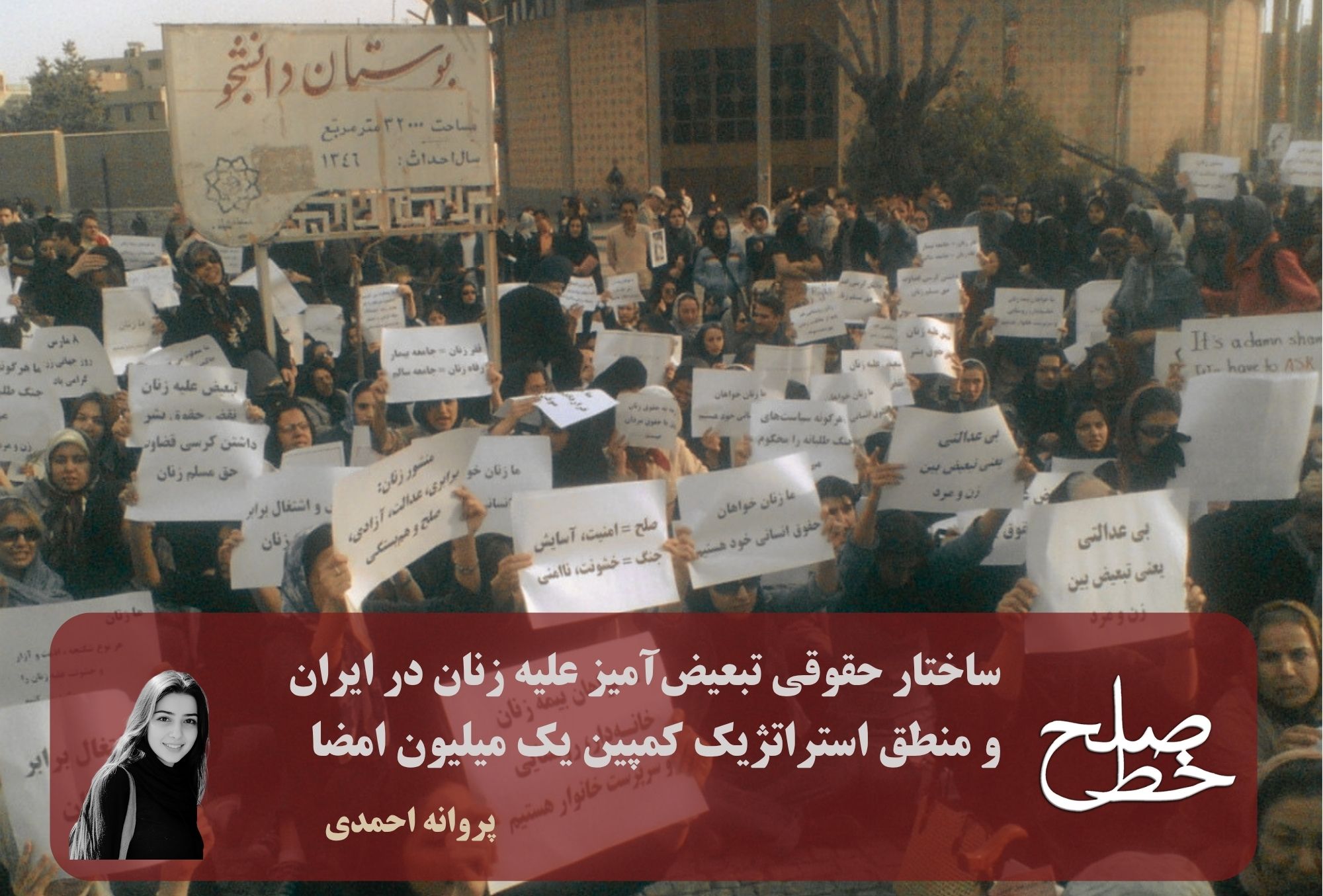
The Discriminatory Legal Structure Against Women in Iran and the Strategic Logic of the One Million Signatures Campaign/ Parvaneh Ahmadi
The legal, social, and political status of women in contemporary Iranian history, particularly in the decades following the establishment of the Islamic Republic in 1979 (1357), has always been marked by profound contradictions and complexities. On the one hand, as time has passed, Iranian society has witnessed the dynamism and extensive presence of women in the public sphere, higher education, and civil activities, to the extent that in recent decades women have constituted more than half of university graduates and the young skilled workforce, while the fertility rate has declined dramatically, indicating profound demographic and cultural changes. On the other hand, this social dynamism has encountered obstacles imposed by the ruling legal, political, and ideological structure. This structure has severely restricted women’s economic and political participation and kept both their labor-force participation rate and their share of senior decision-making positions, such as seats in parliament, among the lowest levels in the world. This stark contradiction between the objective realities and social capacities of Iranian women and patriarchal laws based on traditional interpretations of Islamic jurisprudence has contributed to the growth and evolution of civil and feminist movements in Iran.
In the course of the women’s movement’s struggle to achieve equal rights, the “One Million Signatures Campaign,” officially launched on August 27, 2006 (5 Shahrivar 1385), is regarded as one of the most influential campaigns. This social campaign, which emerged from the protest gatherings held in June 2006 (Khordad 1385) in Tehran’s Haft-e Tir Square, sought to move beyond traditional models of broad political struggle and distance itself from closed elite circles by organizing a movement based on raising public awareness and demanding legal rights.
To understand the roots of the formation of the One Million Signatures Campaign, it is essential to examine the trajectory of changes in women’s legal rights following the 1979 Revolution (1357). During the Pahlavi period, reforms concerning women’s rights were introduced, including the granting of voting rights in 1963 (1341) and the adoption of the Family Protection Law in 1967 (1346) and 1975 (1354), which improved women’s rights to some extent in areas such as divorce, child custody, and restrictions on polygamy. With the 1979 Revolution (1357), one of the new system’s first measures was to repeal the 1975 Family Protection Law and return to laws based exclusively on traditional interpretations of Shi’a jurisprudence. The imposition of compulsory hijab, the exclusion of women from serving as judges, and the consolidation of laws defining their individual and social rights as those of second-class citizens sparked a wave of protests in March 1979 (Esfand 1357), which were met with repression.
Throughout the 1980s and the Iran-Iraq War, the security atmosphere prevented the formation of independent women’s movements. However, with the end of the war and the beginning of economic development programs during the presidency of Akbar Hashemi Rafsanjani, followed by the relatively more open political atmosphere of the Reform Era—the administration of Seyed Mohammad Khatami from 1997 to 2005 (1376–1384)—women activists and non-governmental organizations gained some breathing room. Nevertheless, resistance from conservative institutions, such as the Guardian Council, prevented the adoption of the Convention on the Elimination of All Forms of Discrimination against Women (CEDAW) and other equality-oriented bills.
With Mahmoud Ahmadinejad’s government taking office in 2005 (1384), the space for civil activities became severely restricted and securitized, and efforts began to return to more traditional values and introduce bills facilitating polygamy and temporary marriage. In this highly tense atmosphere, activists from the women’s movement organized a peaceful gathering on June 12, 2006 (22 Khordad 1385), in Tehran’s Haft-e Tir Square to protest misogynistic laws. The gathering was met with violent action by security forces, batons, tear gas, and the arrest of activists.
The closure of conventional avenues for street protests and the shutting down of opportunities for reform gave rise to the “One Million Signatures Campaign.” The fundamental logic of the One Million Signatures Campaign rested on the principle that discrimination against women in Iran was not merely a cultural phenomenon or social practice; rather, this discrimination had been institutionalized and theorized in the country’s highest legal texts, including the Constitution, the Civil Code, and the Islamic Penal Code. Iran’s Civil Code, drafted in 1963 and subjected to religious revision after the Revolution, together with the Islamic Penal Code, imposes codes that place women in a subordinate position within the familial and social hierarchy and deprive them of financial, physical, and psychological autonomy.
The most important areas of legal discrimination against women under Iranian law that were direct targets for reform by the One Million Signatures Campaign included the following:
- Age of criminal responsibility: The age of criminal maturity is nine full lunar years for girls and 15 full lunar years for boys. This stark disparity exposes girls while still children to severe adult punishments, including execution and qisas, while boys of the same age enjoy relative immunity.
- Diya: A woman’s diya is structurally half that of a man. Although in recent years—following a 2019 (1398) precedent-setting ruling by the Supreme Court—it was determined that the difference in women’s diya would be paid through the “Bodily Injury Compensation Fund,” this is merely a solution for compensating financial loss, while the underlying discrimination in the ontological valuation of the lives of women and men in jurisprudence and law remains intact.
- Testimony before judicial authorities: The testimony of two women is regarded as equal to the testimony of one man, and in many serious criminal offenses, such as murder or zina, women’s testimony fundamentally lacks independent evidentiary value and is not accepted. This legally diminishes women’s credibility and social agency.
- Right to employment and residence: A husband may prevent his wife from engaging in any occupation that he considers incompatible with family interests or his own dignity. Furthermore, headship of the family and the right to determine the place of residence belong exclusively to the man, creating a serious obstacle to women’s residential autonomy.
- Legal age of marriage: The marriage of a girl before reaching the age of 13 solar years is permitted with the authorization of her legal guardian—the father or paternal grandfather—and the determination of a competent court. This provision creates a legal foundation for the prevalence of the destructive phenomenon of child marriage and the reproduction of poverty and educational deprivation among girls.
- Child custody: In the event of divorce, custody of children belongs to the mother until the age of seven and to the father thereafter. Moreover, if the father dies, legal guardianship passes to the paternal grandfather, and the mother is not recognized even as the natural guardian and legal custodian of her own child.
- Inheritance share: A daughter’s share of her parents’ estate is half that of a son. Furthermore, where there are children, a wife inherits only one-eighth of movable property and the value of buildings and does not inherit the land itself, a situation that severely threatens the financial independence of widowed women.
- Nationality: Unlike an Iranian man, an Iranian woman cannot automatically transmit her nationality to children born of a marriage to a non-Iranian man. This law has left thousands of children in Iran without identity documents and deprived them of access to education and healthcare.
Laws such as men’s unilateral and unconditional right to divorce, the right to multiple wives—polygamy—and temporary marriage, or sigheh, constitute legal instruments that severely threaten women’s psychological, social, and economic security and provide legal legitimacy for the reproduction of domestic violence. The One Million Signatures Campaign recognized that without dismantling such laws, any progress for women in education or the economy would remain fragile and lack legal support.
Why Were Specific Legal Demands Chosen Instead of Broad Political Slogans?
The decision to demand the “reform of specific provisions of the Civil Code and Islamic Penal Code” rather than advancing slogans such as overthrow, regime change, or even secularism was an entirely strategic and pragmatic decision based on a careful reading of the conditions of political blockage and the actual capacities of civil society. The reasons for and consequences of this choice can be examined along the following lines:
1. Connecting the Everyday with the Political
According to theories of new social movements, contemporary social movements have moved away from focusing solely on class conflict or setting the seizure of state power as their objective. Instead, these movements have shifted toward resistance against the colonization of the lifeworld by the system, the defense of identities, everyday rights, and lifestyles. The One Million Signatures Campaign was a clear manifestation of this theoretical transformation within the context of Iranian society.
Issues such as child custody after divorce, the need for a husband’s permission to leave the country, and inequality in diya were not abstract concepts concerning only elites or intellectuals living in the capital; rather, they were crises that afflicted housewives, workers, rural women, and women living on the margins on a daily basis and deprived them of their autonomy. Selecting these specific legal demands made it possible for the broader population to identify with them. Broad political slogans usually polarize the atmosphere and frighten conservative and traditional segments of society, but a woman of any political or religious orientation, when confronted in courthouse corridors with the danger of losing custody of her child because of Article 1169 of the Civil Code, recognizes the necessity of changing that law.
In this way, the campaign succeeded in connecting individuals’ private and silent suffering to a broader structural issue. This strategy transformed the demand for legal change into a widespread demand that neutralized labels such as “the concerns of affluent women” or claims that such demands were “imported.”
2. Building a Broad Coalition and Moving Beyond the Binary of Secular Feminism and Islamic Feminism
One of the historical obstacles facing the women’s movement in the Middle East and North Africa has been the deep divide and confrontation between secular feminism—which regards religious laws as a principal source of oppression and a mechanism for reproducing patriarchy—and Islamic feminism, which seeks an egalitarian reading of religious texts. The One Million Signatures Campaign’s focus on specific legal demands acted as a catalyst for an alliance between these two seemingly contradictory currents.
Campaign activists were able to arrive at a shared framework by using the discourse of human rights alongside the tools of “dynamic jurisprudence” and “ijtihad.” Citing the fatwas of reform-minded religious authorities—such as Ayatollah Sanei or Mousavi Bojnourdi, who considered matters such as the age of maturity or inequality in diya open to ijtihad—they argued that the campaign’s demands did not conflict with the authentic spirit of Islam. At the same time, they argued that Iran’s international obligations, such as the International Covenant on Civil and Political Rights, required these laws to be reformed in accordance with modern human rights standards.
This combined approach led to the formation of a united front of secular women, religious reformists, lawyers, students, and journalists, making it difficult for the government simply to label the movement “anti-religious,” “contrary to Sharia,” or a “regime-change opposition movement.”
3. Managing the Costs of Activism
In authoritarian political structures, broad slogans calling for overthrow or regime change immediately activate the machinery of security repression with maximum force. By focusing on legal reforms in family and civil law, activists in the women’s movement sought to minimize the costs of social participation for ordinary citizens. Signing a lawful and civil petition for equality in diya or custody rights appeared far less costly and safer for an ordinary citizen than participating in radical political gatherings or joining opposition parties. This civil and peaceful approach made broad social networking possible and enabled thousands of volunteers throughout the country to join the campaign without fear of severe political consequences.
4. Raising Legal Awareness
Scholars of the sociology of law emphasize the importance of “legal consciousness” in empowering citizens to claim their rights. The One Million Signatures Campaign defined the collection of one million signatures not merely as an ultimate quantitative goal, but as a legitimate instrument and pretext for engaging people in dialogue. The primary objective was to promote “legal literacy” among women across different levels of society.
Through their work on the ground, campaign activists discovered that many Iranian women were unaware even of some of their existing legal rights, such as conditions stipulated within marriage contracts, or of the fundamental nature of discriminatory laws. The campaign’s Education Committee played an important role in civic education by holding training workshops in Tehran and other cities and preparing booklets in simple language. This enabled women to learn how, even within these flawed laws, they could to some extent protect their independence. The reason “legal reform” was selected as the campaign’s objective was that it gave legitimacy and concrete form to the process of public education and the creation of a feminist movement based on “reform from below.”
The Power Structure’s Response: Securitization and Continuous Repression
The Islamic Republic of Iran, whose hegemonic structure is founded on traditional jurisprudence, quickly recognized the emancipatory and networking potential of this civil campaign and the dangers it contained. Although the campaign’s demands were entirely peaceful, transparent, and framed within legal discourse, security institutions, including the Ministry of Intelligence, classified the movement as an imported project for “soft overthrow,” “cultural invasion,” “hybrid warfare,” and a “threat to national security.” Government-affiliated media claimed that, with the support of Western institutions, the campaign sought to use feminism to destroy the foundations of religious belief and the family in Iran.
To prevent the spread of this civic awareness, the government employed every instrument of repression. Dozens of prominent campaign activists in different cities were repeatedly summoned and arrested and sentenced to severe terms of imprisonment, flogging, and travel bans. Legal experts and lawyers such as Shirin Ebadi and Nasrin Sotoudeh were subjected to the most severe security pressures; Nasrin Sotoudeh was later sentenced to years of imprisonment and disbarment on charges of acting against national security, while the Defenders of Human Rights Center was sealed.
In addition to physical repression and arrests, severe internet censorship and filtering were imposed on the movement’s means of communication. The campaign’s main websites and analytical websites supporting it were filtered dozens of times and relaunched under new addresses in an effort to prevent disruption of their networked communication with society. Through this comprehensive repression, the government demonstrated that it regarded even minimal reforms to the Civil Code as an existential threat to its ideological legitimacy and was in no way prepared to make structural concessions.
From Legal Reformism to the Revolutionary “Woman, Life, Freedom” Uprising
Although the One Million Signatures Campaign was organizationally weakened in the years following widespread government repression and apparently failed to achieve its quantitative goal of collecting one million signatures or to change legislation passed by parliament, the seeds it planted in the sphere of awareness-raising paved the way for the women’s movement in the decades that followed. Women’s movement activists gradually formed new coalitions around more specific issues. Campaigns such as the Women’s Coalition Against the Family Protection Bill—which was formed in opposition to a bill facilitating polygamy and succeeded through resistance in stopping some of its dangerous provisions—the “Campaign to Change the Male Face of Parliament” in 2015 (1394), with the slogan of allocating at least 50 parliamentary seats to women, the “Law Without Stoning Campaign,” and the campaign against domestic violence were all logical extensions of strategies learned during the One Million Signatures Campaign.
The principal discursive transformation, however, occurred when society came to realize that the established system would not submit to any peaceful reform. The Islamic Republic government’s insistence on preserving misogynistic laws and responding to every civil demand with prison sentences gradually led a new generation of Iranian women to the firm conclusion that the strategy of “legal reform from within the system” had completely lost its effectiveness. This awareness shifted protest from a reformist phase to a radical and structure-breaking phase.
The evolution of this trajectory can be seen in civil-disobedience campaigns against compulsory hijab, such as “My Stealthy Freedom” and “White Wednesdays,” as well as women’s emergence from the shadows in the civil movement known as the “Girls of Enghelab Street” in December 2017–January 2018 (Dey 1396). This accumulated process of discontent and feminist awareness ultimately erupted in September 2022 (Shahrivar 1401), following the government killing of Jina (Mahsa) Amini in the custody of the Guidance Patrol, in the form of the nationwide and revolutionary “Woman, Life, Freedom” uprising.
The experience of the One Million Signatures Campaign demonstrates in the historiography of social movements that peaceful civil actions, even when halted in the short term by the iron wall of repression imposed by authoritarian governments, never disappear. Rather, they accumulate in society’s historical memory and in citizens’ individual consciousness and, at critical historical junctures, re-emerge with greater intensity and more radical demands, paving the way for fundamental change and social revolutions.
 Created By: Parvaneh Ahmadi
 September 23, 2026
Tags
"Million Signature Campaign" Civil society Custody rights Fatherhood Feminism Parvaneh Ahmadi Peace Line 185 The right to divorce. Women's rights