


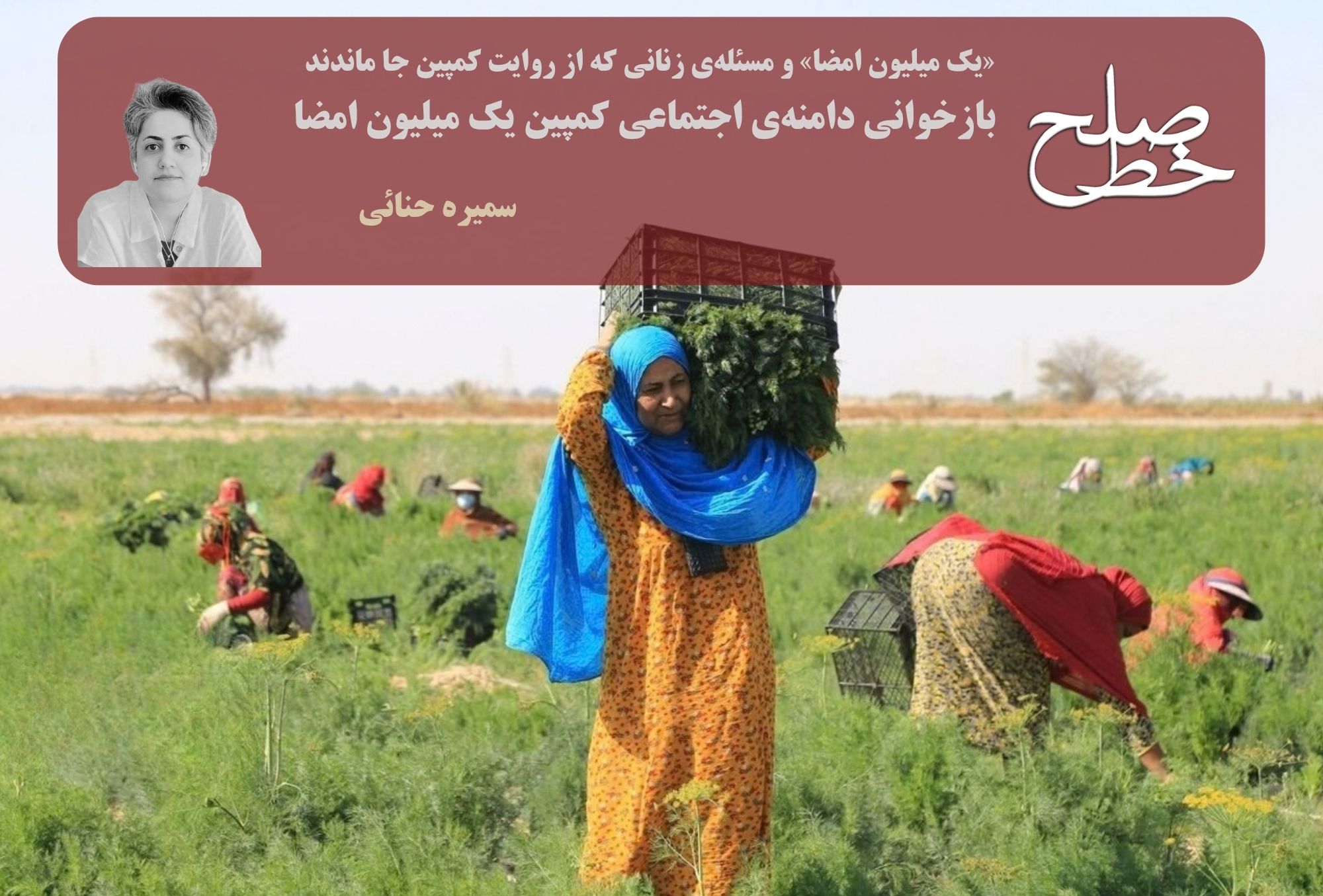
The One Million Signatures Campaign and the Women Left Out of Its Narrative/ Samireh Hanaei
When does a movement that claims to represent “all women” turn the experience of one particular group of women into the general experience of women as a whole? When we speak of the “Iranian women’s movement,” exactly which women are we talking about? Who defines these women? Who decides what constitutes a women’s issue? Is an issue that a women’s rights activist considers fundamental necessarily the same issue that a woman in a small town, a village, a border region, or an urban periphery sees as the priority in her own life? If a woman does not consider herself a feminist, does she fall outside the circle of the “women” represented by the women’s movement? If she disagrees with some feminist demands, where does her experience belong? And if she has had no opportunity even to hear those demands, how can we speak of her choosing or rejecting them?
A Collective Demand?
In the prevailing narrative of Iran’s women’s movement, we have repeatedly spoken of “women,” but have less often asked exactly who these “women” are. Is the demand that is most visible necessarily the demand that engages the greatest number of women? Or might what is heard most often in the media, universities, social networks, and civil institutions be the voices of women who have greater opportunities than others to be seen?
There is a distance between “having an issue,” “being able to articulate it,” “having access to a platform,” and “having it become the dominant narrative.” A woman may experience a problem without defining it in feminist language. She may work for years in a village, a deprived neighborhood, or a region far from the center on issues of security, livelihood, girls’ education, violence, marriage, or employment, yet her work may never be recorded in the official narrative of “women’s activism.” By contrast, the demand of a smaller group may, because of its access to broader media, academic, civil, or communications networks, become more visible than other demands and gradually become established as “women’s demand.” The question, then, is not only who speaks, but who has the opportunity to have their voice heard as though speaking on behalf of others.
A Historical Test
To understand this issue, one can look at the One Million Signatures Campaign. The “One Million Signatures Campaign to Change Discriminatory Laws,” launched in 2006 (1385), was one of the important organized experiences of Iran’s women’s movement in transforming legal discrimination into a public issue. The campaign expanded beyond Tehran. It created a network of activists in more than 15 provinces, and nearly one thousand people were trained in its methods of activism. Campaign activists were not merely seeking to collect signatures. Face-to-face dialogue, workshops, legal education, and bringing discussion of legal discrimination into the public sphere were important parts of their work. The historical significance of this experience lies precisely here: an issue that could have remained confined to legal texts and limited activist circles entered public discussion.
Yet this same experience raises a fundamental question: what image of “Iran” is represented by 15 provinces out of the 30 provinces that existed in 2006? More importantly, which women were included within those 15 provinces?
The campaign’s early reports mention cities such as Tabriz, Rasht, Zanjan, Hamedan, Isfahan, Shiraz, Yazd, Mashhad, Gorgan, Sanandaj, Qom, Qazvin, Kermanshah, Babol, and Karaj. Later reports add cities such as Arak, Khorramabad, and Zahedan. Among the southern and southeastern regions of Iran, there is clear and documented evidence of organized campaign activity in Zahedan. In its principal sources and official reports, however, the campaign did not document local networks or representation with the same clarity in Bushehr, Khuzestan, and Hormozgan. These four provinces are not merely four points on a map; they are part of Iran’s social diversity—regions inhabited by Baluch, Arab, coastal Gulf communities, and populations with distinct historical experiences.
Of course, the absence of a province’s name from an archive does not, by itself, prove that no activity took place there. But this very absence of a documented trace raises a serious question: if, for whatever reason—including security restrictions, lack of resources, absence of a local network, linguistic and cultural differences, or organizational decisions—the campaign could not or did not establish an organized presence in parts of Iran, can it also be regarded as representing the demands of women in those regions? Raising this question does not necessarily diminish the campaign’s historical importance. On the contrary, perhaps its importance requires us to speak more precisely about the boundaries of its representation. Being active in a province is not the same as having access to the women of that province. Having a network is not the same as representing. And signing is not the same as becoming a member of a movement. This experience itself creates an opportunity to ask a larger question: when we speak of “the women of Iran,” who is included in this “women,” and who remains outside it?
Which Woman?
The issue must move beyond geography and address the concept of “woman” itself. Is the “Iranian woman” a single subject? Do a university-educated woman in Tehran, a worker, a rural woman, a Baluch woman, an Arab woman, a Turk, a religious woman, a nonreligious woman, a young woman, a middle-aged woman, and a woman who does not consider herself a feminist all share one “women’s issue”? If they do not, who can transform one woman’s experience into the general experience of all women?
What about women who have no relationship with feminism? If a woman believes that a man should be the family breadwinner, that a woman should accept a traditional role, or that some gender differences are natural, does she cease to fall within the category of “women” because of these beliefs? If a woman who herself reproduces a gender stereotype becomes a victim of violence, economic discrimination, or legal restrictions, within which circle of women’s rights issues does her experience belong?
Here, a distinction must be made among feminism, women, and women’s issues. Not all women are feminists, but their lives do not therefore fall outside the issue of women’s rights. Even a woman who does not regard an inequality as a problem may still live under the effects of that inequality. The first question, then, may not be “What do women want?” Before that, we must ask: who has the opportunity to ask women what they want? The answer to this question is itself shaped by power, geography, class, resources, access, and the possibility of being seen.
Imagine a woman on the outskirts of a city who does not attend a meeting on “women’s rights” at all. This is not necessarily because she has no problem. Perhaps she is working, cannot travel, does not trust the organizers, is unfamiliar with the language of the meeting, or has a more urgent problem in her life. In this case, “absence” should not immediately be interpreted as “lack of demand.” At the same time, however, one cannot speak on her behalf either. It is important not to present whatever activists in a particular field have identified as though it were unquestionably her demand. It is at this point that the complexity of representation becomes apparent.
A Louder Voice or a More Numerous One?
In social movements, visibility is not always the same as breadth. Sometimes a voice is heard more often not only because of the importance of its demand, but because its bearer has greater access to media, universities, social networks, civil organizations, financial resources, or public connections. So is every demand that goes viral the demand of the majority of women? If the voice of one group is repeatedly amplified while another group’s voice never reaches the media, can visibility be used to measure the importance or prevalence of their demands?
This issue is not limited to today or to social media. The same question can be raised in the history of the women’s movement. Who had the opportunity to launch campaigns? Who had the opportunity to travel, receive training, hold workshops, and build networks? Who possessed the resources and relative security necessary to continue activism? And who, even if active, lacked the ability to have that activity recorded? Ultimately, who wrote the history of the women’s movement? A woman may have worked for years in a remote village on behalf of women in her community, yet her name may remain absent from every book, report, website, or archive. Does her absence from history mean that her activism did not exist?
The central issue is not to find a “true representative of Iranian women,” because perhaps no such single representative exists at all. In addition to asking which women Iran’s women’s movement has fought for, we should ask which women have been able to participate in defining “the women of Iran.” What mechanism allows the voice of one group of women to become the voice of “women”? Who gains the opportunity to speak? Who is heard? Who is seen? And who remains so far outside this process that even her absence is never recorded in history?
Perhaps in revisiting the Iranian women’s movement, we should not look only at those who stand at the center of the narrative. Sometimes we need to look at the margins of that narrative and ask: which women were present in the history of Iran’s women’s movement but were never recognized as “representatives of women”?
The Challenge of Demands
If we accept that no group can easily present itself as the voice of “all women,” the next question is: how can we move closer to a voice that reflects the experiences of a greater number of women? The answer should not be sought in finding a new representative for women. The methods of “listening to women” must be improved.
No campaign, civil organization, researcher, or movement can speak with every individual woman in a society. Class, geographical, ethnic, linguistic, generational, and cultural differences also prevent us from simply generalizing the experience of a small group to society as a whole. Perhaps, then, the issue should not be framed as finding the “real voice of all women,” but rather as asking how the possibility of more women being heard can be increased while simultaneously preventing the experience of one group from being transformed into the experience of all women.
For this to happen, women’s activism needs to be connected more closely than before with methods of social research—not in the sense of merely holding social workshops, nor in the sense of sociologists or experts speaking for women from behind their desks. The solution can be sought in a shared path among women’s lived experiences, scientific research, and social action.
The first change must occur in the way problems are formulated. Women do not always express the problems of their lives in legal, sociological, or feminist language. One woman may speak of not being permitted to work, another of lacking an independent income, another of fear of violence, another of being unable to leave a relationship, and another of her daughter being unable to make the choice she wants. For the researcher, these experiences may correspond to concepts such as gender inequality, economic dependency, violence, or restrictions on agency, but the woman herself does not necessarily define her life through those concepts.
The role of the activist and researcher is not to hand a woman a ready-made concept and then ask whether she agrees with it. The issue is not to test women to see whether they agree with our vocabulary and frameworks. We must first understand what they experience, how they explain it, and what they consider most important in their own lives. Only then can connections be drawn among different narratives and broader social, legal, and economic patterns identified. For this reason, we should move from “asking about a demand” toward discovering the problem.
Instead of beginning by asking, “Do women in this region agree with this demand?” we should ask: What are the most important problems in your life? In the first method, the issue is already defined and the woman merely takes a position on it. In the second, a problem may emerge that had never previously been on activists’ agenda.
Even listening to women’s narratives alone is not sufficient. Twenty people who have participated in a workshop cannot represent a local community, just as several hundred accounts published on social media do not necessarily provide a complete picture of women in a city or province. Personal experience is valuable, but it is not the same as social representation.
Identifying the Problem
A combination of qualitative and quantitative research, in-depth interviews, discussion groups, field observation, and social surveys can help distinguish among an individual account, a shared experience, and a social pattern. Even at this stage, the researcher should not regard themselves as the owner of the truth. If, from a collection of interviews and data, we conclude that several issues recur among women in a particular region, it is better to return those conclusions to the same community.
Do the women themselves consider this image of their lives accurate? What has been overlooked? Which experiences were excluded from the research process? Has the language of the research conveyed the problem correctly? In this way, the process of listening can become cyclical: listening, analyzing, returning, revising, and listening again.
Instead of asking, “Who represents women?” we should ask: What mechanisms exist for listening to women? Representation should be temporary, revisable, and accountable. From this perspective, the experience of the One Million Signatures Campaign can be revisited not simply as a historical success or failure, but as a point from which to raise a new question.
Twenty years after the campaign began, we should ask what happened in subsequent years to the women who were less visible in its narrative. Did another group hear their voices? Did their issues enter research, policymaking, civil activities, or social movements? If not, what prevented this?
This question can form the basis for another kind of activism: returning to those who were absent.
This issue is especially important in Iran because a significant portion of civil and feminist activity takes shape within networks whose members know one another, read one another’s work, and amplify one another within the media sphere, while large parts of society may have no direct familiarity with these networks. There is a difference between “a demand becoming visible” and “a demand becoming social.” An online campaign, a hashtag, or several workshops may bring an issue into the public sphere, but one cannot infer merely from its visibility that it represents a widespread demand among the women of a society.
If the women’s movement wants to speak with greater confidence about the social scope of its demands, it must also learn the language of communication with society. Activism cannot remain solely at the level of producing texts, statements, campaigns, and concepts. The ultimate objective of the women’s movement should not be to find a woman capable of speaking for all women. Such a woman probably does not exist. The objective can instead be to build mechanisms through which more women gain the opportunity to speak: women whose voices are loud and women whose voices are less often heard, women who consider themselves feminists and women who do not define themselves in that way, women at the center and women on the margins, university-educated women and homemakers.
In such an approach, the activist does not own women’s voices; the activist is responsible for creating the possibility that those voices can be heard. The researcher, too, does not own the truth about women; their task is to identify patterns, reveal differences, and test their interpretations against data and lived experience. Society is not merely the audience for a demand; it is part of the process through which the problem is defined.
Ultimately, the goal should be to create conditions in which more women can speak for themselves about their lives and in which their voices are genuinely heard before they are recorded in the name of “women.”
 Created By: Samireh Hanai
 September 23, 2026
Tags
"Million Signature Campaign" Civil society Peace Line 185 Samira Hanaei The right to divorce. Women's rights