


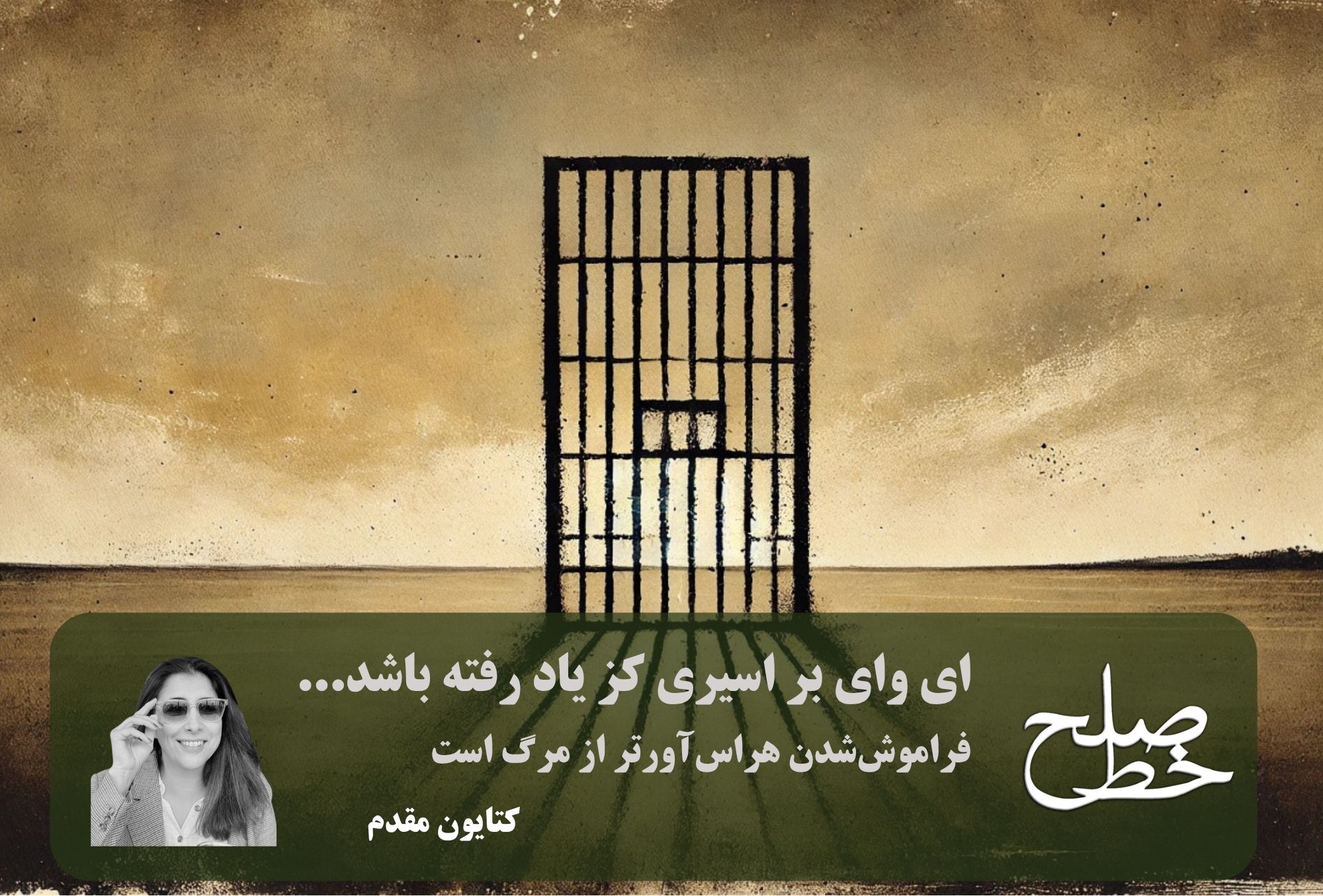
Oh Woe to the Captive Who Has Been Forgotten…/ Katayoun Moghaddam
Over the past three months, following the severe suppression of domestic protests in Iran and then with the outbreak of war in the region, the Islamic Republic government has drastically restricted—and at times effectively cut off—residents’ access to the internet. This disruption is not merely a break in the flow of information; it means living in a state of continuous anxiety. We Iranians have spent these days with indescribable نگرانی—anxiety about what we do not know and do not see, and about what may be happening in a silence devoid of news.
In recent weeks, this situation has grown more complex and darker. The limited information that reaches the outside world either barely passes through Iran’s filtering system or is disseminated by the propaganda networks of governments involved in the war. These are strange times in which truth belongs to no one. Under such conditions, accurately analyzing reality and predicting the future of the war, as well as the situation of military and civilian populations, has become difficult for outside observers. The noise of slogans—long live this, down with that; no to war, yes to war—has only deepened the ambiguity.
With these limited facts, we know that people inside the country, like any nation caught in war, face not only the fear of physical harm and financial loss but also the burden of anxiety over an uncertain future. In the absence of sirens and shelters, the responsibility for preserving one’s life falls largely on individuals themselves. Choices are limited, and not everyone is in a position to leave their home or workplace. Yet still, some degree of possibility remains—not always and not for everyone—to flee or seek refuge in a safer place.
Consider this unstable situation. Now place yourself in the position of someone who does not even have this limited possibility.
They hear the roar of explosions. They hear the sound of shattering glass, and they stand behind a locked door—a door whose key is in someone else’s hand. This absolute defenselessness is no less than the fear of death itself; perhaps it is even heavier and more lethal.
We are speaking of prisoners. People who have no voice to carry their fear beyond the walls, no possibility of leaving their cells, and no shelter in which to find even a moment’s calm. They do not even know how close the danger is, nor what fate awaits them tomorrow—if there is a tomorrow.
In many countries around the world, there exists a recognized principle: when an individual’s freedom is taken away, the responsibility for preserving their life rests entirely with the state. This principle is not a single codified law with a fixed date, but rather one that has gradually taken shape and been established in international law.
Historical experiences have clearly demonstrated this necessity. In the final days of World War II, as Allied forces approached, the Nazi regime moved prisoners in “death marches,” during which thousands lost their lives. In camps such as Dachau and Auschwitz, many prisoners were left in deadly conditions without the possibility of evacuation or effective protection. During Hurricane Katrina in 2005, hundreds of prisoners in Orleans Parish Prison were abandoned as floodwaters gradually rose and engulfed large parts of the facility. Accounts later published by freed prisoners and human rights reports described how some inmates remained for hours—and even days—in cells where water had risen to their chests or even their necks.
These tragedies later became part of the foundation for developing international standards regarding prisoners, aimed at preventing large-scale human catastrophes in future crises. These rules emphasize that governments are obligated, under all circumstances—including emergencies—to safeguard the lives, health, and dignity of prisoners.
Based on these principles, in many countries prisons are required to have emergency evacuation plans. In some cases, after earthquakes or in wartime conditions, low-risk prisoners are temporarily released or transferred to safer locations to prevent humanitarian disasters.
In Iran, however, prisons—as expected—do not adhere to such principles, due to a profound gap in policymaking and crisis management. Aging buildings, severe overcrowding, limited exit routes, and a lack of transparency regarding emergency infrastructure have made the safety of these prisons deeply concerning.
The issue is not limited to overcrowding and infrastructure. For political prisoners, the situation takes on more complex and bitter dimensions. When the government perceives itself under threat, pressure on political prisoners intensifies: communications become more restricted, surveillance more severe, and the shadow of heavy sentences and execution threats looms larger than ever over their lives. Numerous reports in recent months—of violence, prolonged solitary confinement, and deprivation of family visits—indicate that these prisoners not only lack minimum safety standards during wartime but are also doubly exposed to psychological harm.
This harm stems from a fear that does not strike all at once, but settles gradually in the mind, drop by drop. Living in anticipation of an explosion whose time and place are unknown, while being utterly unable to react, flee, or even hide—this combination pushes the mind to the brink of collapse.
A prisoner faces not only external danger but also a kind of internal erosion. Lack of information is one of the most severe forms of anxiety: not knowing what is happening, not knowing whether your family is alive, whether they are still there, whether they even know what condition you are in. Not knowing whether the outside world is still the same world you remember. This unknowing traps the mind in an endless cycle of speculation, fear, and darkness.
Solitary confinement, which in itself is one of the most severe forms of psychological pressure, can in such conditions become a compounded form of torture. Total disconnection from the world, absence of sound, light, and signs of normal life, strips time of meaning. Hours stretch endlessly, night and day blur together, and the mind, seeking escape from this void, retreats inward—to a place that is often far from safe.
Many reports speak of chronic anxiety, panic attacks, prolonged insomnia, and psychological breakdown. These are not merely side effects; they are part of the lived experience of imprisonment—an experience that, in wartime, becomes a hundred times more intense and complex.
One of the prisoners caught in the New Orleans storm recounted after being rescued that, during the disaster, cries and pleas for help could be heard from other cells, but there was no response—no guard, no instruction, not even an explanation of what was happening. They did not know whether anyone would come to get them out, or whether they would leave that situation alive at all. In his words: “The most frightening part was not the water or the risk of drowning, but the feeling that we had been completely forgotten—as if our existence had been erased from the equations of the outside world.”
And more terrifying than death, there is only one thing: being forgotten.
The forgetting of human beings who remain behind walls, whose voices of helplessness reach nowhere, stands in stark violation of human dignity and ethics.
If there is no attentive ear within Iran, we must extend a hand to international organizations so that the voices of our prisoners may be heard amid war, chaos, and harm.
In such circumstances, the role of international human rights institutions is more vital than ever. Organizations such as Amnesty International, Human Rights Watch, the International Committee of the Red Cross, and the United Nations Human Rights Council are among the bodies that can, through monitoring, reporting, and applying international pressure, play a role in protecting the lives and dignity of prisoners.
Let us be the voice of the voiceless, so that another human catastrophe does not unfold in our homeland.
 Created By: Katayoun Moghadam
 March 21, 2026
Tags
Iran-US war Katayoun Moghadam New Orleans Hurricane peace line Peace Line 179 ماهنامه خط صلح