


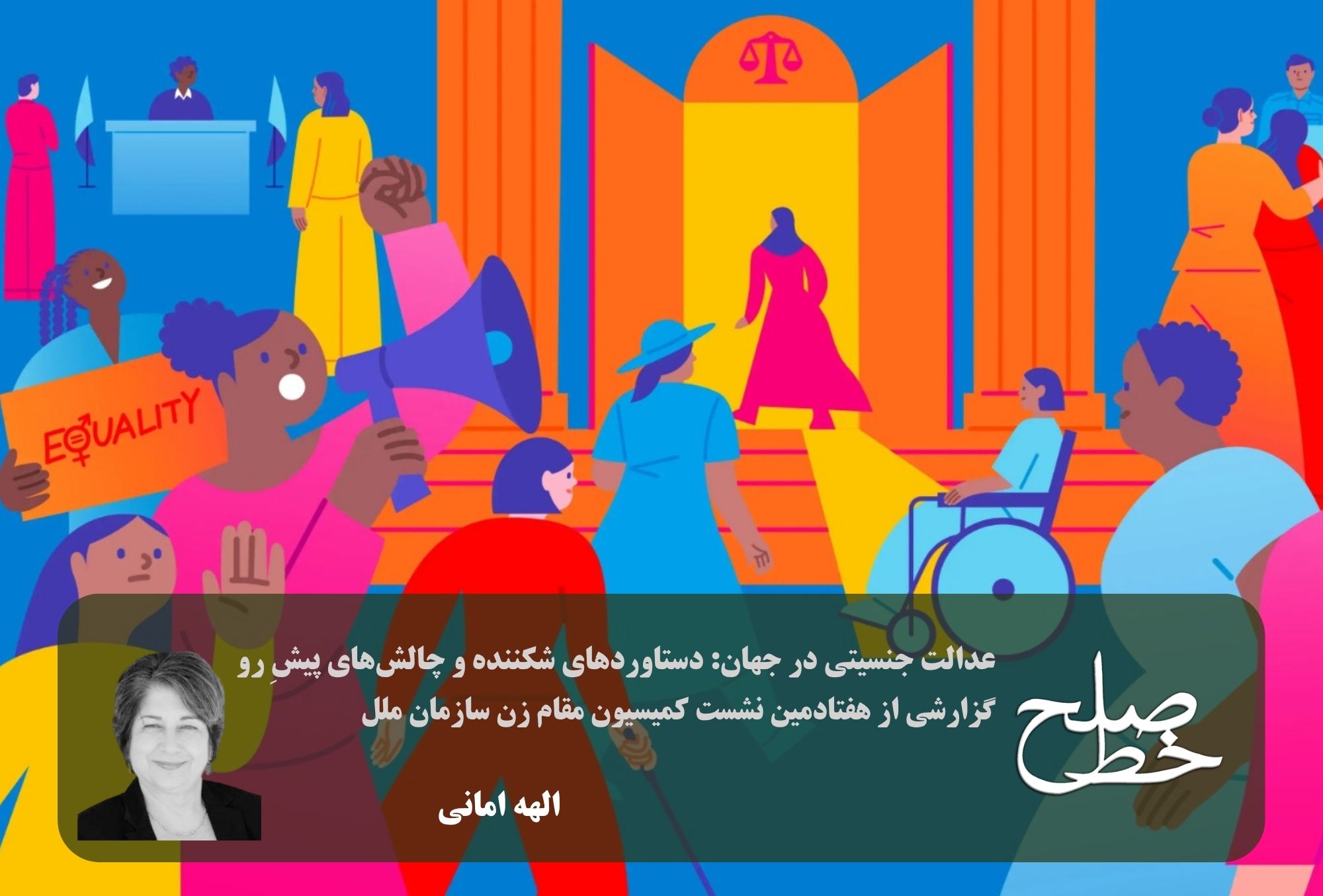
Gender Justice in the World: Fragile Achievements and Challenges Ahead / Elaheh Amani
The seventieth session of the United Nations Commission on the Status of Women (CSW70) was held from March 9 to March 19, 2026, at the United Nations Headquarters in New York. The theme of this session was “Ensuring and strengthening access to justice for all women and girls,” and it encompassed axes such as “promoting fair and equal legal systems,” “eliminating discriminatory laws,” and “addressing structural barriers that hinder women’s access to justice.” More than 15,000 participants and over 5,000 organizations (in person and virtually) from 139 countries took part in this meeting. Of course, the challenges for women from other countries, especially the Global South, to attend this session have been estimated to be greater than in previous years.
Iran does not have an official presence at this session as a member of the United Nations Commission on the Status of Women. The reason goes back to the “Woman, Life, Freedom” uprising and the revocation of Iran’s membership on December 14, 2022, by the United Nations Economic and Social Council (ECOSOC). Through a resolution, this council expelled the Islamic Republic of Iran from the United Nations Commission on the Status of Women (CSW). This expulsion was applied for the remainder of Iran’s four-year term of membership (2022 to 2026). This decision was taken in response to the suppression of protests following the death of Mahsa Amini and with the aim of supporting the rights of Iranian women and girls, and it was the first time in the history of the Commission on the Status of Women.
Access to justice for women in Iran faces deep structural and legal challenges rooted in legal inequalities and weaknesses in judicial protections. In some areas, the value of women’s testimony is considered less than that of men, and in cases such as blood money (diyeh), this inequality is explicitly reflected in the law. Likewise, in family laws, the right to divorce is predominantly in the hands of men, and issues related to child custody and guardianship are often regulated in favor of the father. On the other hand, the absence of a comprehensive law to combat violence against women and the limited and weak definition of domestic violence reduce the possibility of effectively pursuing such cases. These legal inequalities, alongside complex, costly, and lengthy judicial processes, further restrict women’s practical access to justice.
In addition, cultural, social, and institutional barriers also play a significant role in weakening women’s access to justice. Fear of social stigma, family pressure to remain silent, and the normalization of violence in certain contexts deter many women from filing complaints. At the institutional level, the presence of gendered attitudes among some officials and judges, as well as the lack of support mechanisms such as safe shelters and counseling services, further complicate the situation. Restrictions on the activities of civil society organizations and the risks faced by women’s rights activists also reduce support for victims. As a result, the realization of justice for women in Iran—especially under current conditions and in light of a devastating war—faces a long and challenging path. Iran also has one of the highest rates of execution of women in the world. The number of women prisoners in Iran—alongside the execution of women—is also one of the areas of concern for the global community regarding justice for women.
Alongside shortcomings in justice within the legal system and criminal laws, the high rate of executions and the presence of political prisoners, the lack of support systems regarding violence against women, honor killings, the absence of justice in the face of violence in cyberspace, and the lack of intersectional justice—especially concerning Afghan refugees and women from ethnic, religious, and gender minorities—highlight additional layers of injustice. Economic and political justice in Iran also ranks very low in global indices. In Iran and in today’s world, achieving gender justice is a dream in the distant future.
The Secretary-General of the United Nations, Antonio Guterres, in his speech at the opening ceremony of this session, stated that gender equality has always and fundamentally been an issue of power. He continued: “We live in a male-dominated world and in a male-dominated culture. Gender equality—always—has been an issue of power. Not a single step forward in women’s rights has been gifted to women; it has been achieved. This achievement is the result of the efforts of generations of women and girls, advocates and activists for women’s rights, some community leaders, and seekers of justice. You have earned it. Therefore, first of all, I want to say: thank you.”
Now, in the twenty-first century, justice still remains a distant dream for millions of women and girls. Discriminatory laws persist. Patriarchal norms continue. Around the world, women enjoy only 64 percent of the legal rights that men have. When women meaningfully participate in peace processes and transitional justice, agreements become more durable and societies experience deeper healing. But the world still falls short for women. Participation of women is spoken of, but women are not present at negotiation tables. Protection and security for women are discussed, but sexual violence continues with impunity.
Justice safeguards human rights and human dignity. When a woman’s testimony is ignored, when a girl is denied the right to appear in court, when laws are discriminatory or when the police fail to act in support of women, human rights for all are eroded and diminished. Justice also means confronting the epidemic of violence against women and girls in all its forms: domestic violence, human trafficking, sexual violence in conflicts, and harassment that restricts women’s freedom every day.
Sima Bahous, Executive Director of UN Women, emphasized in her speech at the opening ceremony that we have come together at a time when the world faces multiple crises. Peace remains on a distant horizon, and the world is deeply and increasingly divided. Gender inequality is also exacerbated by the evils of war and conflict: from Afghanistan and Haiti to Iran, Myanmar, Palestine, South Sudan, Sudan, Syria, Ukraine, and Yemen and beyond. She also called for a return to diplomacy and dialogue and for an end to the killings in the Middle East, Africa, and other regions of the world.
As mentioned above, at the seventieth session of the United Nations Commission on the Status of Women, the official theme was “Ensuring and strengthening access to justice for all women and girls.” Many side events and parallel sessions of non-governmental organizations addressed various dimensions of justice that affect the lives of women around the world.
Below are the most important justice-related issues raised in side events and NGO sessions.
Access to Justice and Legal Reforms
In many side events and NGO sessions at the United Nations Headquarters, emphasis was placed on removing legal and structural barriers that prevent women from accessing justice systems. Specific aspects of this axis include the following:
Judicial systems must be accountable regarding gender discrimination, the provision of legal aid, and justice mechanisms.
Governments must reform discriminatory laws and improve legal structures, judicial institutions, and courts to enable women’s access to justice.
Some of these sessions addressed how to create justice systems that are effective for all women—including women in various countries across three continents of Africa, Asia, and Latin America, or in conflict-affected regions.
Violence Against Women and Girls
Ending gender-based violence and strengthening government accountability was also one of the main axes of this session and NGO meetings. Specific aspects of this axis include issues such as domestic violence and sexual violence, violence in public spaces and workplaces, legal protections and services for survivors, and prevention and prosecution strategies. Some side events also addressed legal aid services and policy reforms to combat violence against women and girls.
In sessions related to violence against women and girls, speakers referred to the increase in femicide, conflict-related sexual violence, and misogyny in online spaces. Many emphasized the necessity of gender-responsive budgeting and the more active role of men and boys in confronting harmful gender narratives and norms. Others stressed that when femicide and gender-based killings are classified as ordinary murders, the structural and systemic inequality inherent in these crimes remains hidden, making prevention efforts more difficult. The reality is that ending violence against women requires the creation of justice-centered systems based on the needs of survivors, clear legal recognition of femicide and its consequences, and coordinated action among a range of civil society institutions, government bodies, the United Nations, and local communities at the forefront of these efforts.
Women Prisoners and Reform of the Criminal Justice System
One of the important and relatively new topics at this session was the situation of women prisoners and the question of whether justice is observed in their trials. Specific aspects of this axis include issues such as discriminatory laws that lead to the criminalization of women, the link between poverty across all countries and violence and the imprisonment of women, prison conditions for women and access to lawyers that poor women can benefit from, and alternatives for imprisoned mothers.
One of the global agreements adopted during this session amid considerable controversy (discussed later in this article and how the United States influenced it with its opposing vote) explicitly highlights women prisoners—both political prisoners and those imprisoned for ordinary crimes—as part of international efforts to recognize justice for women and girls, and also emphasizes growing concern about the increasing number of women prisoners worldwide.
At this session, regarding women prisoners, the Vance Center and the Penal Reform International panel presented a statement on behalf of the “Women in Prison Network,” emphasizing the necessity of including imprisoned and formerly imprisoned women in broader discussions on gender equality, particularly in United Nations spaces such as the Commission on the Status of Women.
This statement recalls that despite the significant increase in the rate of women’s imprisonment worldwide, “major women’s rights forums, including this Commission, still treat the issue of women’s imprisonment as marginal. Formerly imprisoned women are still largely absent from the discussions of the Commission on the Status of Women.”
The statement also refers to the specific experiences of women in criminal justice systems and how factors such as race, ethnicity, migration status, gender identity, and poverty shape these experiences. It also points to the compounded risks of violence that women face throughout criminal processes, the impact of these harms on their families and communities, and the lack of reliable data for policymakers in addressing the issue of the criminalization and imprisonment of women.
It should be noted that more than 733,000 to 741,000 women and girls worldwide are held in penal institutions, accounting for about 7 percent of the total global prison population. Although women are a minority in prison populations, the number of women prisoners has increased by nearly 60 percent since 2000, and this growth has been faster than that of male prisoners. The United States has the highest number of women prisoners (more than 174,000), followed by China in second place.
Digital Justice and Online Violence
At this session, many side events and meetings organized by civil society and non-governmental institutions addressed the concept of justice in the digital age. Specific aspects of this axis include issues such as cyber violence against women and girls, technology-facilitated gender-based violence, algorithmic bias and discrimination in artificial intelligence, and the protection of women’s rights in digital spaces.
For example, some sessions on cyber violence against girls addressed legal solutions and policies to combat various forms of online abuse against women and girls, especially girl children (under 18 years old).
Intersectional Justice
In official discussions, side events, and NGO programs, it was emphasized that justice must recognize and take into account the various forms of discrimination experienced by women from ethnic, religious, gender, and other marginalized groups. Specific aspects of this axis include issues such as justice for women with disabilities, the rights of Indigenous women, migrant and refugee women, rural women, and women on the economic margins and in disadvantaged social classes. Several sessions focused on barriers to access to justice and the necessity of creating inclusive legal systems.
Economic and Social Justice
Many events examined the relationship between economic inequality and poverty with justice. Specific aspects of this axis include issues such as financial exploitation of women and workplace discrimination, shortcomings and limited capacities of social protection structures, women’s access to land, food, and economic resources, and justice in agricultural and rural economies for women. These discussions clearly show how economic inequalities can hinder women’s access to justice.
Climate and Environmental Justice
Another relatively new topic in the field of justice is climate justice for women. Side events and non-profit organizations, especially from the Global South, addressed issues such as: displacement and migration caused by climate change for women, the care economy and climate transition, environmental justice and access to various resources to incorporate climate justice for women, and women’s presence in leadership positions in environmental policymaking.
Political Justice and Women’s Participation
Justice is also linked to political representation and women’s participation in decision-making at the macro level. Specific aspects of this axis include issues such as women’s presence in government management and justice institutions, barriers to women’s political leadership, and women’s democratic participation in the political structures of different societies.
It should be noted that overall, discussions on justice in the side events and NGO sessions of this session go far beyond courts and laws and encompass a wide range of issues, including violence against women, criminal justice reform, digital rights, economic inequality, climate justice, and political participation, all reflecting global efforts to achieve comprehensive and inclusive justice for women and girls.
Controversy Over Ensuring and Strengthening Access to Justice for All Women and Girls
At this session, the United States adopted a controversial position that was unprecedented in the 70-year history of this Commission. The United Nations Commission on the Status of Women has 45 member states, elected by the United Nations Economic and Social Council for four-year terms. The composition of members is determined based on geographical distribution among different regions of the world to maintain regional balance. The current members of this Commission for the 2026 and 2027 sessions include the countries listed below. Among the African countries, members include Cape Verde, Côte d’Ivoire, Democratic Republic of the Congo, Ethiopia, Gabon, Mali, Morocco, Mozambique, Nigeria, Rwanda, South Africa, Tanzania, and Zimbabwe. In the Asia-Pacific group, Bangladesh, China, India, Japan, Maldives, Mongolia, Philippines, Qatar, Republic of Korea (South Korea), Saudi Arabia, and Sri Lanka are members. In the Eastern European group, the Czech Republic, Lithuania, Romania, and Ukraine are present. In the Latin America and Caribbean region, Belize, Bolivia, Brazil, Chile, Colombia, Cuba, Dominican Republic, Mexico, and Uruguay are members. In the Western Europe and North America group, Belgium, Italy, the Netherlands, Portugal, Spain, the United Kingdom, and the United States are members.
In total, only these 45 countries are official members with voting rights in the Commission. Each of these countries serves a four-year term, although the start and end times of their seats differ. However, all 193 member states of the United Nations can participate in the Commission’s annual sessions, attend negotiations, and engage in discussions on global policies regarding women’s rights and gender equality.
The working method of this Commission over the past 70 years has been that the draft of the “Agreed Conclusions” is prepared by these 45 countries, and during two weeks of negotiations, they reach a conclusion regarding the positions reflected in this document on the theme of the session, which is “Ensuring and strengthening access to justice for all women and girls.”
This year, for the first time in the history of this Commission, the United States proposed a vote on the items included in the draft “Agreed Conclusions.” This action by the United States reflected the continuation of the Donald Trump administration’s opposition to gender equality at the global level. At the same time, it showed that resistance across the world is very widespread. This is the first time in the 70-year history of the Commission on the Status of Women that the “Agreed Conclusions,” instead of being adopted by consensus, were put to a vote by the 45 elected members of the Commission. Nevertheless, despite Washington’s controversial action, the member states present at the opening session on March 9 approved this document by majority vote.
The document, the “Agreed Conclusions,” was ultimately adopted with 37 votes in favor, 6 abstentions (Côte d’Ivoire, Democratic Republic of the Congo, Egypt, Mali, Mauritania, and Saudi Arabia), and only one opposing vote from the United States. This action reflected a growing divide between the United States and many other countries on the first day of the Commission’s session. The United States’ request for a vote was its final attempt to distance itself from the collective agreement on this document. Among the issues opposed by the United States were diversity, equity, and inclusion (DEI), the impacts of climate change on women, the definition of gender, and the sexual and reproductive health rights of women and girls.
The “Agreed Conclusions” of the annual session of the Commission on the Status of Women set the main guidelines for governments in promoting women’s rights at the national level. This framework was established after the 1995 Beijing Declaration and Platform for Action and has usually been adopted by consensus since 1996. In 2003 and 2012, no document was adopted, but never until this year had the text been put to a formal vote. This year, with its insistence on a vote and casting the only negative vote, the United States took a step backward for gender equality within United Nations mechanisms.
The seventieth session of the United Nations Commission on the Status of Women is being held at a time when respect for international laws and regulations is more fragile than ever. In the early days of the current year, the President of the United States signed an executive order suspending U.S. support for 66 international organizations, institutions, and commissions. The United States has also considered withdrawing support from the World Health Organization, the Human Rights Council, UNESCO, and several other bodies.
Global conventions and institutions were formed after World War II so that conflicts would be resolved not through violence but through international law and dialogue, and so that the “battlefield” would be transformed into the “negotiation table”—a matter that today remains suspended between hope and despair. In reality, war is the failure of diplomacy, politics, and humanity.
 Created By: Elahe Amani
 March 21, 2026
Tags
CSW70 Elahe Amani Empowerment of women Gender equality peace line Peace Line 179 United Nations Women's Commission Women's participation in politics Women's rights ماهنامه خط صلح