


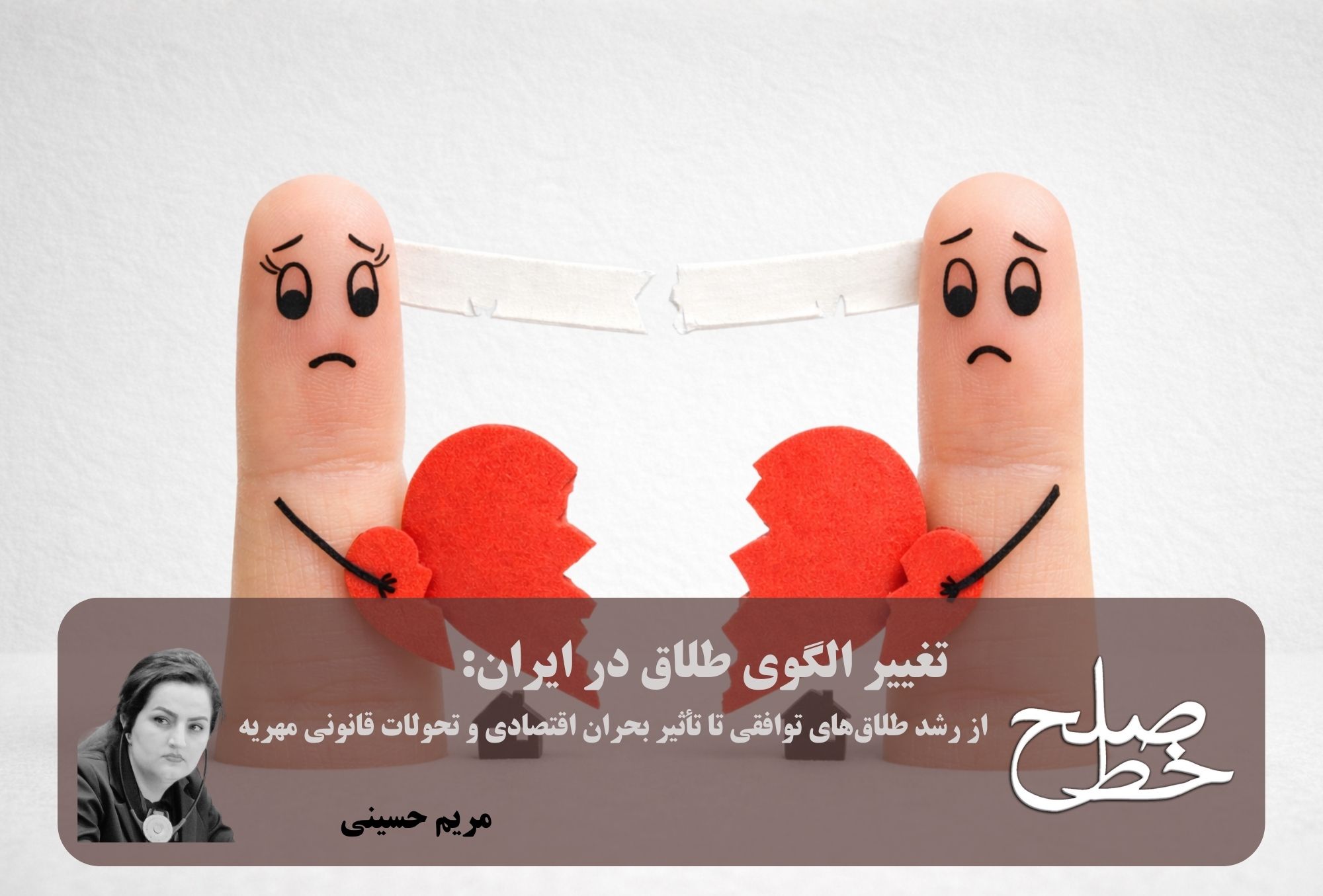
Changing divorce patterns in Iran/ Maryam Hosseini
Divorce in Iranian society is no longer a marginal or merely individual phenomenon, but a social, legal, and economic issue; an issue that reflects profound changes in the family structure, gender relations, and living conditions of society. The increase in the number of separations, especially consensual divorces, the change in the age of divorce, and the simultaneous nature of this trend with legal reforms in the field of dowry, have made it more necessary to reexamine this phenomenon. The following article, from a legal perspective and in an analytical and journalistic context, aims to examine the changing pattern of divorce in Iran, a change that is not simply the result of cultural changes and the growth of women’s legal awareness, but also directly reflects the traces of chronic economic crises and structural inequalities in family rights.
De-stigmatizing divorce and increasing legal awareness
In past decades, divorce in Iranian society was associated with the label of failure, social stigma, and moral collapse. Women in particular, who suffered heavy social costs for separation, often preferred to remain in harmful relationships, but in recent years this situation has gradually changed. The improvement of women’s education, the expansion of media and social networks, and the prominence of women’s lived experiences have made divorce, rather than being a taboo, a possible solution to the serious impasses of cohabitation. This de-ugliness can be seen not only in metropolitan cities, but also in many small towns. One of the most important factors in this paradigm shift is the growth of women’s legal awareness of their rights in the process of marriage and separation. Widespread access to legal information, the re-distribution of experiences in cyberspace, and the activism of lawyers and women’s rights activists in the public arena have led many women to no longer consider divorce to be an unconscious or emotional decision. Today’s women are more familiar than ever with concepts such as dowry, alimony, hardship, custody, and the financial consequences of separation. This knowledge has increased their bargaining power and has led them to choose, in many cases, amicable divorce as a less stressful path.
In this regard, in the new paradigm, divorce has become more of a conscious act than before. A decision made after weighing the costs and consequences, not an emotional reaction. This change is a sign of increased women’s agency and a change in the understanding of marriage. Divorce in this sense is not a denial of the value of the family, but an attempt to redefine it based on human dignity. The increase in divorce can be seen as a sign of strengthening “female agency.” An agency in which women do not see themselves simply as victims of circumstances, but as activists who demand the right to make decisions about their lives. This agency, of course, did not form in a vacuum, but is the result of decades of women’s struggle for access to education, legal awareness, and presence in the public arena. Divorce is one of the concrete manifestations of this agency, albeit a costly and risky one.
Changing the age of divorce and the spread of consensual divorces
Divorce by mutual consent has become one of the most prominent features of the new pattern of divorce in Iran. On the surface, this type of separation is seen as a sign of the couple’s intellectual maturity and reaching a common understanding, but a closer look shows that this agreement is not always the product of equality. In the Iranian legal system, structural inequality in the right to divorce forces women to make financial concessions in order to leave the relationship. In many cases, divorce by mutual consent means waiving dowry, alimony, or other legal rights. So while divorce by mutual consent can reduce apparent tensions, it does not necessarily guarantee justice. Another notable development is the increase in divorce at an older age and after years of cohabitation. This phenomenon shows that divorce is no longer limited to the early years of marriage, to the point where even couples with adult children are now deciding to separate. This change indicates that enduring chronic dissatisfaction is no longer considered a value. After years of playing traditional roles, many women decide to choose the path of separation to preserve their mental health and human dignity. Of course, not all separations end in court; a significant portion of divorces occur on an emotional level years before they are officially registered. Couples live together but there is no living, secure, and supportive relationship between them. Emotional divorce, although not seen in official statistics, is one of the most important signs of the ineffectiveness of the legal and family support system. In many cases, women remain in a state of emotional divorce for years, with no possibility of escape or hope of repairing the relationship. When an official divorce occurs, it is actually the end of a dead relationship that is recorded, not the sudden collapse of the family.
Economic crisis and changing factors of conflict
The economy is one of the most important variables affecting family relationships. Inflation, unemployment, job insecurity, and the housing crisis have turned the living space into a tense environment. Financial disputes gradually turn into emotional and psychological conflicts and wear out the relationship. In such circumstances, divorce is often not the result of a sudden decision, but the end of a long-term erosion. The economic crisis roughens the language of conversation and destroys hope for the future. Although the economic crisis affects all family members, its consequences are more severe for women. Lower economic participation, informal employment, financial dependence, and the main burden of housework put women in a more vulnerable position. For many women, divorce is not only a separation from their spouse, but also entering a risky phase in economic and social terms. However, continuing to live in eroding conditions also has heavy costs. In addition to the economy, the factors of conflict have also changed in nature. In the past, family interference was a major factor in marital disputes. Today, this role has diminished and has been replaced by tensions within the relationship. High expectations of marriage, changing gender roles, and economic pressures are driving couples to a dead end. This change shows that existing laws are still based on traditional marriage patterns and are not in line with new realities. Along with these factors, infidelity, although less officially discussed, has also become one of the effective factors in divorce. The spread of virtual relationships, emotional vacuum, and lack of communication skills are the basis for this phenomenon. From a legal perspective, infidelity is difficult to prove and is often examined in the form of hardship. This legal vacuum places women in a difficult position and places the burden of proof on them.
Dowry Challenges and the Inefficiency of Island Reforms
In Iranian law, dowry is a woman’s only independent financial right. In the absence of equal divorce rights, property division, and post-separation protections, dowry plays a compensatory role. Recent reforms to the dowry law have been aimed at reducing the number of prisoners, but weakening this right without a fair replacement jeopardizes women’s economic security. Converting on-demand to on-demand, eliminating the right to imprisonment, and limiting the means of collecting dowry will exacerbate inequality if not implemented without complementary reforms. The fundamental question is, what mechanism will exist to protect women in the absence of an effective dowry? The limitation of women’s legal means can push them further towards consensual divorce, an agreement that is sometimes the result of hidden coercion and power imbalances. In such circumstances, agreement does not necessarily mean consent. Focusing solely on dowry, without considering other aspects of family law, is an example of insular reforms. Family law is an interconnected system, and changes in one part without reforming other parts will upset the balance.
Divorce is not a neutral phenomenon. After separation, women face economic insecurity, the heavy responsibility of children, and social judgments. This inequality necessitates a serious review of family laws. Understanding the issue of divorce is not possible without reexamining the concept of “family” in the Iranian legal system. The legislator still imagines the family as a static institution, based on the division of traditional and hierarchical roles, an institution in which the man plays the role of breadwinner and main decision-maker and the woman plays the role of caregiver, companion, and subordinate. This legal image is significantly different from the social reality of today’s Iranian families. Today, families are smaller, relationships are more horizontal, and mutual expectations are more complex. Women are more educated, have a stronger economic role, and demand real participation in decision-making in their shared life. However, the law still relies on old patterns, and this gap is one of the roots of conflict and ultimately divorce. Women’s bodies have also always been a major arena for legislative intervention in family law. From restrictions on the right to divorce to controls over fertility, clothing, and relationships, family policy in Iran is structurally tied to the control of women’s bodies and decisions. Divorce, in this sense, is not just a legal dispute, but an act that removes women’s bodies and lives from structural control. Resistance to this act is often not out of concern for the family, but out of fear of losing this control.
The necessity of moving from a property-based perspective to restorative justice
Domestic violence is not just about physical abuse. Psychological, economic, verbal, and controlling violence are more common forms of violence that are less visible and less documented. Depriving women of financial resources, constant humiliation, controlling communication, and unilateral decision-making are all examples of structural violence. The Iranian legal system is ineffective in identifying and responding to these forms of violence. Many women can only escape the cycle of violence by agreeing to divorce, even if this decision comes with heavy costs. One of the dominant concepts in official discourse is the preservation of the family at all costs. This concept, while seemingly moral, in practice means forcing women to remain in harmful, unequal, and violent relationships. In this discourse, the family is considered an absolute value, without considering the quality of the relationships within it. Such a view sacrifices individual dignity to an abstract whole and turns divorce into a sin. In the meantime, children are often presented as victims of divorce. However, the question of what consequences remain for children of staying in a tense and violent family is less addressed. Research shows that the quality of the parental relationship, more than the apparent structure of the family, affects the mental health of the child. Custody and visitation laws in Iran are still regulated with a property-oriented perspective and pay less attention to the emotional and psychological needs of the child. Reforming these laws is an integral part of reviewing divorce-related policies.
A look at other legal systems shows that the reduction of family conflicts has been achieved not by restricting divorce, but by ensuring legal equality and social protection. In many countries, the division of joint property, financial support after divorce, and equal access to the right to separation have reduced the intensity of conflicts. These experiences show that divorce is not necessarily a sign of moral collapse, but can be part of a flexible and humane legal system. One of the neglected approaches in family law in Iran is restorative justice. An approach that focuses on repairing harm, supporting the more vulnerable party, and reducing conflict, rather than focusing solely on punishment or coercion. In the framework of restorative justice, divorce is not seen as a failure, but rather as part of the process of rebuilding life. Such a view can be the basis for reforming custody laws, financial support, and post-divorce counseling.
The family on the path to justice, equality and security
Population policies also play an important role in exacerbating family tensions. A one-sided emphasis on population growth without providing economic and social infrastructure places an additional burden on families, especially women. In such an environment, divorce is not only a personal decision, but also a response to structural pressures that have been ignored in policymaking. Of course, it should be noted that the experience of divorce is not the same for all women. Women from lower classes, women living in deprived areas, and women without support networks pay much higher costs. Analyzing divorce without taking into account this intersection of inequalities presents an incomplete picture. Gender justice cannot be achieved without class and regional justice. The role of the media is also very important in shaping public opinion about divorce. Representing divorce as a personal failure of women or a threat to social order leads to the reproduction of social stigma. In contrast, analytical and realistic narratives can help to understand the complexities of this phenomenon. The media can be a platform for women’s voices to be heard and their lived experiences to be reflected, experiences that are often ignored in statistics and laws.
To gain a deeper understanding of the changing pattern of divorce in Iran, one cannot rely solely on statistics or legal reforms. Divorce must be analyzed in the context of a “social transition,” a transition in which society moves from traditional patterns of authority, gender, and family to more fluid and individual-centered forms. In this context, marriage is no longer simply a socio-economic institution, but rather an emotional, identity, and participatory project. When this project fails, divorce becomes an exit mechanism. The increase in divorce in such a context is not necessarily a sign of a moral crisis, but rather a sign of the inability of legal institutions to keep pace with social changes. Establishing equal divorce rights, recognizing joint property, creating a system of financial support after divorce, facilitating the proof of violence, and reviewing custody laws are among the reforms necessary to achieve gender justice in family law. The Iranian family is in transition. This transition is fraught with tension, but it can lead to more just and humane families. Women are no longer willing to accept traditional roles without receiving equal rights. If family law in Iran is to keep pace with social realities, it must move away from the logic of control and towards the logic of support. Support that is based on security, equality and human dignity. Divorce in such a system will be a last resort, not the only tool available to women. The increase in divorce in Iran is a mirror that simultaneously reflects the ineffectiveness of economic policies, legal inequalities and social changes. A reductionist approach to this phenomenon will only deepen the crisis. If legislators and policymakers are truly concerned about the family, they must stop controlling women’s bodies and decisions and move towards creating supportive and just structures. A family that is maintained on the basis of coercion is neither sustainable nor healthy. Divorce cannot be curbed by restrictive legislation, but it can be made a last resort, not the only possible option, through justice, equality, and security.
 Created By: مریم حسینی
 December 22, 2025
Tags
Consensual divorce Custody Divorce Dowry Family If possible Maryam Hosseini peace line Peace Line 176 Prisoners' dowry The right to divorce. Upon request ماهنامه خط صلح