


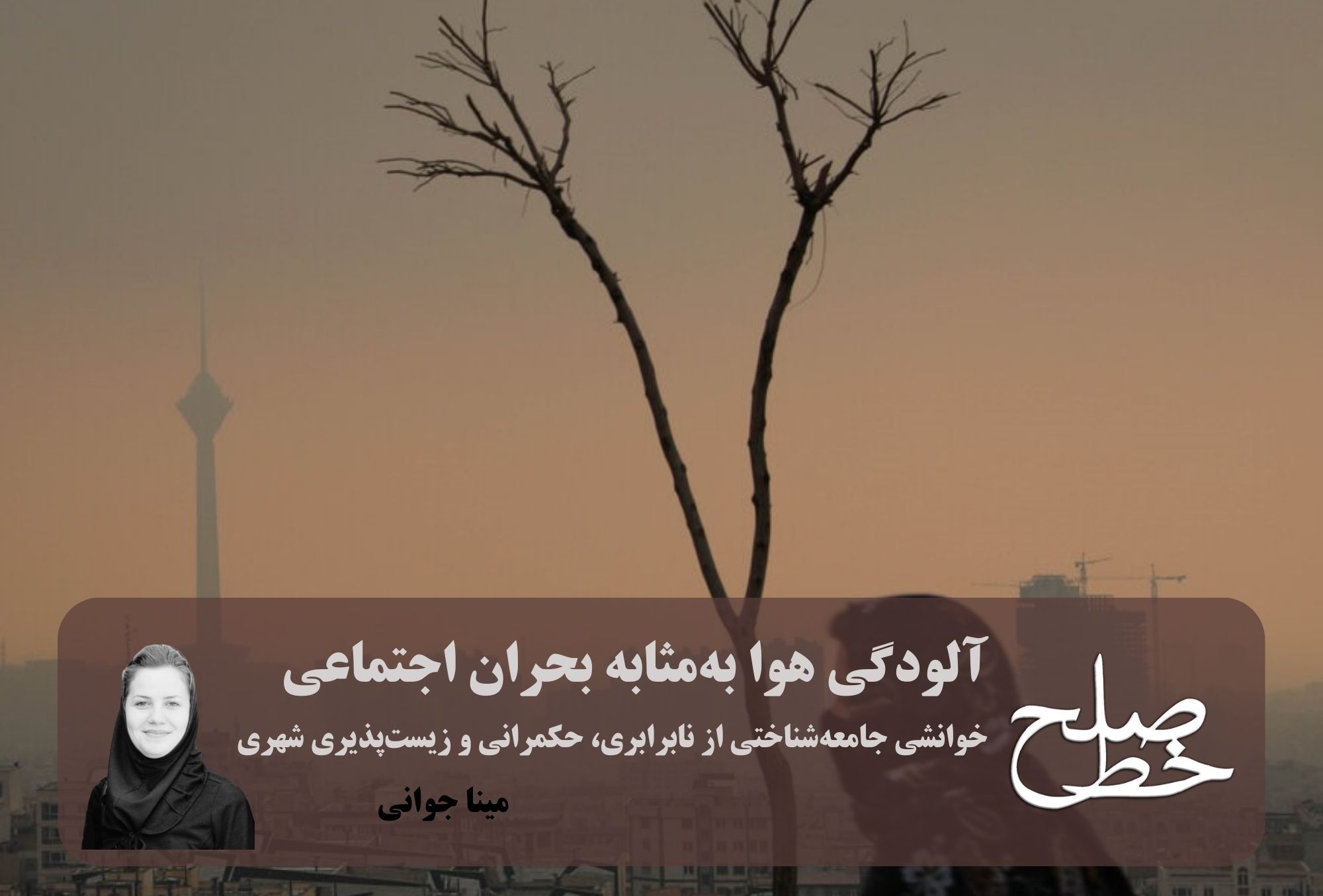
Air Pollution as a Social Crisis/Mina Jawani
In recent decades, air pollution has become one of the most persistent and complex environmental and social challenges in Iran’s major cities; a challenge that, although seemingly an environmental and public health issue, functions far beyond an ecological crisis in sociological analysis. Today, air pollution has emerged as a “full-fledged social phenomenon”; a phenomenon in which economic and political structures, urban development patterns, daily lifestyles, and power relations reproduce each other and distribute its asymmetrical consequences among different social groups.
Environmental sociology studies show that pollution is not a natural phenomenon, but rather the product of institutional decisions, ineffective laws, and development choices that are applied unequally over time to urban bodies and spaces. From this perspective, air pollution in Iran can be seen as a prominent example of “environmental inequality,” where disadvantaged groups—from children and the elderly to workers and the marginalized—suffer the most harm, while more affluent groups with greater access to health facilities, safe spaces, and coping tools (from air purifiers to the ability to leave the city) experience the least exposure. This inequality is reflected not only in health indicators, but also in the quality and affordability of living in the city.
At a larger level, air pollution as a structural phenomenon points to weak urban governance, a lack of evidence-based policymaking, and a lack of institutional coherence in crisis management. The annual recurrence of polluted days and the lack of sustainable solutions have created a kind of “crisis routine” in which society becomes accustomed to the abnormal situation and public sensitivity to it decreases. This situation erodes not only physical health, but also public trust, a sense of institutional efficacy, and the capacity for collective action for change. On the other hand, at the cultural and lifestyle level, air pollution is a reflection of energy consumption patterns, a structural dependence on the private car, and a certain sense of social status that is deeply rooted in large cities. Individual and collective choices in the fields of transportation, fuel consumption, and urban lifestyles are woven into macro-economic and political structures in such a way that understanding the relationship between individual action and collective outcome becomes one of the central issues of urban sociology.
Given these dimensions, air pollution is not just an environmental crisis; it is also an indicator for measuring social justice, quality of governance, and social cohesion.
This note attempts to examine the social-structural dimensions of this phenomenon using a sociological approach and show how the air pollution crisis has become a mirror for understanding our current social situation.
Environmental Inequality in Iran: A Structural Analysis of Risk Distribution
Air pollution in Iranian cities must be understood within a broader theoretical framework, referred to in the environmental sociology literature as “Environmental Inequality.” This concept is based on the idea that the distribution of environmental risks is never random or natural, but is the product of a specific arrangement of economic, spatial, and institutional structures that expose social groups asymmetrically to environmental consequences. In Iran, this pattern of inequality is not only evident, but also structural and persistent.
From a spatial perspective, the construction of large Iranian cities, especially Tehran, Alborz, Ahvaz, Isfahan, and Mashhad, shows that the establishment of polluting industries, dense traffic networks, and disruptive uses has occurred mainly in the vicinity of lower urban classes. This pattern, known in urban sociology research as “Class-Based Spatial Segregation,” has turned air quality into an indicator of class distinction. Specifically, southern areas of Tehran, such as Shush, Naziabad, Javadieh, and parts of Islamshahr and Rey, are located in the vicinity of busy highways and industrial zones and structurally face higher levels of suspended pollutants. In contrast, the affluent areas of the north of the city have a different experience of “breathing rights” due to their altitude, green cover, and distance from polluting uses.
This spatial pattern overlaps with the economic pattern. Low-income households that lack the financial means to relocate, migrate to urban areas, or use coping mechanisms, such as air purifiers, schools of appropriate standards, or the ability to leave the city on polluted days, are exposed to higher levels of respiratory risk. From this perspective, air pollution in Iran is not simply a matter of individual health disparities, but rather a reflection of the mechanisms that link the possibility of healthy living to economic capital.
In addition to class and spatial dimensions, the generational dimension is also important. Children and the elderly in Iran are exposed to air pollution in a context where the health care system, schools, and support institutions lack adequate mechanisms to protect high-risk groups. The frequent school closures in Tehran and Mashhad are an example of the educational structures’ inability to integrate air quality into their decision-making, while the closures themselves deepen educational inequality among students who do not have access to alternative facilities. The result is a kind of educational-environmental dichotomy that once again places a heavy burden on children from lower classes.
This inequality does not only persist at the tangible level of harm, but is also reproduced at the symbolic level. Residents of underprivileged areas in Iranian cities often experience an “environmental exclusion”; an experience that is reflected in their general perception of the value of their bodies and lives. The feeling that some areas and some groups are considered “expendable” is a direct consequence of a complex combination of ineffective policies, unequal prioritization, and institutional indifference. This feeling of exclusion leads in the long run to a decline in social trust, urban divergence, and the weakening of social capital.
Thus, environmental inequality in Iran is not a random or secondary phenomenon, but rather a reflection of established spatial-class structures, development-oriented policies lacking justice-oriented considerations, and weak governance in regulating the relationships between industry, transportation, and public health. Therefore, air pollution cannot be considered simply as a health or environmental challenge; rather, it should be reinterpreted as an analytical indicator for understanding the state of social inequality and the quality of urban governance in Iran.
The governance crisis and the structural production of air pollution
Air pollution in Iran cannot be considered simply the result of a set of scattered environmental factors; it is rather the direct product of a deep crisis in the governance structure. From the perspective of political sociology and institutional analysis, air pollution in Iran acts as a “structural consequence”; a consequence that has been shaped by decades of policy decisions, economic priorities, and governance patterns. This crisis is not a point and transient, but permanent and reproducible, and this reproducibility makes it one of the important indicators of the ineffectiveness of governance in Iran.
The first dimension of this crisis is the institutional disconnect and lack of coordination among the responsible organizations. The management of the air pollution crisis in Iran is divided among various institutions: the Ministry of Oil, the Ministry of Energy, the Ministry of Health, municipalities, the Environmental Protection Organization, the traffic police, etc. This institutional fragmentation means that none of the institutions has a clear, accountable, and traceable responsibility. The result is a kind of “structural evasion of responsibility”; a situation that delays decision-making, makes policies unstable, and makes actions superficial and fragmented. Therefore, every year with the onset of the cold season, the same pollution patterns are repeated, without any effective treatment or corrective mechanism being formed.
The second dimension is the political economy of energy. Structural dependence on cheap fossil fuels, the production of low-quality, low-standard vehicles, and the lack of investment in clean public transport are all signs of a prioritization of short-term economic policies over public health. In such a context, air pollution is not an “environmental accident” but the inevitable consequence of a development model that has prioritized industrial growth over environmental considerations. The automotive industry, as a prime example, has benefited from government support for many years while being one of the most important producers of pollutants, a paradox that shows how the problem of air pollution is tied to economic structures and power networks.
The third dimension is the crisis of transparency and the lack of reliable data. In many cases, information on the levels of pollutants, sources of emissions, and health consequences is delayed, censored, or reduced. This lack of transparency not only affects public trust, but also undermines the possibility of scientific decision-making and evidence-based policymaking. In such a context, pollution control programs become more symbolic measures than corrective mechanisms.
The fourth dimension is the normalization of the crisis; a process that operates through the annual repetition of polluted days, the failure to provide sustainable solutions, and the transfer of responsibility to natural factors such as “cold,” “temperature inversion,” or “no wind.” This normalization not only reduces public sensitivity but also weakens the capacity for collective action for urban demand. From this perspective, air pollution is not only an environmental crisis, but also a symbol of the erosion of the state-society relationship and the decline in the power of social mobilization for change.
Ultimately, air pollution in Iran should be considered part of a “structural production”; a production that has been formed at the intersection of development policies, bureaucratic structures, weak governance, and insufficient investment in clean infrastructure. Until institutional reforms, a change in the urban governance model, and a radical overhaul of energy and transportation policies are implemented, this crisis will continue to reproduce itself and serve as an indicator for measuring the quality of governance in Iran.
From the erosion of daily life to the disruption of social cohesion
Air pollution in Iran does not merely act as a physical health threat; it is also gradually shaping a kind of “social experience of living in a state of crisis.” This experience, which is simultaneously biological, psychological, and cultural, transforms daily life patterns and profoundly affects the quality of collective life.
First: Air pollution causes psychological erosion and increases collective anxiety. International research has shown that long-term exposure to pollutants is associated with increased depression, decreased concentration, mood swings, and negative feelings about the future. In Iran, the continuation of polluted days and frequent school closures reinforce the feeling of “instability” and “uncontrollability”; a feeling that is not only individual but also collective. When people expect the crisis to intensify every year with the onset of the cold season, the situation gradually turns into an “anxious psychological rhythm” that affects social relations.
Second: Air pollution disrupts daily life and urban activity patterns. Continuous closures, reduced hours of operation, erratic urban traffic, and the confinement of citizens to enclosed spaces gradually undermine social order. For families, unpredictable school closures pose not only an educational problem, but also an economic and emotional one; for workers and outdoor occupations, reduced air quality leads to reduced income and increased job risk. On a larger scale, this situation leads to a “decline in social productivity” and the erosion of the city’s economic capacity.
Third: The cultural consequences of air pollution are very serious. This phenomenon gradually weakens the sense of belonging to the city and trust in public spaces. When streets, parks, schools and urban spaces become unhealthy and dangerous places, people’s relationship with the city is disrupted. The city turns from a place of living and collective experience into a threatening space that must be escaped. This experience, especially among children and adolescents, can lead to the formation of generations with a weakened sense of belonging and social capital.
Fourth: Air pollution leads to a kind of institutional distrust and social disillusionment. The inability or unwillingness of responsible institutions to provide fundamental solutions leads to the formation of the feeling that crises are not solvable, but “structural and permanent.” This perception reduces the spirit of social participation and the desire for collective action. In such a context, public demand for the right to clean air is also weakened and a kind of “social passivity” takes root.
Fifth: Air pollution exacerbates class divisions and leads to the reproduction of “unequal lifestyles.” Wealthier families can afford air purifiers, less polluted homes, periodic trips to escape the crisis, or private medical services; but the lower classes, forced to breathe polluted air, are more vulnerable and have fewer means to protect themselves. This difference is even reflected in the psychological experience of the crisis: for the upper classes, the crisis is “manageable” and for the lower classes, it is “inevitable and debilitating.”
In sum, air pollution in Iran has become a “complex social crisis”: one that targets not only bodies but also the experience of living, social relations, psychological capacities, and cultural cohesion of society. From this perspective, tackling air pollution does not simply require environmental reforms; it also requires restructuring governance structures, promoting spatial justice, and strengthening social capital.
Future Horizons: Social Rethinking and the Feasibility of Transitioning to Sustainable Cities
In the face of the air pollution crisis in Iran, the main question is not only how to reduce pollutants, but also how society can find a new path out of this crisis to rethink the meaning of “city,” “collective life,” and “future planning.” Air pollution confronts us with gaps that are much deeper than an environmental threat: the gap between development and livability, between policymaking and lived realities, between citizen rights and governance priorities. From this perspective, now is the time to consider the issue of air pollution not simply as a crisis, but as an “opportunity to reinvent the future of the city.”
First: The current crisis highlights the need for a transition to sustainable cities. This transition is not possible with technological improvements or technical reforms alone, but requires fundamental changes in collective values, consumption patterns, transportation methods, and development policies. A society moving towards sustainability must recognize the right to breathe, the right to clean spaces, and the right to participate in urban decision-making as the first rights of citizens.
Second: Rethinking the governance structure and the response to air pollution requires a new definition of social responsibility. This responsibility lies not only with the government, but also with civil society, universities, the media, and even businesses. Universities can provide a deeper understanding of the social consequences of the crisis through interdisciplinary research; the media can prevent the normalization of pollution; businesses can change production and distribution patterns towards greater environmental compatibility; and citizens can demand the “right to clean air” through collective action.
Third: The future of air pollution control in Iran depends on strengthening environmental ethics and a culture of attention to the future; a culture that emphasizes intergenerational responsibility, social solidarity, and the sustainable presence of humans in the environment instead of short-term, consumer-oriented behaviors. Cultural change, albeit gradual, is the foundation of any sustainable structural reform. Fourth: The future horizon requires that air pollution be redefined not as an “inevitable fate” but as a changeable issue. The experience of many countries shows that even heavily polluted metropolises can be transformed into healthier and fairer cities within a few years with institutional reforms, data transparency, clean energy, and public participation. The problem in Iran is not a lack of feasibility; it is a lack of political will and institutional coordination.
Footnotes:
1- Gorczyca, K., & Zozulia, D. (2025). “We have the right to breathe clean air”: Mobilizing communities in the fight for good air quality . Environment and Planning C: Politics and Space .
2- Joshi, B., & Swarnakar, P. (2022). How fair is our air? The injustice of procedure, distribution, and recognition within the discourse of air pollution in Delhi, India. Environmental Sociology, 9 , 176–189.
3- Loopmans, M., Smits, L., & Kenis, A. (2021). Rethinking environmental justice: Capability building, public knowledge and the struggle against traffic-related air pollution. Environment and Planning C: Politics and Space, 40 , 705–723.
4- Maturo, A., & Moretti, V. (2018). Sociological theories on air pollution: Between environmental justice and the risk society approach. [Journal title not provided] .
5- York, R., & Rosa, EA (2012). Choking on modernity: A human ecology of air pollution. Social Problems, 59 (2), 282–300.
 Created By: Mina Javani
 December 22, 2025
Tags
Air pollution Air pollution in Tehran Class division Environment Environmental destruction Mina Youth Nazabad peace line Peace Line 176 Right of citizenship Right to health Social justice South of the city ماهنامه خط صلح