


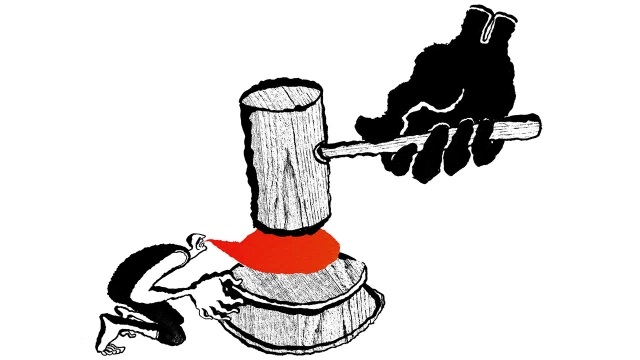
Is insulting politicians considered a citizen’s right? / Ehsan Hosseinzadeh
There is no Farsi text provided. Please provide the text that needs to be translated.
Ehsan Hossein Zadeh
Is “insulting politicians part of citizenship rights?” is a question that some politicians and legal systems have currently answered with imprisonment and flogging, and some potential future politicians and current opposition members are predicting punishment for such actions in Iran after the Islamic Republic.
In legal literature, under the title of Defamation Law, there is a discussion about insulting well-known individuals and politicians, and in fact, this law seeks to create a balance between the freedom of expression of citizens on one hand, and the credibility and reputation of famous individuals on the other hand. (1) This is because on one hand, we have vulnerable citizens who are constantly harmed by the decisions of politicians and influential individuals, and on the other hand, we have politicians or famous figures who have power, wealth, and political and social influence, but their only vulnerable asset is their reputation and popularity. Supporters of freedom of expression call for leniency and leniency from the legislator and the judicial system to prevent the creation of a dictatorship against the insult and defamation of citizens against public figures, and in contrast, supporters of individual rights argue that the rights of politicians, even if their number is small, must be respected and freedom of expression should not be used as a means of damaging
What is the current approach of the laws of the Islamic Republic in this regard?
The penal laws of the Islamic Republic have considered insulting political authorities as a crime, and this has been proven in the judicial process as well. Not only insults, but also any criticism towards the political authorities of the country, especially the first person of the country who is considered the leader of the Islamic Republic according to the constitution, is not allowed. Therefore, Article 514 of the Penal Code states: “Anyone who insults Imam Khomeini, the founder of the Islamic Republic, and the Supreme Leader in any way, will be sentenced to imprisonment from six months to two years.” This is while insulting ordinary individuals is considered a separate crime in another article. If you follow the news of political prisoners, you will remember countless cases of political prisoners who have been lashed or imprisoned for criticizing the leader, the president, or even one of the members of parliament. One of these cases was Mohammad Najafi, a prosecutor who was sentenced to imprisonment for insulting the leader.
What approach do advanced and democratic countries like America and Europe have in this regard?
According to American courts, in terms of the material elements of the crime, in order to commit this crime, the accused must attribute a false and defamatory statement to a famous person (not an ordinary person) and this statement must damage the reputation of the person. Therefore, the burden of proof for this crime falls on the politician, who must first prove that the statement or announcement that was published is false, and secondly, must prove that this statement or announcement has damaged their reputation. Therefore, the law has taken this step to protect freedom of speech and has placed the burden of proof on the famous person. American courts explicitly state that this crime will not be committed simply by expressing an opinion about a politician. For example, if a citizen says “I hate that politician,” this crime will not be committed. In fact, this statement or announcement that damages the reputation of the politician must contain a message that can be verified about the politician. For example, if a citizen says that a
The experience of implementing defamation laws in America has shown that the cost of litigation for such complaints is very heavy. On one side of the lawsuit are wealthy and famous individuals who have a lot of money and influence and are seeking to convict an ordinary citizen who has damaged their reputation, and on the other side is an ordinary citizen without influence and even without enough money to hire a lawyer to defend themselves. These cases usually take years to be resolved and ordinary people do not have the ability to pay for the costs of such lawsuits. Interestingly, popular newspapers act very cautiously in this matter. The legal team of newspapers, knowing that politicians and famous individuals have high financial and influential capabilities, immediately delete any news or headline that may cause trouble for them, making freedom of expression compromised. Ordinary citizens, on one hand, and newspapers and popular websites, on the other hand, censor themselves out of fear of the wealth and influence of famous individuals, especially politicians, and as a result, the freedom of expression becomes a
From the perspective of European Union law, the origin of the law of defamation comes from Article 8 of the European Convention on Human Rights, which states: “Everyone has the right to respect for his private and family life.” Therefore, this is a strong legal basis for restricting freedom of expression in order to protect the reputation of individuals under the protection of the law. In fact, the European Union and the European Court of Human Rights have not yet fully abolished the law of defamation. However, this level of respect for personal rights in the European Union and sacrificing freedom of expression is not correct, and from the perspective of the International Press Institute, it leads to the spread of censorship and the limitation of freedom of expression. (4).
What do human rights organizations say about this?
The former special rapporteur of the United Nations Human Rights Commission recommends to countries to refrain from criminalizing insults against political authorities; as this crime is a barrier to freedom of expression and limits the freedom of citizens in societies. The special rapporteur of the United Nations in promoting and protecting freedom of expression and opinion states that the crime of insulting political authorities (Defamation Law) should be abolished in favor of civil rights and warns that this law is “a serious threat to freedom of expression that countries use through criminalizing this act. The international judicial procedure is against the criminalization of insulting political authorities and the Human Rights Committee has issued a statement in support of any legal measures that criminalize insults against governments and political authorities, and ultimately recommends that countries take steps towards decriminalizing insults against political authorities and that imprisonment as a punishment for it should be completely eliminated.”
***
The legislator of any country must refrain from accusing and punishing individuals for criticizing political authorities and influential figures in order to prevent obstruction of freedom of speech; because being strict with citizens and emphasizing support for the individual rights of politicians will be equivalent to injecting fear into society and intimidating journalists, civil and political activists so that they do not criticize or attack important and influential political figures. Being afraid of a simple criticism or saying anything that may result in being labeled or accused of insulting authorities is equivalent to silencing critics and silencing civil society. A dynamic civil society, whose characteristic is to improve and reform society, should not be afraid of speaking out for the future. Although no one denies the rights of individuals in power and their individual rights should be respected, the scales of justice should always lean towards expanding freedom of speech and weighing heavily in favor of the rights of the people.
Notes:
Milo, Darius, Aftera, and Azadi are expressing themselves.
Magazine.
Oxford Online Scholarship, January 2008.
For more information, refer to: Definition of Slander Law in .
Foundation.
Electronic border.
Martin, Brian, defamation law and freedom of speech.
University.
Wulongong, November 1996.
Freedom of speech, media law and defamation.
Report.
World Press Institute, February 2015.
How powerful individuals use slanderous laws to silence their critics.
Economist.
July 13, 2017.
Freedom of speech, media law, and defamation.
Report.
World Press Institute, February 2015.
 Created By: Ehsan Hossein Zadeh
 March 21, 2019
Tags
Defamation law Ehsan Hosseinzadeh Monthly Peace Line Magazine peace line