


A Look at the Economic Situation of Retirees, Employees, and Workers in the Country / Amir Javaheri Langroudi
“Right-aligned image” Amir Javaheri Langroudi
Days and weeks have passed, and we were facing the 40th anniversary of the February 1979 revolution. Now, the year 98 has also begun. But life in the vast geography of Iran is so difficult, as the poet says: “What is this secret that every spring comes with mourning for our hearts?” Nowruz has arrived, but there is no news from “Baharan”. But let’s see how the essence and concept of the February revolution, in defending the existence of independence, freedom, and social justice, has opened its mouth for its tomorrow, to be accountable to the social forces that brought the revolution to fruition.
From the bloody revolution of Bahman 57, this contradictory revolution first devoured its own children, and then became a playground for the force that divided society into “us” and “them”. The efforts of those who sacrificed themselves for the revolution became a mere tool, and their magnificent souls, who had created greatness, were not allowed to rest. These are the same souls who, even today, are watching over all the desires of the past to strengthen the revolution.
As we talk without formality, I will say: the responsibility of answering for not meeting the demands and needs of society rests more than ever on the shoulders of the agents of the system and the ruling political powers, who in the past four decades have steered the society towards ups and downs, and today we are all witnesses to the unpredictable fate of that existence.
We all witnessed that in the past forty years, the victory of the Iranian Revolution was achieved through the unity of all national and freedom-seeking forces and the masses on the margins of society who stood together to overthrow the Pahlavi monarchy and pave the way for independence, freedom, and social justice as prerequisites for the advancement of our society and people. Our generation saw how the people of Iran, including Persians, Turks, Kurds, Arabs, Balochis, Lurs, Gilaks, and Mazandaranis; Muslims and Christians, communists and mystics, men and women from urban and rural communities, united and stood strong against the powerful military regime that called itself an island of stability in the region and manifested itself in the form of Pahlavi dictatorship.
Since the February Revolution, the political power derived from the revolution has been denied to all channels of freedom and the determining forces of society (such as the millions of workers) have been disbelieved and turned away from. We have all witnessed how these former workers, now known as cultural, military, and numerous retired personnel, as well as the masses of street children, are floating under the line of poverty and destitution in our society, and are still struggling and striving to make a living.
***
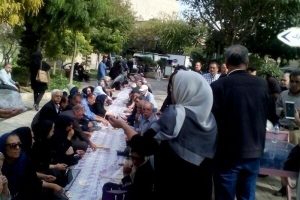
In Iran, the cycle of problems and misfortunes for retirees, employees, and workers, both men and women, never ends. Retirees and low-ranking employees do not receive enough wages and benefits, and they do not have access to adequate healthcare services. Despite being a significant force, they lack a united and organized voice to demand their rights due to their scattered and muted voices. What has caused this level of decline for them? Governments have always made empty promises and used populist policies to deceive the working class, leaving them with empty social security funds and forcing them to face their struggles alone. They have prioritized their own political agendas over fulfilling their financial commitments to the working class, and then they have turned a blind eye and refused to take responsibility. In reality, governments have been taking money from the pockets of the main contributors to the social security fund – the working class – to fund their own advertising campaigns. As a result, the government is now the biggest debtor to the social security
Living with poverty, not having enough, having multiple jobs instead of rest, in difficult conditions and with various illnesses in old age, is still a reality for a large number of retirees in Iran. It should be noted that the Social Security Organization, which is a non-governmental public institution and an international organization, and the pension funds – which should be considered as a financial support for the working class – receive all pensioners for unemployment or disability benefits and are supposed to “collect them” and transfer them to the private sector. Apart from this, a significant portion of the unemployed – who are undoubtedly an inseparable part of the working class – are not covered by social security protection. Retirees say that due to inflation and exorbitant prices, the social security pension does not even cover one week of their expenses and it can be said that in Iran, no one is more destitute and unsupported than retired workers. In Iran, the “golden years of retirement” are truly a time
In every corner of the country, thousands of retirees spend their days turning into nights. Without a doubt, it can be said that none of them are satisfied with their standard of living and well-being. They have no hope of support from anywhere and their hands are tied, with no justice to be found. The true statistics are not available, but more than several million workers, after a lifetime of production and construction, receive an average of less than two million tomans per month, most of them are renters and homeless, carrying the burden of a home on their shoulders; and even if they are successful in receiving their wages on time…
Based on the latest call for retirees from the national, military, and cultural sectors, it has been announced for the seventh of Esfand 97: “Today, the main demand of retirees is for a review and amendment of the figures in the budget bill for 1398 and an increase in the budget for equalization by 1,500 billion tomans, as well as an increase in the retirement coefficient to 40%.” In other words, all the benefits and privileges that are given to active workers must also be given to retirees. However, at our street rally, we witnessed the slogan and the victorious event, and we were faced with a confrontation with the entire ruling power, especially the dark-faced ones who have inflicted pain and torture on the bodies of workers. They cried out: “Torture, documentary, no longer has an effect.” The worker of yesterday and the retiree of today sees himself in a body where every whip falls on the heads of his children and
***
Retirees today are the tired mothers and fathers of yesterday; pushed out of work and left in the turmoil of the contradictory cycle of life. In the budget display, several issues are clear; including: while “adherence to the principles of the 30th article of the Constitution and stopping the process of privatization and trading of educational services, which has become the basis for commercialization of education and changing its nature”, is one of the important demands of the country’s cultural activists, in the 98 budget, 10% of education is explicitly allocated to purchasing related services. This means that education has been turned into a business to the extent that it not only breaks the unity of teachers’ unions, but also provides services to 10% of students through the “private sector”, with a salary equivalent to one-third of the current poverty line for teachers; a move that has no other meaning than “cultural genocide”.
While 12 years have passed since the approval of the Nursing Services Tariff Law, despite the fact that the main burden of the healthcare system falls on nurses, the necessary budget of 2 trillion tomans has not been allocated for the implementation of the law in the next budget. According to Taghizadeh, the CEO of the Retirement Fund, the minimum required budget for aligning the salaries of retirees is 15 trillion tomans, which will not even be 25% covered in the best case scenario in the next budget. There is also no clear plan for how the predicted amount will be allocated.
Based on what lies ahead of us, it becomes clear that under the name of importing goods, they have raised and taken out more than 3 billion dollars in foreign currency. Under the name of distributing food, by creating mafia networks in the market, they have greatly increased prices. While the whip of high prices falls on the consumer, they take billions in bribes from the gap between government currency and free distribution of imported goods. Under the name of “resistance economy,” they sit in their palaces and advise us to tighten our belts and eat dry bread. Under the name of strengthening national security, they smuggle over 6 billion dollars worth of clothing annually through private ports and leave at least 260,000 people in the Iranian clothing market without food. Under the name of “jihadist management,” they distribute bribes for managerial positions, as well as land, plains, mountains, forests, and coasts. Under the name of development and construction, they destroy the country’s
Therefore, it is clear that the budget for the coming year should prioritize austerity and poverty reduction for workers, teachers, nurses, retirees, disabled individuals, and marginalized urban and rural populations, as well as the general working class. Only through independent class organization and united protests can all sectors of demand challenge the exploitative and poverty-inducing policies of the 98 budget.
It is clear to all retirees, unemployed individuals, and workers that liberation from inflation and high prices, poverty and destitution, lack of real social welfare and access to fair wages equivalent to the average cost of living in urban households is an essential and necessary means for their survival. Therefore, achieving this goal is the result of a comprehensive economic and social struggle and its connection to the political struggle of these groups.
It is upon each of us to not leave this comprehensive camp of the community alone and support and assist them with all our strength in their desires and needs, and be the voice of the voiceless.
 Created By: Amir Javaheri Langaroudi
 March 21, 2019
Tags
Amir Javaheri Langroudi expensive Expensive meat Monthly Peace Line Magazine peace line Retirees Right to nutrition Spinal column