


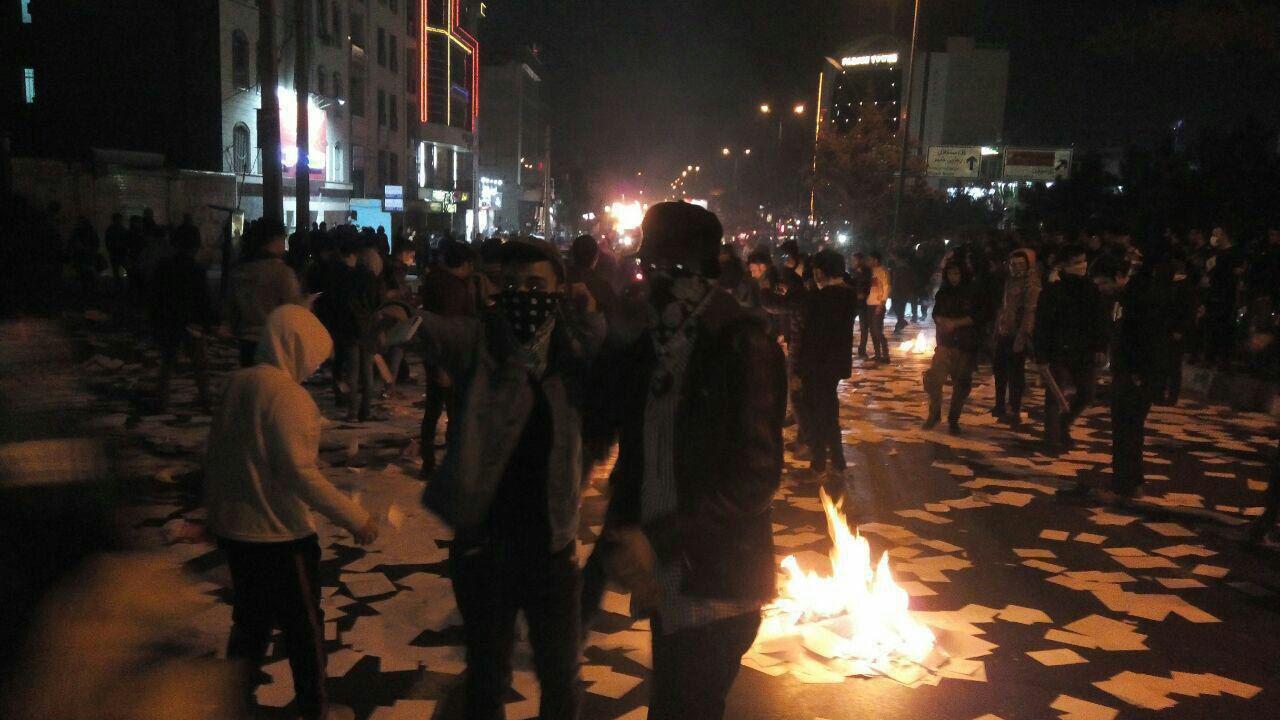
Protests of December 96, dangers and necessities/ Behnam Darayizadeh
This is a caption.
Behnam Darvayi Zadeh
In this note, an attempt is made to not only explain the nationwide protests of last December, but also to address the necessities and dangers that are present in the current protests in Iran. The reality is that without such an analysis, it is impossible to talk about the future or the necessities of the current situation. Therefore, in this note, we will first discuss the nature of these protests and then address the current dangers and necessities.
Features.
About the characteristics or features of the protests in Iran in December 2017, especially in comparison with the protests in 2009 or the “Green Movement”, there has been a lot of talk. Therefore, we will not dwell on this topic and only briefly mention the most prominent features of this movement.
First – The reality is that “widespread” protests in December 2017 were the most important characteristic of this movement. In contemporary Iranian history, from the Constitutional Revolution to the present, you cannot find any other social-political movement that has simultaneously taken place in more than 80 cities, and even in some rural centers, radical anti-government protests have taken place. During the “Constitutional Revolution,” which was unprecedented even compared to the 1957 revolution, the scope of the December 2017 protests was unparalleled.
Second- These protests were not only widespread, but their growth or spread was unprecedented. The closest experience that many of us may remember is the protests of 88 or the “Green Movement”. The Green Movement, although formed around a political news or event (announcement of election results) and had the potential for public incitement, its growth and spread was lower compared to the events of last December. In the events of last December, in less than 48 hours, without any specific event taking place, dozens of small and large cities became involved and put forward radical demands and requests.
The third and most important characteristic of the events of December 96 was their “radical” nature. This means that, unlike the “Green Movement”, the slogans or demands of the people, from the very beginning, were a symbol of the “integrity of the Islamic Republic”. Almost no reformist slogans were raised. On the other hand, there were almost no common slogans with the “Green Movement”. Even the familiar and central slogans of “Ya Hussein/Mir Hussein” or the nightly chants of “Allahu Akbar” – despite the fact that the issue of “house arrest” still exists – were not raised.
Fourthly, “lack of leadership” is another point that many analysts have rightly pointed out. However, compared to the previous three characteristics, it is not as “distinct” or central. The reality is that numerous protest movements in the contemporary history of the region have formed and succeeded without a specific leader. The most familiar example of this is the so-called “Arab Spring” uprisings in Egypt and Tunisia, which led to the downfall of long-standing regimes of “Mubarak” and “Ben Ali”.
Regardless, although the protests of December 2017 in Iran took shape without any symbolic political leadership, it cannot be denied that the role of “social networks” was much more prominent. Some of the “Telegram” channels, specifically “Aman News”, were able to play a role in inciting or even directing the protests by disseminating widespread news or videos of the protests; an issue that deserves to be analyzed separately.

What is the nature or essence of protests?
There has been a lot of discussion about the nature or essence of the protests in December 2017; was it a class movement? Was it the working class of Iranian society that led these protests? What name should be given to this December movement to define its nature or essence?
This was not a working class movement. Or at least “industrial working class” in its traditional and classical sense, did not lead or represent this movement. There is no doubt that workers’ protests in Iran are currently the most widespread. However, the protests of December 2017 cannot be specifically attributed to the “working class” of Iran. Although workers, along with other economic dissidents, had a serious and prominent presence during these protests, it is wrong to assume that the working class of Iran had control or leadership over these protests. Let me give an example: Yazd province is the most industrial province in Iran. It is estimated that 67% of the population are workers.
Light.
The industries and factories in this city (1) are somewhat dependent on the industrial sector and production centers of the province; however, despite such a population-economic structure, Yazd and other cities in this province were among the few areas that remained silent during the protests of last December. This means that almost no protest movement was reported in these areas.
On the other hand, it seems that “urban dwellers” did not represent the December 96 movement. In fact, just like workers, although urban dwellers also participated in these widespread protest movements, it cannot be said that this group or spectrum of society led the December 96 protest movement.
Millions of people living on the outskirts, especially around big cities such as Tehran, nowadays. In recent years, due to economic policies and specifically urban planning policies, conditions have progressed in a way that continuously adds to the population of these marginalized or newly established neighborhoods. In fact, individuals have gathered in these areas solely out of economic need and inability, without any specific connections or shared cultural and historical backgrounds. It cannot be denied that during the December uprising, for various reasons, these areas remained quiet and did not witness any particular protests.
The reality is that the protests in Iran last December were largely “local.” This means that local connections or shared local demands played a significant role. From issues such as water shortages and environmental crises, such as air pollution and dust storms, to the closure of local industrial centers and more. This has led to widespread unemployment among the local workforce, especially among young people in the region.
This statement is defensible that the demands or requests of the December 2017 movement have mainly been economic; however, these demands become “political” when these dissatisfied individuals say that you, the ruling government, do not have the ability to respond to our basic demands and improve our living conditions due to incompetence, mismanagement, and of course, corruption in the organized financial and governmental institutions.
The reality is that the best name that can be given to this movement is “The Eliminated”. This name can to a great extent reflect the dominant situation or define its essence. This movement is for those who have no voice. Recognized political forces, even those in opposition, have ignored them.
They have understood correctly that in the continuation and persistence of this situation, there is no chance for them, not even for their survival. Day by day, the situation has gotten worse and the economic plans and promises have not led to anywhere. They see that in the table where the rulers are sitting, there is no share for them and they have been eliminated.
It is a mistake to assume that these individuals are necessarily poor or destitute city dwellers. Many of them may occupy layers close to the middle class or even within the middle class of the city. However, they feel excluded or marginalized. The losers of financial institutions affiliated with the Revolutionary Guards and others are a good example of these individuals. Groups that cannot be called “poor” in the usual sense. They have invested and trusted these financial institutions, but in the end, in the chaos of a corrupt and rent-seeking economy, they have lost their assets.

Upcoming dangers.
It seems that the most important danger facing the 96 Iran protest movement is the possibility of it being infiltrated by right-wing, extreme right-wing, or even fascist elements. The reality is that such movements are not only active within the country, but also outside of it. They have media outlets and, in fact, have power and influence. On the other hand, it cannot be denied that among the slogans and demands of the protesters, there are also racist or reactionary slogans heard. It is self-deception to think that the December 96 protest movement was a progressive and forward-looking movement, and that left-wing forces were leading it.
The reality is that not only in Iran or the Middle East, but also in Europe or America, there is always the possibility that street protesters may be attracted to radical right-wing forces. This has happened repeatedly, especially during periods of serious crises in the capitalist system, or when left-wing forces are unable to provide a reliable and hopeful alternative, or when they are simply not present in society due to political suppression (in the Middle East and elsewhere). Therefore, there is no reason to assume that in the current situation, in the absence of left and progressive forces in Iran, street protesters will necessarily choose the right path. This is a serious danger that should be warned about from the very beginning.
Another danger that could threaten the current protests in Iran is that this “protest potential” may turn against itself instead of standing in opposition to the Islamic Republic. What does this mean? It means that local economic protesters in small cities, who are struggling with daily shortages of energy resources, may turn against each other. Environmental crises, regardless of their cause or origin, have serious political and social consequences. Aside from future waves of migration, recent news and reports also show that conditions in central and dry regions of Iran are currently critical and tense. These tensions, in addition to external hostility (specifically towards Afghanistan), could lead to serious local conflicts between indigenous peoples. People who, in the end, are both chained and divided by their social class.
Some short predictions and conclusions.
It is expected that the protests of December 2017 will be repeated in the short and medium term. It is possible that the direction of these protests may not necessarily be progressive and forward-looking; meaning that although these protests have shown the integrity of the Islamic Republic, their demands may not necessarily be legitimate and defensible. For example, if extremist nationalist tendencies become more prominent and we witness the widespread promotion of anti-Arab, anti-Afghan, or similar slogans. Or ultimately, in the absence of left and progressive forces, these protests may merge with the dominant discourse of the right and neoliberalism. In any case, it is expected that the time gap between protests – regardless of their nature and direction – will decrease and their demands will become more radical than they are now.
It is clear that there are other important factors at play; the most crucial factor that needs to be addressed is how the Islamic Republic will react. The reality is that the Islamic Republic still has many cards to play. On the other hand, it seems that during the protests of December 2017, the government not only did not use all of its power to suppress them, but it did not even use half of it. In any case, it is a historical fact that no political structure will change as long as there is potential for dissatisfaction in society. The crisis of efficiency or management is important and influential; but real and meaningful changes in society can only happen when the ability or “management of suppression” is also in crisis. However, as long as the Islamic Republic, or any other authoritarian regime, can maintain and manage the core of suppression – despite the serious crises of legitimacy and efficiency – it can still remain in power.
It was indicated that the Islamic Republic still has many cards to play in dealing with social and political dissidents. “Playing on security concerns” or fear-mongering can be one of these effective tools in controlling society.
The reality is that the middle class in Iran still has a lot to lose. They are not willing to sacrifice their economic security or, worse, their lives at any cost. For example, if a bomb were to explode on one of the streets or main squares of Tehran, or if operations similar to those carried out by Al-Qaeda and ISIS in Europe were to be planned and executed in Tehran, it would not be unthinkable for significant portions of society, especially among the middle or upper class – despite their different lifestyles from the ruling regime – to turn their backs on the Islamic Republic or its regional policies and ultimately create nationalistic heroes like Qasem Soleimani or other figures of the Revolutionary Guards.
Given the analysis and the image presented of the future protests in Iran; now we can address the classic question in a clearer space: What should be done? It seems that the victory of a “radical street policy” primarily depends on serious intervention by progressive elements. The reality is that the danger of assimilation into right-wing rhetoric or extremist nationalist forces is serious. We must warn against the empowerment of these forces, who only have a “political” problem with the Islamic Republic and overlook serious criticism of its economic and political policies.
At the end, it seems that it should be emphasized that the mistake or humiliation of the middle class can be a historical error. Although it is arguable that the Iranian middle class has the potential to stand against the Islamic Republic by provoking its security concerns, this class should not be ignored or labeled as a supporter of the Islamic Republic. What should be done is to support activists of this class in advancing their demands, such as women’s rights, rights of sexual minorities, individual freedoms, optional dress, etc., and not let these areas fall into the hands of right-wing and neoliberal forces.
Note:
67% of the population of the province is connected to the labor community, the website of the General Office of Cooperatives, Labor and Social Welfare of Kerman Province, October 9, 2017.
 Created By: Behnam Daraei Zadeh
 March 20, 2018
Tags
Behnam Darvayi Zadeh Behnam Darvayi Zadeh Middle class Nationwide protests in December peace line