


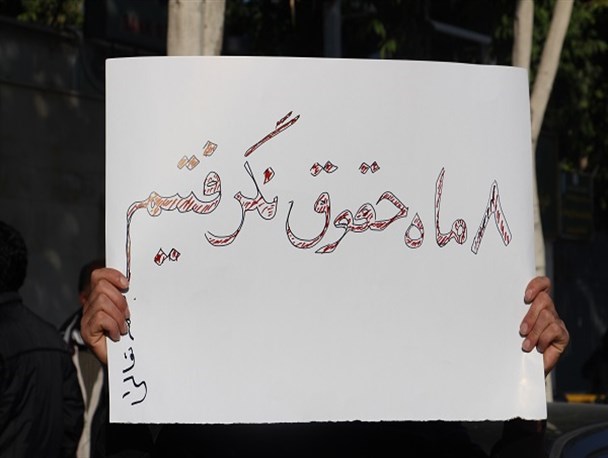
Challenges of labor laws in the discussion of rights and wages/ Shahin Sadegh Zadeh Milani
There is no Farsi text provided to translate. Please provide the text to be translated.
Shahin Sadeghzadeh Milan
The Iranian labor law and the security system of the Islamic Republic have created intertwined obstacles against the protection of workers’ rights. On one hand, the labor law institutionalizes government supervision and control over labor unions, limiting collective bargaining. On the other hand, the labor law is designed in a way that allows employers to undermine the job security of workers through temporary or “white” contracts, putting them in a vulnerable position.
A. Group chanting.
Collective bargaining is one of the most important and effective tools for workers to secure their rights and benefits from employers. As employers hold a position of power over workers, an individual worker is not able to ensure fair working conditions alone. Therefore, the right to form labor unions and associations is mentioned in international treaties. Article 8 of the International Covenant on Economic, Social and Cultural Rights states: “The States Parties to the present Covenant undertake to ensure: […]”.
Everyone has the right to form an association for the advancement and protection of their economic and social interests, in accordance with the regulations of the relevant organization, and to join the association of their choice. This right cannot be restricted except by what is prescribed by law and is necessary in a democratic society for the interests of national security, public order, or the protection of the rights and freedoms of others.
The position of the Islamic Republic of Iran’s Labor Law regarding labor unions is different from Article 8 of the International Covenant on Economic, Social and Cultural Rights. Paragraph 4 of Article 131 of the Labor Law states: “Workers of a unit can only have one of the three following: Islamic Labor Council, Trade Union, or Workers’ Representative.” Paragraph 5 of the same article states: “The regulations for the formation, scope of duties and powers, and functioning of trade unions and relevant associations will be approved by the Supreme Labor Council.” According to the law on the formation of Islamic Labor Councils, the committee that determines the qualifications of workers’ representatives before the elections of Islamic Labor Councils is composed of: [list of qualifications].
1- Representative of the Ministry of Labor.
2- Representative of the relevant ministry.
3- Elected representative of the employees’ assembly…
In other words, two members out of the three members of the governing body that initially controls the membership of workers in Islamic councils are under the control of the government. Such interference in the structure of labor organizations violates Iran’s international commitments based on the International Covenant on Economic, Social, and Cultural Rights. This level of government interference in labor organizations is not for the purpose of ensuring public security and has no connection to preventing violence.
Temporary and white contracts.
According to Ahmad Moshirian, the deputy minister of labor, more than 90% of employment contracts in Iran are temporary, even though the work itself may be permanent. According to Article 7, Clause 1 of the Labor Law, the Ministry of Labor is obligated to prepare regulations regarding the maximum duration of temporary contracts. Furthermore, according to Article 199 of the Labor Law, these regulations must be prepared and approved by the Cabinet six months after the implementation of the Labor Law. However, twenty-seven years after the approval of the Labor Law, these regulations have still not been approved by the Cabinet. This legal loophole in practice renders the guarantees provided by the Labor Law ineffective. For example, in the case of a disciplinary issue for an employee, instead of addressing the issue through disciplinary committees, the employer can simply terminate the employee’s contract and rehire them after the temporary contract has expired. This renders the mechanism of disciplinary committees, which are meant to protect the rights of employees according
Contracts known as “white contracts” are those whose terms are not specified at the time of signing and are determined by the employer after the worker signs them. This type of contract puts workers in a very weak position compared to the employer and essentially gives the employer absolute control over the working conditions. Additionally, sometimes workers sign blank checks that are later used by the employer as a means of pressuring them. According to the secretary of the Semnan workers’ union, “Some employers, when hiring workers, take advantage of their power by taking blank checks, promissory notes, and white contracts, in order to have leverage and protest against the injustices imposed on them. This happens because if the employer fails to fulfill their obligations towards the worker, they can pressure them with the signed check or promissory note, so that they do not complain against their employer… Currently, in Semnan, there are workers who have been fired after several years of work, but because the employer has their signed
من برای شنیدن خبرهای جدید و جذاب در مورد دوستان و خانواده ام از شبکه های اجتماعی استفاده می کنم
I use social networks to hear new and exciting news about my friends and family.
Director of Legal Affairs at the Center for Human Rights Documents in Iran.
 Created By: Admin
 December 29, 2017
Tags
Labor law Monthly Peace Line Magazine Obstacles/Barriers/Circumstances/Challenges Ahead peace line Shahin Sadegh Zadeh Milani Workers