


The portrayal of women on Iranian television/ Jafari’s thoughts.
This is a caption
This is a caption.
Jafari’s thought
She screams and hits her head and face with both hands while crying, goes to sleep with full hijab and wakes up, gets ready to go to the salon or buy clothes, and locks her husband in the house. If she is dying, she definitely thinks seriously about finding her next husband or even lives with her second husband in the last months of her life. When her husband comes home from work, she stands at the door waiting to take his coat, usually seen by viewers cooking or taking care of other household matters. These are the dominant images of women in the national media of Iran and some TV series show women with their hands up as a sign of their basic and primary rights.
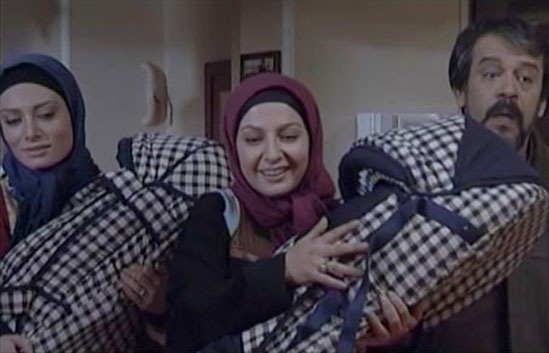
“Another Lady” directed by Cyrus Moghadam, which aired on Channel 5 during Norooz 1383, justifies polygamy with gentle and subtle explanations and brings the audience to a point where their hearts ache for the charming and seemingly intellectual man in the series, and they wish for him to have a second marriage before the death of his first wife.
“Saeed Derakhshan and his wife, Mehri Salehi, are a happy couple and seemingly intellectuals who work at the office of a women’s rights magazine. Saeed Derakhshan is the only male writer in this institution and the main reason for this is that he is apparently a strong advocate for women’s rights and intends to write a book on this subject.”
Mehri and Saeed, after 12 years of marriage, are not able to have children. The employees of “Banooye Avval” magazine consist of individuals who each represent a unique personality with their own patterns of behavior, values, and behaviors, and each of them is somehow connected to Mehri and Saeed (the heroic couple of the story).
Shirin Studdeh is a magazine photographer whose husband has passed away. She intends to marry her late husband’s friend, but after a while, their relationship falls apart for various reasons. As Mehrisalehi is her closest friend, she confides in her as a widow, sharing her problems and tragedies with her.
The story reaches a point with the illness of Laleh Sabouri in the role of Mehrisalehi where all the pages are turned; brain cancer and the fact that she has a short time to live, brings the story to a point where Mehrisalehi negotiates with her photographer friend to accept to enter their lives as a second wife and due to her inability to have children, which after apparent objections from both sides, a second marriage takes place in the presence of the first wife who is on her deathbed. The next event, which cannot be justified logically other than the director’s desire or the writer’s irrationality, is Mehrisudden pregnancy in the last year of her life. Mehris and Shirin go through the difficult time of pregnancy with all their love, friendship and close relationship, and they bring it to an end! And the babies are born. Both are baby girls.
After a while, Shirin accidentally sees the stamped test papers and becomes upset, and Saeed also realizes the situation.
“Shirin tells Saeed that Mahri has decided to bring her into their life because of her abundant love for him – not just for the sake of having a child. Mahri doesn’t want Saeed to be left alone and without a family after her death. Saeed is surprised and touched by this immense kindness. In the end, Mahri dies and in the final scene of the movie, several years have passed and Saeed, Shirin, and their children are happily living together, and both husband and wife still remember Mahri fondly. And with this simplicity, the taboo of polygamy is also accepted by a so-called defender of women’s rights. The question here is, is this also the case in the real world? Is it the first thing a woman should think about when her husband’s family member becomes ill, to find a new wife for him? The intellectual man in the story does not receive any awards for his goodness throughout the
The story of Iranian television’s feminist series does not end here.
In “The Gradual Death of a Dream”, a series directed by Fereydoun Jirani, the lead role is played by a female writer who becomes famous for writing a novel. She is separated from her husband by the hands of her constant manipulator and goes to Turkey with her daughter. There, after the death of her sister who had always played the seductive role, and a strange and mysterious forgetfulness about the award-winning novel, she returns to the embrace of her family and remarries her husband. It should be noted that all the women in the family wear headscarves, and Samiyeh (the writer) wears a coat. In this series, which took two years to make and had a huge budget, and was broadcast on Channel 2 in 2008, all the characteristics of an independent woman are portrayed as a threat, and the old conflict between individual independence and maintaining a warm family unit is strongly evident. The man’s efforts to bring back his
Among all the TV series that have been aired on Iranian television, perhaps the series “Peytakht” attempted to portray an independent woman, but in this regard, it was not very successful, either intentionally or unintentionally. A woman named Homa Saadat, played by Rima Raminfar, in the first season of the series, gives up her studies at Tehran University due to the hardships of living in the capital for her family and leaving the capital becomes a blessing, which is celebrated at the end of the last episode of the first season. In the next season of the series, Homa Saadat, in her husband’s unemployment, opens a restaurant with homemade food and makes a living, and in the capital, with all the ridicule and mockery she faces for her candidacy in the city council, after being elected as a representative of Aliabad city council, she tries to improve the situation of her city. But she faces doubt and suspicion from her husband (Moh
In the 96 New Year programs, there is also a program being broadcast on Channel 3 called “A Time to Laugh”. In this program, which has four judges, each of the judges judges the stand-up comedy performances presented by the participants step by step. Let’s overlook the content of the anti-women stand-up comedies that have become a normal thing on Iranian television, and focus on the behavior of the only female judge in the competition, “Shahrzad Lorestani”. Her face at the end of all the stand-up performances is very serious, while the other judges show reactions ranging from smiles to laughter during and after the performances. Another interesting point is that Mrs. Lorestani does not shake hands after the performances, while the male judges and mostly male audience members applaud while sitting or standing at the end of each performance. With this controlled behavior of Mrs. Shahrzad Lorestani in a program where laughing is supposed to be natural, her laughter as
Postscript: Talking about Mehran Modiri’s anti-feminist works in his series and hosting, is an old story that has been heard many times and requires another time.
 Created By: Andisheh Jafari
 March 27, 2017
Tags
Actors of life Another lady Cyrus Macedonian Gradual death of a dream Jafari's thought Laleh Sabouri Monthly Peace Line Magazine New movies peace line Polygamy Series Shahre Lorestani Lorestani city Television