


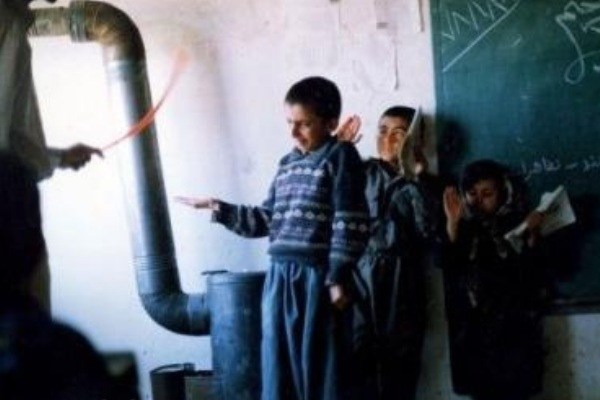
“Teacher’s stick” that is no longer a flower!/ Ahmad Madadi
This is a caption
This is a caption.
Ahmad Madadi
These days, it may be rare for a week to pass without a photo, video, or news related to physical punishment of a student making its way to social media and the media. The leakage of news and videos of physical punishment, often involving male students, the initial denial of school officials, follow-up and interviews, and the presentation of more evidence and documents, the retraction of the denial, news of disciplinary action against the teacher or school officials, or obtaining the consent of the student’s parents, is a repetitive cycle that usually occurs after each “physical punishment” news. The hasty conclusions of those who are distant from the “school” institution are usually framed in a way that suggests the spread of violence in society and its prevalence in all aspects, including the education system. But has physical punishment in schools in the country really increased compared to previous years? If not, then what does all this footage and news and photos indicate about the critical situation in the education system?
Perhaps it is rare to find a teacher – at least in boys’ schools in the country – who has not faced a bloody and bruised student during their years of teaching, either beaten by a classmate or fellow student, or as a result of physical punishment by one of the teachers or school staff. The violence reported in schools is not isolated from the society as a whole, which at various levels is plagued by violence. While in some parts of society, with the rise and fall of development and economic indicators, the amount of violence may increase or decrease, it does not seem that violence in schools follows such indicators. Contrary to public opinion and published news, it does not seem that teachers agree with the statement that “the amount of physical punishment of students in schools has increased”.
The thing that has caused physical punishment to be reflected more in the news and media and forced government officials to react is a widespread change that has created access to social networks in society. Although it may not be possible to prove with reasons that the level of physical punishment in schools has decreased in the country, without a doubt, the “coverage and reflection of physical punishment news” has increased in society. “Students with mobile phones who have turned classrooms into glass classrooms to broadcast their teachers’ smallest behaviors and words in a shorter distance than school breaks throughout the country, a father who posts a picture of his son with asthma on his Twitter account and immediately faces a flood of messages from reporters, and a sister who posts pictures and videos of her brother on her Instagram account with bruises on his body”; all of them indicate a fundamental change in the dominant relationships in social relations, which the outdated structure of the Iranian education institution cannot recognize and therefore resorts to the familiar old ways of denial, intimidation, and threats.
Global Physical Punishment Status
Physical punishment is an undeniable reality in the education system in Iran. “Inheritance” is the traditional teaching method in schools that has managed to maintain its central position in the establishment of modern education institutions and remains a constant companion in classrooms and schools. However, Iran is not the only country facing the issue of physical punishment in schools. According to the final report of the 6th “World Congress on Violence in Schools and Public Policies” held in Peru in 2015, as of May 2015, physical punishment had been banned in 125 countries. Among these, 46 countries have completely prohibited it in all forms, even at home. However, according to this report, there are still 74 countries in the world that have not completely abolished physical punishment in their educational institutions.
The interesting point here is that Iran is among the countries that have banned physical punishment for years, but in practice, it has not been successful in abolishing physical punishment in schools.
Physical punishment in Iranian laws
According to Article 77 of the Executive Regulations of Schools (approved in 1379), “any other form of punishment such as humiliation, physical punishment, and assigning extra assignments for the purpose of punishment is prohibited” and student punishment is only limited to the following cases:
Private verbal reminder and warning
Oral reminder and warning in the presence of students in the relevant class.
- ان
Changing classes in case of having multiple classes in a grade, with informing the students’ parents.
Written notification and information to the student’s guardian.
Temporary dismissal from school with prior notice to the student’s guardian for a maximum of three days.
Moving to another school
According to the Deputy of Parliamentary Affairs of the Ministry of Education for the academic year 94-95, forty cases of physical punishment have been brought up in disciplinary committees for administrative offenses and have resulted in a verdict. These forty cases are a small portion of the hundreds of physical punishments that either go unreported and are resolved with the consent of the parents, or there is no complaint of physical punishment and even the parents have no problem with their children being punished. In a country where physical punishment is not only prohibited and illegal, but also subject to reprimand, warning, and disciplinary and judicial action, why do a large number of schools still resort to illegal physical punishment? Why, despite being legally prohibited, is the cane still considered one of the most important educational tools in many (especially boys’) schools in the country?
Where is the problem?
It is essential to mention that at the school level, there are various levels of violence, one of which is physical punishment, which is imposed by the educational staff against students. Unlike many forms of violence in society, the government and authorities oppose the use of physical punishment legally and practically and try to control it, but a part of society (teachers and sometimes parents) are not willing to cooperate with the government and resist the implementation of the law. Physical punishment against students is one of the indicators and symbols that can show how sensitive our society is towards the use of violence against vulnerable social groups, such as children and adolescents. However, suppressing violence in schools for “intrinsic” reasons and taking direct social and cultural consequences from it does not seem accurate and valid.
A combination of structural and executive factors, along with hardware and software deficiencies in schools, has created a cycle of violence in schools where physical punishment is just one link in the chain. Student violence against each other, as well as verbal and behavioral violence against teachers and school staff, are other links in this cycle of violence that the rules and regulations of the Ministry of Education do not have the ability to confront. Emphasizing one-sidedly on violence against students and highlighting physical punishment, although it is done correctly and points to an important social problem in the education system, will not lead to anywhere without considering other aspects of this violence in schools. It is less common for news of teachers being beaten by students to be published, but the reality is that this type of violence occurs at various levels in schools across the country. The death of Mohsen Khoshkhashi, a physics teacher in Bojnourd, as a result of being stabbed by his student, is a good example to examine the
Who is to blame?
Without a doubt, teachers and school staff are the main culprits for the continued use of physical punishment against students. It is true that a small percentage of teachers themselves engage in physical punishment, and in most cases they delegate it to school administrators. However, the criticism falls on the majority of teachers who remain silent in the face of these explicit acts of violence within the school system. In my ten years of experience in various schools in four provinces of the country, I can confidently say that I have not seen a single case of open opposition to the use of physical punishment by teachers. The most I have seen is a protest against the severity of the punishment used against students. But in addition to teachers, parents of students are also among the main culprits in the prevalence of physical punishment in schools. In my ten years of teaching, I have rarely seen parents who object to the physical punishment of their children in school.
The role of managers and officials in education and training in perpetuating and sustaining this cycle of violence is of a different nature. Although they may appear to be opposed to any form of physical abuse and see themselves as opponents of physical punishment in schools, in practice, their wrong policies and incorrect implementation of educational and training policies actually create the conditions for the continuation of violence in schools. Failure to provide the minimum necessary conditions to prevent violence, such as overcrowding in classrooms, insufficient presence of counselors in schools, neglect of mental health in the workplace for teachers and students, alongside the promotion of theories of violence through curriculum and extracurricular activities such as promoting and advocating non-educational relationships such as militarism in educational environments, are among the factors that have created the conditions for the continuation of violence against children in the education system.
 Created By: Ahmad Medadi
 December 26, 2016
Tags
Ahmad Madadi Boys' schools Child abuse Cycle of violence Education and training Educational staff Mohsen Khoshkhashi Monthly Peace Line Magazine peace line Physical discipline Physical punishment Reproduction of violence Schools 2 Students Teachers