


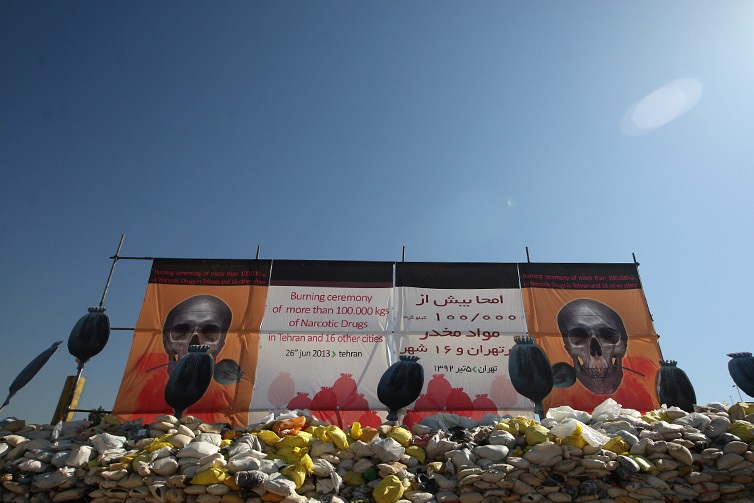
The winners and losers of the drug industry in Iran/ Mehdi Dehghan
This is a caption
این یک عنوان است
This is a caption.
Mehdi Dehghan
The economic problems in Iran have caused the profitable trade of drugs and their smuggling to become larger every day, leading to an increase in the influx of dirty money into the Iranian system and a more severe problem of money laundering. However, in the midst of this, small-scale drug dealers and smugglers are the only ones who face imprisonment and execution from this large table of revolution; a ruling that even lacks a legal basis. According to social and economic experts, 90% of drug dealers and small-scale sellers have turned to this path due to economic reasons, but some officials insist on the execution and hanging of these individuals instead of solving the economic problems.
Of course, with the increase in executions in Iran, this issue has turned into a major crisis and now officials are thinking of ways to prevent the escalation of the execution tsunami, which was announced in Azar 1393. A bill to abolish the death penalty for drug offenders is currently being drafted, but the noose of incompetence of the officials of the Islamic Republic of Iran still hangs over the victims.
According to statistics announced in 2012, approximately 76% and in 2013, approximately 62% of executions in Iran were related to the issue of drugs, and according to statements from judicial officials, this figure has reached 80% in 2015.
Generally, peddlers are executed.
Irj Abdii, a member of the Social Commission of the Ninth Parliament, stated in an interview with the House of Representatives News Agency that with the removal of the death penalty from drug trafficking crimes, “the approval of this plan will reduce the financial burden on the government in the fight against drugs. Considering the severity of the death penalty, the increase in social harms of this punishment for the families of the convicts, the ineffectiveness of this punishment in reducing drug trafficking and addiction, and the fact that drug dealers are usually sentenced to death, the subject of removing the death penalty from drug trafficking crimes and replacing it with other punishments has been included in this plan.”
Abdi emphasized that the death penalty is not a deterrent for crimes such as drug trafficking, stating: “Considering the negative propaganda of international organizations regarding the death penalty for drug trafficking in the Islamic Republic of Iran, it is necessary to consider alternative punishments instead of execution.” Elhiyar Malekshahi, the head of the Judiciary and Legal Commission of the Parliament, also stated recently that it is necessary to review the law related to drug crimes, saying: “Reducing executions for drug crimes is a positive step that should be supported in its implementation.”
Drug mafia
The excessive profit of drug trade has led to the formation of various mafia groups in Iran, creating a safe haven for those involved in this field. We are still witnessing the irony of losing our national assets, such as oil wells or oil rigs, while there is never any talk about the behind-the-scenes of the highly profitable drug industry, the big players and the dirty money that follows. Addicts and small-scale traffickers are also the main victims and losers of this industry. Addicts, who are like profitable oil wells, and in this cycle, big players connected to power and wealth, small-scale sellers, and addiction treatment centers all profit from it. In the midst of all this, the judicial system of the Islamic Republic of Iran imposes the harshest punishments, including execution, on traffickers and small-scale sellers, while turning a blind eye to the big players and main actors of the drug mafia connected to wealthy and powerful institutions, and it is the people who must pay the price for
According to research, the global drug trade generates an income of over $600 billion. Generally, euros and dollars are laundered by “special” individuals and used in legal activities. These special individuals can be owners of organized banks and economic enterprises. One of the reasons for concern among officials is Iran’s removal from the FATF blacklist, which highlights the need for transparency and more precise addressing of the issue of money laundering in Iran.
It should be noted that Abdolreza Rahmani Fazli, the Minister of Interior, attended the open session of the parliament last month to present a report on dirty money. He warned about dirty money from drug trafficking and money laundering, and following that, in a statement from the Anti-Drug Headquarters, the impact of dirty money from drug trafficking in all areas, including politics, was warned about.
The income from drug trafficking equals one year of subsidies!
Recently, Ali Hashemi, the head of the independent committee for fighting against drugs in the Secretariat of the Assembly of Experts, announced in an interview that the amount of money generated from drug trafficking is at least 40 trillion tomans and the annual sales of smugglers is 16 to 17 trillion tomans. In other words, the income from drug trafficking is equivalent to a year’s worth of subsidies. With such statistics, the question arises of how money laundering is carried out in this trade. Of course, Iranian officials are well aware of the answer to this question, but addressing issues such as transparency, identification of money transfers, money laundering, etc. are considered red lines for the system.
The research conducted on money laundering clearly shows a strong relationship between official and illegal economies. Currently, the drug industry has spread its roots in all provinces of the country. Drugs are one of the most heinous and concerning issues of the present century worldwide. There is a direct correlation between crime and drug use, with more than 50% of crimes being linked to drug use.
Currently, drug trafficking has taken on an organized commercial form, which moves large amounts of capital, employs a significant workforce, and uses corrupt practices or threats and infiltration of skilled labor. Today, all kinds of drugs are produced for a market that, according to statistics provided by the United Nations, has over 250 million occasional or permanent consumers, all over the world.
A challenge called “neighborhood with Afghanistan”
Afghanistan, Iran, and Pakistan are known as the “Golden Crescent”. Iran, due to its geographical location and proximity to Afghanistan, which is recognized as the largest producer of opium in the world, plays a significant role in the transit and trafficking of drugs, which has led to a significant financial flow. The added value of trafficking each kilogram of opium from the borders of Afghanistan to the retail markets is more than 4 times the purchase price from Afghan sellers.
Due to the significant difference in the price of drugs between Iran and European countries, the profits from this trade can increase up to tens of times, motivating smugglers to overcome any obstacles in their way to transport drugs to the farthest corners of the world. As a result, smugglers resort to various methods such as creating organized groups, spreading corruption, and using bribery systems to facilitate their operations and transfer drugs to different countries.
Currently, the level of trafficking and consumption of crystal meth in the country has decreased, while the consumption of industrial drugs has increased. Although the use of industrial and chemical drugs is not as old, a review of the discovery of these types of drugs shows a growing trend among drug users to use industrial drugs; to the point that the consumption of traditional drugs such as crystal meth has decreased over time and has been replaced by glass and crack. In the meantime, the change in the discovery rate of some types of drugs such as cocaine and marijuana does not follow the above rule.
For example, the increase in the discovery of glass or crystal indicates a multiple increase in the consumption of this type of drug, to the extent that according to the former head of the NAJA anti-narcotics police, in 1387, the discovery of glass increased by 440 percent compared to the previous year.
We have witnessed a significant increase in the discovery of industrial drugs in recent years in this village. Based on the hypothesis that the amount and composition of these discoveries are dependent on the combination and amount of consumption by users in society, it can be acknowledged that the consumption curve for industrial drugs has a steeper slope compared to traditional drugs.
In a situation where Iran’s economy is facing difficult times both in terms of coping with the consequences of new economic policies and the imposed sanctions, even the slightest cost regarding drugs can be seen as an increase in economic pressure on individuals who are not facing the phenomenon of addiction. On the other hand, in such circumstances, how should the issue of drugs and addiction be dealt with and in what direction should it regain its stability? Will continuing heavy punishment policies and executions be successful in eliminating the problem in recent years?
Most economists believe that changes in policies and strategies are not only influenced by changes in the prevailing conditions of variables and components that cause fluctuations, but in some cases policymakers are forced to make changes in their strategies and policies in order to achieve their goals.
The development of a Muslim society cannot be achieved without relying on human and physical resources. In a young society, in the midst of drug trafficking, where drug addiction is a common social problem, development cannot be achieved without eliminating the death penalty and striving to minimize this issue and providing opportunities for everyone to participate in development programs. Therefore, the only way to address the issue of drugs is to change strategies and policies in this area. In the current situation, with the prevailing conditions and the damages caused by drugs on society, development, preservation of human dignity, expansion of social welfare, and social security will only remain as slogans, as a part of society is involved in a matter that is not in line with these concepts. Therefore, preventing the escalation of the execution tsunami will not be possible without considering fundamental changes in the law on combating drugs and eliminating the death penalty.
Is execution the solution?
Society, which includes non-drug users, in addition to being burdened by the costs of drug users and actors in the field of drugs, are also affected by the government’s performance and are forced to pay some of the costs. These costs include a wide range of government actions, from positive actions to those resulting from poor government performance. For example, when the law sentences a smuggler to death, although on the surface the society may find peace with his elimination, the families of smugglers rarely have a positive view of losing their breadwinner. Considering that drug smuggling is so profitable that the smuggler is able to meet the needs of his family, his execution naturally intensifies dissatisfaction among his family and turns them into dissatisfied members of society. This population has increased in recent years.
The calamities that have befallen Iran over the past few decades.
According to research conducted in 1332, the number of drug users has been estimated at 1.5 million out of a population of 15 million people aged 16 and above. Based on this, a budget of 6 rials per person per month was allocated in the annual budget of that year for the treatment of these individuals. In 1975, Gen-Harold estimated the number of Iranian addicts at 400,000. Additionally, Savak (the National Intelligence and Security Organization during the years before the Islamic Revolution) has estimated the number of users at 1.5 million. Official government sources have announced the number of addicts and drug users to be 2 million during the 1370s decade. Unofficial estimates, both inside and outside the country, suggest a number of 3 to 7 million drug users.
The Ministry of Health and Medical Education in the “Epidemiology of Substance Abuse in Iran” project, which was carried out by the Health Deputy of this ministry in collaboration with the Anti-Drug Headquarters in 1381, announced that the number of drug users in the country was 3.76 million. However, now different statistics are being announced that do not match the reality of society. The existence of multiple estimates indicates that obtaining information about the number of drug users and addicts is the most necessary step in drug-related research; a subject that officials of the Islamic Republic of Iran are afraid to clarify and announce.
 Created By: Mehdi Dehghan
 September 25, 2016
Tags
Addiction Afghanistan 2 Black market Crime Drug trafficking Drug trafficking 2 Execution Income from drugs Laundry Magazine number 65 Mehdi Dehghan Monthly Peace Line Magazine Narcotics peace line Smuggler Triac اقتصاد