


Soft Obligations; The Story of Life of Peyman-Parisa/ Amirhossein Zolghadri
This is not a complete sentence, so it cannot be translated accurately. Please provide a complete sentence for translation.
Amirhossein Zolghadri
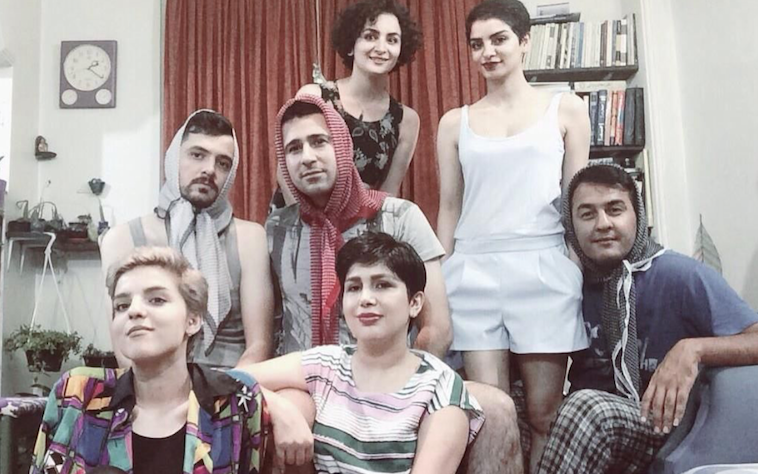
If you visit the page of Youshaki’s Freedoms today, you will not only see women who have removed their hijabs in public places to protest against its mandatory nature, but you will also see images of men wearing hijabs, to say that mandatory hijab denies the rights of all Iranian citizens on their bodies.
The new challenge of this page, for me as an outsider, has a meaning beyond just protesting against mandatory hijab. It is a protest against all forms of forced masculinity and femininity. That is why I did not find it appropriate to share the experiences of a boy who has been imposed with hijab and other things that are considered feminine in our society.
When I was in Iran, I had the chance to hear the life story of a person named Peyman. Perhaps if I didn’t base my social interactions on my true identity most of the time, I would have never heard this story and it may have never been told, just like many other stories.
The story of getting to know Piman.
Seeing a woman freely riding as a passenger on the Qom-Tehran highway was interesting to me. For this reason, I decided to get in her car among the cars that were looking for passengers in “Seventy-Two Tons”. I sat in the front seat, but it seemed that luck was not on her side and no one else got in her car except for me.
Two steps further, a clergyman and his two friends were busy checking and adjusting their cars, as if they had not agreed on a price with anyone. But they didn’t come near the car I was in. Until the female driver, who was fully covered, shouted, “Do I look like a beggar to you, sir?” They scowled even more and went to find another car.
When I saw this scene, I decided to go to Tehran in a closed form.
During the journey, that lady couldn’t control her curiosity and asked me, “Why did you come to Qom with this outfit (hat and tie)?” I also engaged in conversation with her and brought the discussion to where I wanted it to go, “Equality of rights and dignity for individuals regardless of their differences.” And she, who had trusted me, talked about the challenges of her job and her own story – “Peyman” – where she had to be “Pari”.
For example, one of these challenges that was a nightmare for him every night, is the scene when the police stop his car and reveal his true identity as a man, and then he is unable to convince the police. Because of this, he has many restrictions in the lines he takes as a passenger.
Peyman said: “No one loves me except God. The fact that no one has stopped me on the road during these four years and asked for my identification card is a blessing from God.”
“Peyman speaks of his loneliness and not being able to have a companion. Although he had previously fallen in love with his relatives’ daughters, he does not think he can fall in love now because of a secret he holds.”
He had a few male suitors, but he doesn’t have any feelings towards men and unfortunately he hates them and feels insecure around them.
Peyman doesn’t know exactly what being transgender means, but in his words he always refers to the fact that he doesn’t see himself as a woman, but society sees him as one and in order to survive in Iran, he must act like a woman most of the time, not Peyman. But when I mention gender reassignment to him, he responds with a humorous tone: “If I can live without fear by cutting off this flesh and even without any sexual desire, I’m willing to do it.”
I don’t know what decision Peyman has made for his life today, whether he has changed his gender like many others or not; but I know that if society respected the uniqueness of people’s identities, he would remain Peyman.
People’s words
Peyman was born in Shiraz, in a family of artists where the santur was always playing in their home. However, Peyman’s voice was not suitable for them. He says, “Since I was about ten years old, they told me that my voice and way of speaking were feminine, but as I grew older, things got worse. Everyone told me to speak like a man, but I really didn’t know what to do and how to be the way they wanted me to be.”
The translation of the Farsi text is: “The image on the right is 300 pixels wide.”
Photo of the National Day of Iranian Sexual Minorities page.
I, who have faced a challenge similar to what he has experienced in my personal life, ask him: “Did all the problems end with your voice?”
Peyman says: “No! Since childhood, even though they made fun of me for being skinny and my crooked fingers, comparing me to all kinds of cartoon characters, but until I was in high school, they never said that your body is also like your feminine voice and you are not a man at all.”
The pressures that family and relatives put on a person from childhood to youth because of their appearance, make them lose hope in receiving help from their family to go to university. In order to not be unemployed and homeless, they settle for a high school diploma and choose to go to the military.
Fate takes him to South Khorasan and his military service – which he describes as exhausting – is completed there. He says, “During my military service, I would visit home, but when I received my discharge papers, I wrote a long letter to my family and left it with my diary on the shoe rack and left. Although I had made friends in different cities, I didn’t know where to go. I just had a feeling that Mashhad is a safe place; that’s why I bought a bus ticket and left.”
After several days of displacement and hardship, Peyman finally leaves the refugee camp and goes to the home of one of his friends – whom he had met during his military service – but after a few days, he is assaulted by a group. Trembling, Peyman says, “I am not gay and I have never been attracted to any man. I know I am a man myself, but others do not see me as one. That’s why I have faced so many troubles until now.”
After the invasion, Peyman decides to go to Tehran to find a better life due to the fears he had, but after a while the only thing he can do is selling drugs.
He continues like this: “I have never used drugs myself, but due to poverty, I was forced to do it, which is not easy at all and has many difficulties and dangers. I was very simple and fearful and had no creativity, I just did whatever I was told. I regretted it very soon and felt guilty.”
Peyman says he has found a new way that “has helped me stay alive so far” and explains it as follows: “The person who used to give me goods to sell would call me by a feminine name. At first, I would get upset, but later, because of his friendly behavior, I no longer got upset. It was the first time in my life that I didn’t consider being called by a feminine name taboo and I didn’t have a bad feeling about it. Later, when I was forced to wear mandatory hijab because of the guidance patrol, so that others wouldn’t think I was a girl dressed in boys’ clothes, I officially became a fairy and have remained one until today. Going out in women’s clothing, which I don’t consider feminine myself and only see as a type of clothing like my boys’ clothes, was the best experience of my life that I had during its most bitter period. In other words, it is better to say that I
I ask: “Did you mention the tour of Arshad, do you have a bad memory of the tour of Arshad?”
She says: “Yes! Not much! I haven’t been in Tehran either! But the incident that made me wear the hijab was when a member of the Guidance Patrol in Tehran stopped me and I had some materials in my backpack. I was very scared but I controlled myself and told myself that I have my documents with me as usual and I don’t have any specific clothing or hairstyle, maybe they think I’m a girl! In short, I showed him my ID and he didn’t put me in the van, but from then on I became a chadori.”
Peyman no longer sells drugs today and has mortgaged a small house in Tehran. He owns a Pride car which he uses to transport passengers from Tehran to other cities. He is satisfied with his life and considers himself successful for the efforts he has made to continue living. However, the effects of past wounds still linger in his heart. Although everyone knows him as Parviz, he sees himself as Peyman.
The contract is not homosexual or trans, but the norms of Iranian society have turned him into a minority and caused many problems for him. These problems should be solved by the society around him, not him, and fortunately it seems that these days, a part of the Iranian people are trying to challenge the culture of male dominance and solve it, and perhaps in the future, people like Peyman will not be forced to pay a high price for living.
Explanation:
1- Piman is a pseudonym that the author has chosen in order to preserve the individual’s identity.
2- The words of the contract have been transferred to the content.
 Created By: Admin
 August 23, 2016
Tags
"Gender identity" "Slow Freedom Campaign" Compulsory hijab for men Monthly magazine issue number 64 Monthly Peace Line Magazine Others sexual Qom-Tehran Highway Slowly, women's freedoms in Iran Transcendental