


You have a slave in the world and Iran, intellectual and historical backgrounds/ Mohammad Mohabi.
According to a report by a global foundation, currently around 46 million people are victims of modern slavery. The Walk Free Foundation, which is working towards eradicating slavery, has surveyed 167 countries and states that more than fifty percent of modern slavery victims live in India, China, Pakistan, Bangladesh, and Uzbekistan.
The beginning of the era of slavery in human history is not very clear. According to the Encyclopedia Britannica, “We have evidence of slavery dating back to the eighth century BC.”
Slavery was prevalent in ancient Greece and Rome. According to Will Durant, “around 30 years before Christ, the number of slaves in the city of Rome was estimated to be four hundred thousand, or half the population of Italy to be one million and five hundred thousand.”
Christine Sen, a Danish orientalist, writes: Iranians usually had their hands tied behind their backs and were sold as slaves.
Slavery was also permitted in the Jewish religion; as we read in the Torah: “You may purchase slaves and maidservants from the surrounding nations. You may also purchase the sons of foreign visitors who reside among you, and their families who are born in your land. They will become your property and you may pass them on to your children as inherited possessions, making them slaves forever.”
In Christianity, slavery was also accepted. Saint Paul writes: “O slaves! You should know that as animals, you must obey your master with simplicity of heart.” Plato also considered slavery as a divine punishment for slaves.
James Hawks, a famous priest, writes: “The Holy Gospel of Jesus Christ never speaks about the release and freedom of slaves, but rather, it commands slaves to obey their masters and their masters’ families.”
In Islam, although slavery was common in the Arabian Peninsula (the birthplace of Islam), a fundamental change in the rights of slaves can be seen. While slavery was accepted and even the Prophet and the Rashidun caliphs had slaves, Islam placed slaves on the same level as free individuals in terms of social and human status, and piety was the measure of a person’s virtue. However, this text does not discuss the practical effects on human rights.

The system of slavery remained in force until the first half of the 19th century, but from that point on, the movement for its abolition began worldwide. In France, it was prevalent until the revolution of 1848, in the Netherlands until 1863, and in America until 1860. However, after the bloody wars between the North and South on this issue, the system of slavery gradually declined. The Southern states, due to their desperate need for slaves to manage their agriculture and farming, were in favor of maintaining the current situation and clashed with the Northerners. After four years, these wars ended in favor of the North and slavery was abolished in America. These conflicts are known as the “Civil War” in history.
One of the famous historians writes: “The people of Greece had many slaves, who were taken from prisoners of war, captives of raids, street children, homeless children, and criminals.”
Historical journey of slavery factors
The factors of enslavement and freedom must be eliminated in the presence of those who deprive others of their freedom, among those who have deprived themselves of this right for no reason, and in the types of systems that govern humanity. The root of the emergence of slavery and, so to speak, the “causes of its creation” can be found in the following subjects:
A- The spirit of employment in humans: According to Sigmund Freud, “humans are naturally servants and exploiters”. As a result of mutual employment in the field of action, humans neutralize each other or employ each other in some way. The extensive needs of humans require such interaction, but the difference between rational and physical powers, as well as the social and economic power of some elites, has led the powerful and intelligent members of society to enslave or trade with the needy and weak through deceit, trickery, coercion, or through the stage of slavery.
B- Weakness and Submissiveness: Powerful individuals have always been the role models and masters of the weak in some societies. Some people, due to fear of social and natural disasters, or the inability to meet their basic needs, seek refuge and support from other human beings and see themselves as parasitic and dependent beings. This attitude has led them to give up their independence and serve the powerful through force and deception.
C- Tribal Wars: Some believe that the main origin of slavery should be sought in tribal wars. In these futile battles, heavy casualties were usually inflicted on both the victorious and defeated sides, and they believed that the best way to compensate for the losses was for some elements of the defeated tribe to be put to work, which gradually led to the ownership and enslavement of humans.
Of course, nowadays, slavery caused by war is also common and prevalent in the form of forced labor camps; although not as severe as before and international laws have somewhat prevented it, the exploitative spirit within human institutions has not allowed the system of slavery to become obsolete.
D- Punishment of Criminals: The development of human societies and relationships between individuals at certain points in history led to conflicts of interest and the need for laws to punish criminals. Owners of stolen property would force thieves into slavery and say, “The punishment for a thief is to accept slavery to the owner of the property.” Similarly, a creditor would make a debtor who could not pay his debt into his own slave. In cases of injury or murder, the killer and the one who inflicted the injury would be employed by the injured or the heirs of the deceased to carry out their work.
The Philosophical Origin of Slavery: In the past, some thinkers considered slavery to be an inherent matter for slaves. Some Greek philosophers believed that humans are fundamentally divided into two categories: free people and slaves, with the latter only created to serve the free group.
Aristotle considered slavery to be one of the necessities of human society and emphasized that the government should only use slaves. Therefore, the ancient Greek class system dictated that administrative positions and government and parliamentary positions should be reserved for pure and free Greeks, while menial tasks such as farming, animal husbandry, mining, bridge building, and transportation were left to slaves, who were often prisoners of war or descendants of slaves.

Aristotle believed that the white race or the Greek race, is a superior and constructive race, and other races do not have the same abilities and should be enslaved or kept in servitude like animals.
The Indians believed that because slaves were created from the feet of the gods, they were lowly creatures deserving of humiliation and must be subjected to all kinds of degradation, torture, and hard labor, unless according to the “law of reincarnation,” their lowly souls would be elevated through suffering and pain and eventually be reborn into the bodies of the ruling and wealthy. This was also the case among the ancient nations of the Chaldeans, Assyrians, Egyptians, Persians, and Jews. The Arabs also enslaved prisoners of war, even if they were of their own race.
The history of slavery in Iran.
The word “bondage” in ancient Persian language is “varteh” (captive), in Avestan language “variteh”, in Middle Persian “vardag” (captive and prisoner) and “vardagiye” (slavery), and in Pahlavi texts, the term “enshahrig” or “bande” is often used to refer to a slave.
Among women, there was an official practice that allowed a man to become a servant and be provided with daily food by a wealthy man. Such a person had the status of a slave, but if his master did not give him enough food, he could leave him at any time. During the formation of their government (in the first half of the 6th century BC), the Achaemenids only recognized this simple form of slavery and did not consider slave labor economically important. Many slaves who worked as household servants for the Achaemenids and Persians (such as bakers, cooks, cupbearers, and stewards) were also taken from among representatives of defeated nations. The Achaemenids would buy a certain number of these slaves from slave traders.
Military slavery was a known phenomenon during the Sassanid era, but since the Sassanid army relied on a cavalry of armored and free men, if there were any slaves, they were part of the insignificant group of foot soldiers, where conscripted soldiers, consisting of villagers and other lower-class individuals, had a major role.
In summary, slavery has been common in Iran, just like in other parts of the world. It continued even after the advent of Islam among various ruling governments.
In the 11th century AH, European travelers were influenced by the abundance and power of the slaves of the Safavid court and the homes of the nobles. According to Shariden, there were about three thousand of them in the court and some were with lords and wealthy people. They were called “laleh” or “ustad” out of respect. They were bought at a high price and most of them were white-skinned people from the port of Malabar in India.
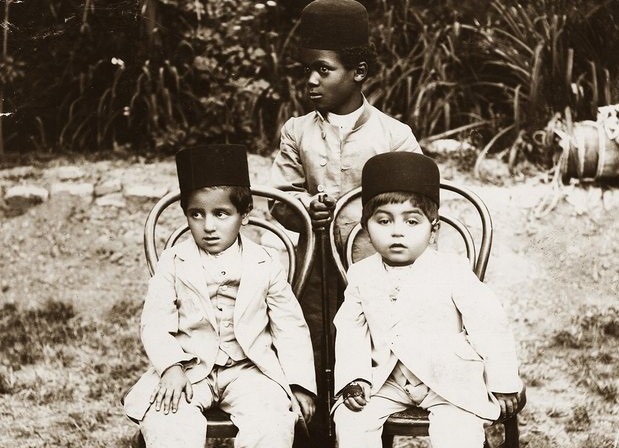
The first attempts to abolish slavery in Iran began during the reign of Naser al-Din Shah Qajar. In 1265, Naser al-Din Shah banned the importation of black slaves into Iran by sea.
“این عکس یک منظره زیبا از کوهستان است”
This photo is a beautiful landscape of the mountains.
“Slave in Qajar – Photo of Guardian”
In the year 1268, Iran and England signed a treaty which allowed English ships to inspect Iranian ships in order to find slaves. According to article thirteen of the peace treaty dated 1274 between England and Iran, the right to inspect ships was extended until 1290. However, these treaties did not have a significant impact on the amount of slave trade, and this trade only decreased to some extent due to stricter maritime inspections after 1287. Under a new treaty signed in 1300, England’s authority was expanded; the slaves found on Iranian ships were freed and the court responsible for prosecuting the Iranian ship owner’s crime had to be formed in the presence of a British consular representative. Iran also participated in the Brussels Conference in this year regarding the abolition of slavery.
As a result, in 1307, Iran banned the trade and import of slaves, both by sea and land. In 1328, the slave trade was officially stopped by law; however, it still existed for a while until it was completely abolished at the end of the Qajar period. Iran officially committed to abolishing slavery by joining the 1926 Geneva Convention and the Universal Declaration of Human Rights (1948).
An Overview of Slavery in Iran: A Look at the Footnote of Akhvan-Sa’aleth’s Commentary on Hajji Firuz.
There is no doubt that the concept of freedom is widely seen in Iranian literature and culture. However, Iranian society is fundamentally inflexible and its relationships are based on social class. As William B. Mehn states in his book “Language, Power, and Status in Iran,” Iranians have a friendly and intimate relationship with those of equal status, a subservient relationship with those of higher status, and an unjust and sometimes disrespectful relationship with those of lower status.
One of the symbols that is considered a symbol of racism and slavery in Iranian culture is the character of Hajji Firuz. Mehdi Akhavan Sales, in a footnote in his poem “Arghanoon”, by showing his disgust for Hajji Firuz, has called it “the remnants of the hateful covenant of savagery and slavery.”
Haji Firouz is a legendary figure in Iranian folklore who appears in the first days of each year, alongside Uncle Nowruz, to announce the arrival of the new year to the people. He is a tall and dark-faced man, wearing a conical hat, pointed shoes, and a red outfit. He comes to the streets with a tambourine and a drum, dancing, performing sweet acts, and singing traditional songs. Some believe that these symbols do not represent a free person and were usually slaves in ancient times.
The writer believes that this interpretation of the third brother is not without flaws. Mehrdad Bahar, an Iranian writer and researcher, considers Hajji Firuz to be associated with the celebrations of Siavash. According to him, it is believed that this figure is derived from one of the myths of Tammuz, the god of agriculture and quadrupeds, in ancient Mesopotamia. He then states that the blackened face of Hajji Firuz is a sign of his return from the land of the dead, and his red robe represents the blood of Siavash. He also suggests that the word “Siavash” can mean “black man” or “dark-faced”.
Katyoon Mazdapour, a mythologist and master of ancient languages, has said in an interview that she confirms the translation of the Akkadian tablet and credits the idea to Mehrdad Bahar. In the tablet, it is mentioned that Dumuzi (the husband of the goddess Inanna), for half of the year, goes to the underworld wearing a red garment and playing the circle drum, the lyre, and the flute, to bring back his wife; and this story signifies the beginning of fertility on earth.
It seems that it is not possible to trace slavery with ancient and cultural-historical symbols of Iranians, and it is not logical at all. Iran, like other countries, had slavery in the past and it seems that we should work on the current culture of society so that people do not have a sense of pride and self-importance through job and family status, etc. In today’s Iranian society, there is no equal view between individuals and different professions. The rights of some social classes are neglected. Some business owners, in order to avoid having Iranian labor laws in their workshops, use deceitful methods and hire immigrant workers, including Afghan immigrants, without insurance and minimum wage. Whenever business owners pay the rights of Afghan workers according to the law, without legal supervision and through moral coercion, then we can claim that there is no sign of slavery culture in Iranian society.
 Created By: Mohammad Mohebi
 July 24, 2016
Tags
Boarding system Magazine number 63 Mohammad Mohabbey Monthly Peace Line Magazine Qajar dynasty 2 Servitude Vak Free Foundation You have a modern slave. You have a servant in Iran.