


Mother of the mourning and four decades of mourning mothers/ Ali Ajami
In memory of the passing of one of the mothers of the East.در اینجا ما در حال لذت بردن از طبیعت هستیم[/caption]
Here we are enjoying nature. Ali Ajami
Find me, mother.
Last night you came to my dream
I stayed in your wish
You held my hand in your hand
I wiped your tears, mother
The glasses shattered
My hands were soaked in blood
Come to me, mother, come to me
Two police on both sides of me
Handcuffs on my hands
Find me, mother, find me
Last night you came to my dream
I shed tears from your eyes
I fell on your chest
Did your soul not burn, mother?
The glasses shattered
My hands were soaked in blood
Come to me, mother, come to me…
A song by Ahmad Kaia, translated by Yashar Yagish.
من میخواهم به دانشگاه بروم
I want to go to university.
In the month of Dey that passed, our mother, Behkish (Nireh Jalali), from the mothers of the East, left us forever. Behkish lost five children and her son-in-law in the executions and conflicts of the dark years of the 1960s; Mohammad, Siamak (her son-in-law), Zahra, Mohsen, Mahmoud, and Ali.
Nothing can describe what happened to his mother better than this sentence: “I spent most of my life in front of prison gates to visit and in cemeteries.”
This is a caption for an image.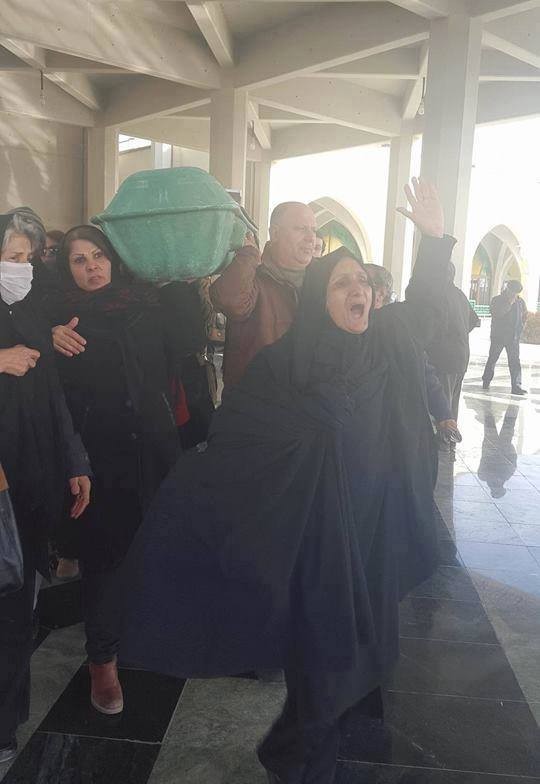
Mother Star of Paradise, in advance, the coffin of Mother Behkish.
Mother Behkish never saw the funerals of her children, she was not present at their burials, and the only thing she had was a bag and their prison belongings. And of course, a shared cemetery with all the grieving mothers of the East. And so, Mother Behkish became a mother of the East, she became one of the grieving mothers, mourning and seeking justice.
But whose shoulders carried the coffin of the mother? The mother of Saeed Zinali, the mother of Setareh Beheshti, the mother of Mostafa Karim Beygi… Although the experiences of cruelty in the East have never been repeated in the Islamic Republic – and will never be repeated in the history of Iran – the process of mourning for mothers has continued and each decade of the Islamic Republic has represented itself in the burial of the mother.
Saeed Zinali’s mother lost her child in the 1970s. Mustafa Karim Beygi’s mother received her son’s blood-stained body ten years later in the 1980s, and the precious gem of love that she had lost the star of in the early years of the 1990s; the current decade.
This is an image caption.
Mother Saeed Zeinali, mother of Hossein Akhtarzand, mother of Mostafa Karimbigi.
Mothers of the East and then “Mothers of Laleh Park”, have been a group for mourning and grieving for the victims of similar and shared experiences, but more importantly, throughout all these years, it has been a space for protesting against this level of injustice and oppression and a place for seeking justice.
But during these four decades, the voice of mourning mothers has not been heard and their numbers have also been added. It must be said and written and shown that the reality is that until someone gives the right answer to the mourning mothers, until the perpetrators of these crimes are identified and brought to trial, until a mother with a picture frame in her hand and a complaint and a question in her eyes stares at us, we cannot remain silent and look away. We must speak and write…
 Created By: Ali Ajami
 January 25, 2016
Tags
Ali Ajami Monthly Magazine Issue 57 Monthly Peace Line Magazine Mother mourners Mother of Paradise Star Mother's love Mothers of the East The mothers of Laleh Park