


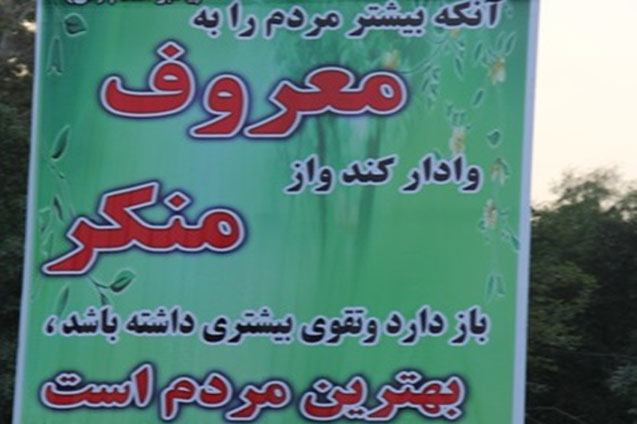
Enjoining good and forbidding evil and the authority of religious identity/ Behzad Mehrani
“Enjoining good and forbidding evil holds a special place in the intellectual and practical framework of Muslims. Although this action is not a religious decree, it is considered a fundamental principle in Islamic jurisprudence. Many Muslims believe that performing these two actions is necessary for the preservation and survival of the religion’s essence and foundation. It seems that without enjoining good and forbidding evil, the religion of God does not have any support or assistance in the external and social realm. Therefore, these two actions are the means of preserving the religion and preventing it from deviating. This is why the responsibility of enjoining good and forbidding evil is not only on specific individuals, but on the entire religious community, as it is a religious duty for all believers to preserve the religion. Avoiding religion does not only harm the non-believers, but also causes harm to both the dry and the wet. “
Shiites believe that as a branch of Islam, Imam Hussein, the third Imam of the Shiites, who holds a special status among this religion, did not have any goal in his uprising against Yazid other than reviving the tradition of enjoining good and forbidding evil. They base this claim on Hussein’s words in his will to Muhammad ibn Hanafiyyah, where the third Imam of the Shiites explicitly states that the purpose of his uprising is nothing but reforming the affairs of his cousin, Muhammad, who has fallen into corruption and has no concern for enjoining good and forbidding evil: “I have only risen to seek reform in the nation of my grandfather, Muhammad, may Allah’s peace and blessings be upon him and his family, and to enjoin good and forbid evil…”
In a religious society where religion is the only factor and inevitably the most important element in maintaining the collective identity, enjoining good and forbidding evil is a mechanism that strives to prevent any part of the society from deviating from this religious identity and breathing in an atmosphere other than the religious space. In such a society, any individual or group that seeks to harm this unity of identity is considered anti-religious and corrupt, and the mission of a faithful human being is to resist anything that goes against religion and inevitably causes harm.
In modern society, which has distanced itself from the traditional and single-identity pre-modern society, no single identity can be the basis for social cohesion. Therefore, commanding good and forbidding evil cannot be a means of promoting cohesion between multiple identities. It should not be forgotten that commanding good and forbidding evil refers to actions that are either commanded or prohibited by religion, and for the modern individual, religion is not the sole factor in shaping identity and promoting cohesion. On the other hand, with the formation of the modern state, what is considered necessary is whatever has been legislated, and this legislation does not necessarily stem from religious beliefs, as religion has been replaced by citizenship. Therefore, not adhering to religious principles and rules does not necessarily mean denying them, and following them is considered commendable. Not following laws based on collective reason may have consequences for the individual, but these consequences do not affect other citizens, as the offender’s dealings are with the judicial system and punishments such as
If we accept that in the new world, humans are not monolithic, we will see that preserving religious identity as a dominant and overpowering identity fundamentally has no meaning.
The religious reform movement, which has made great efforts to establish compatibility between religion and the modern world, has discovered this contradiction in today’s world. Part of this influential movement initially attempted to argue that what the new world recognizes as tools and mechanisms of power control are the same as what is known in the religious system as enjoining good and forbidding evil; free media, independent parties and press, are tools of power control and the modern human uses these powerful tools to enjoin good and forbid evil. However, as this ideological-political movement progressed and the religious government of the Islamic Republic extended its dominance over all aspects of personal and social life, efforts were made to remain silent about the effectiveness or ineffectiveness of enjoining good and forbidding evil in the new world and only to say that what the Islamic Republic and fundamentalist groups impose on the people, especially women, is not the true and accurate meaning of enjoining good and forbidding evil. But there has not been much discussion about
It must be said that the term “shura” in religious thought does not mean democracy or parliament, and just as the medicine of Imam Reza and Imam Sadiq have no relation to modern medicine, and the same way that Quranic geology and cosmology have no relation to modern sciences in these fields, and therefore, enjoining good and forbidding evil is not the fourth pillar of democracy or any similar concept.
“Enjoining good and forbidding evil is a tradition that belongs to the world, where religion was once the only identity for individuals and deviating from this identity was an unforgivable sin and a great denial. Today, even the religious individual is not solely defined by one identity and therefore, enjoining good and forbidding evil cannot be a defender of any collective or individual identity.”
Above all, religion is a personal matter for the new human being and enjoining good and forbidding evil in its verbal form – commonly known as being gentle – is nothing but forcing a specific lifestyle, appearance, behavior, and effort in both individual and social spheres; the same thing that is colloquially referred to as nosiness.
Adopting a lifestyle and attitude with a pleasant language – which is considered the first step of enjoining good and forbidding evil among some believers – is called verbal enjoining of good and forbidding evil. If the worker does not fall on the believers, they will enter into harsher phases. In the non-verbal form, enjoining good and forbidding evil becomes what the guidance circles have brought upon the people of Iran in the thirty years of the Islamic system’s life, and the acid attacks on women are another – although very harsh – form of enjoining good and forbidding evil.
“Enjoining good means imposing a way of life and a type of identity on others, whether through kind words or through violence.”
 Created By: Behzad Mehrani
 December 25, 2014
Tags
Behzad Mehrani Enjoining good and forbidding evil Magazine number 44 Monthly Peace Newsletter, Issue 44