


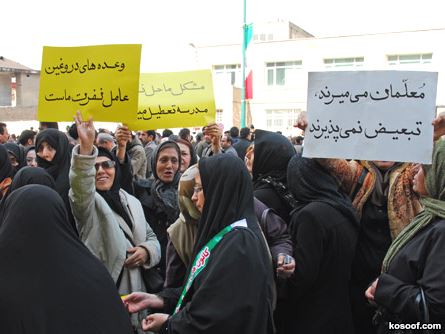
Union of the Missing Ring to Solve Teachers’ Livelihood Problems / Mohammad Habibi
The World Education Organization has organized a campaign this year called “Unity for Quality Education”, which, according to this organization, has united 20 million teachers, trainers, and employees in the field of education around the world. One of the main goals of this campaign is to emphasize quality education as the main focus of government and professional planning from 2015 onwards. In this campaign, teachers and their unions have been asked to take serious action in three areas of quality education; quality teaching, quality teaching tools, and quality learning environment.
It is clear that quality educational tools and a quality learning environment are essential in the realm of duties and responsibilities of governments and educational organizations (which is beyond the scope of this article), but quality teaching is directly related to the duties of teachers. Considering their duties and acting upon them means that teachers are actively involved in the learning process of students. This involves learning about oneself, changes in their field of work, societal expectations, and most importantly, learning about their students and methods for empowering them in their growth and progress.
Performing these tasks correctly, systematically, and optimally, considering the complexities of this profession, is dependent on various factors, the most important of which are the physical and mental health of teachers. This variable has a direct relationship with the economic situation and livelihood of teachers. A situation that has been unstable and sometimes critical for Iranian teachers in the past decade. With the end of the eight-year war and the implementation of economic adjustment policies in the last years of the 1990s, along with the increase in class divisions in Iran, we witnessed a special situation in the living conditions of Iranian teachers, which can be referred to as the “salary gap.” This means that with the implementation of economic adjustment policies, gradually the salaries and wages received by teachers became lower than the average level of official employees in other government sectors. This trend continued in subsequent governments, to the point where it led to public protests by teachers in the years leading up to the Reformist government, which we will discuss further.
The implementation of the coordinated salary payment program in the previous government was actually a hasty reaction to reduce teachers’ protests. The program, like other policies of the past thirty-five years, was carried out without any clear achievements and not only did it have no positive impact on the teachers’ living conditions, but it also paved the way for problems and irregularities in the teacher salary payment system. Changes in governments, replacement of ministers, and the appointment of new staff and organizational managers have not had a positive impact on reducing teachers’ economic problems. In the past year, with the change of government and as a result of the contractionary policies of Rouhani’s cabinet and the dire economic conditions caused by sanctions, some teachers, especially elementary school teachers and non-official educators, have been put in a situation that can be described as a livelihood crisis. Considering the mentioned issues, the main problems of the Iranian teachers’ community can be summarized as follows. It should be noted that these problems have existed for
1- Decrease in purchasing power of teachers over the past year
According to experts, a comparison of salaries and expenses over the past 35 years shows that government employees’ salaries have increased by 100 to 150 times, but during the same period, the prices of goods and services needed by the people have increased by more than 300 times. In other words, the purchasing power of government employees has been reduced by half. (3) Among them, teachers have always been in a more vulnerable position in terms of purchasing power compared to other government employees due to the widening gap in salaries mentioned above, especially in the years after the war. In the new year, despite a 35% inflation rate, the increase in government employees’ salaries was only 20%. In other words, purchasing power has decreased by 15%. Usually, in other government sectors, this deficit is somewhat compensated by paying overtime and other cash and non-cash benefits. However, education lacks such benefits and teachers mostly rely on second and even third jobs to make up for the decrease
On the other hand, among the countries of the world, Iran is ranked at the lowest level in terms of paying salaries to teachers. In 2009, UNESCO announced statistics that showed the purchasing power of teachers in some countries based on the ratio of their salaries to the gross domestic product. For example, the purchasing power of Brazilian teachers was 156%, Egypt 60%, Indonesia 52%, Jordan 301%, Finland 112%, Mexico 175%, and Ireland 122%. Although Iran was not included in this list, based on the average monthly salary of Iranian teachers in 2009 and considering the population and per capita gross domestic product in that year, this figure would be 1.28% for Iranian teachers. (4) Comparing these statistics shows that the purchasing power of Iranian teachers is very low compared to many third world countries, and this figure has even decreased in recent years.
2- Irregular payment of teachers’ salaries and growth of Ministry of Education’s debts in the past year.

“Every year, due to the shortage of mandatory personnel in some fields, teachers are given extra hours as overtime or teaching fees in addition to their mandatory hours. On the other hand, teachers can compensate for some of their financial shortages through overtime fees. With the start of the new academic year (92-93) and the beginning of the government’s work, we witnessed extensive measures by the Ministry of Education to reduce overtime hours and pay irregular salaries. So that the overtime fees for teachers were paid with a five-month delay and in limited amounts. In mid-February, as a result of the widespread protests by teachers in schools, they paid the overtime for the months of Mehr and Aban, and then the payments were made irregularly. And today, while we are at the beginning of the academic year 93-94, the overtime for the months of Ordibehesht and Khordad 93 has not been paid yet. In addition, there is a long list of debts
“In this regard, the total hours of teaching allowance will be announced with a minimum reduction of 10% based on the allocated hours for the academic year 92-93, in order to be distributed among regions through a committee. It should be noted that a percentage of this reduction will be allocated to the province, and if the reduction is more than the announced amount by the headquarters, a portion of it will be allocated to the province again.”
In other words, not only are all departments obligated to reduce overtime hours, but they are also encouraged and incentivized to do so by allowing a portion of the resulting savings to be allocated to the provincial headquarters, which is typically distributed among executive managers as a bonus. Now the fundamental question is, how does the requested overtime decrease?
Investigating how this request is being carried out by the general administrations sheds light on the dimensions of the disaster in the Iranian education system. Sending service personnel and school caretakers as primary school teachers, reducing class hours for basic subjects such as math, physics, and chemistry in high schools, reducing workshop hours in art schools and vocational schools, decreasing the number of students in vocational classes, combining classes and forcing students to pursue fields outside of their interests are just some of the measures that the managers and deputies of the general administrations are taking to achieve their desired rewards.
3- Increase in problems related to teachers’ supplementary insurances.
Over the past few years and based on the policies of the tenth government, a plan called “Golden Insurance” was implemented to cover the medical expenses of teachers. Initially, the Ministry of Education committed to paying half of the monthly expenses deducted from teachers’ salaries for the implementation of this plan. However, after a year, this commitment was forgotten and all expenses were fully deducted from teachers’ salaries. Despite this, there were many obstacles in the implementation of the plan, including a shortage of contracted medical centers and the fixation of payments over the past years, despite inflation in recent years. With the start of the new government and the dispute between the Ministry of Education and Iran Insurance, the coverage agency for supplementary insurance was changed to Hafez Atieh Insurance. This change only worsened the existing problems. At the beginning, during the months of Ordibehesht to Mordad, teachers paid the expenses for Golden Insurance every month. Due to administrative inconsistencies and unpreparedness for Golden
4- Increase in problems related to teachers’ right to teach and non-formal educators.
The increase in higher education among young people during the past decade and the upward trend in unemployment in recent years has led many university graduates to enter the teaching profession in education and training, hoping to be employed on a contractual or official basis. These individuals, known as “temporary teachers,” have no job security or employment contract and usually work in remote and deprived areas with a monthly salary of only three hundred thousand tomans without any benefits or insurance. This is less than half of the minimum wage set by the labor law, while according to experts, the poverty line for each Iranian household is more than one million tomans. In other words, the highest educational institution in the country, by ignoring current laws, is practically exploiting some of the best young people in this land. The new government, by continuing previous policies, on the one hand, by reducing the hours of temporary teaching and on the other hand, by presenting a resolution that prohibits all government agencies from any official or contractual employment, has practically dashed
Next to the official teachers, the situation of non-official teachers in non-profit schools is even worse. The new government, by implementing contraction policies in the education sector and expanding non-profit schools, and increasing their authority, has practically provided the necessary conditions for further exploitation of these teachers. In some non-profit schools in Tehran province, elementary teachers receive a salary equivalent to two hundred thousand tomans for five days of work per week. This is while these teachers are required to sign employment contracts at the beginning of each academic year. These contracts clearly state the monthly salary, health insurance, and annual bonuses, but they are never implemented. Any protest from the teachers of these schools will result in the risk of unemployment, and given the large number of unemployed graduates, replacement is easily done. These teachers are even deprived of having a teacher identification card.
5- Continuation of security approaches in the field of professional activities.
In the field of education, numerous institutions, organizations, and associations have been established over the course of 35 years, each claiming to defend the rights and interests of teachers and educational staff with different approaches. The Islamic Society of Teachers, the Islamic Association of Teachers, the Teachers’ Organization of Iran, the Society of Islamic Educators, and others are all organizations that have been in some way linked to the ruling authorities and have emerged from among groups and political parties affiliated with the government. Therefore, they cannot be considered as professional organizations for teachers.
During the eight years of the Reforms Government and with the gradual opening of the political and social space, we witnessed the establishment of teachers’ unions and their organization of strikes and protests in various cities. Although some successes were achieved at first, despite numerous promises from the Reforms Government to support the expansion of people’s organizations, in the later years of the Khatami government, we saw the arrests and restrictions imposed on union activists and the security crackdown
Sources:
1- Hazareh Moghadam, Nasrin, Quality Education, Teacher and Worker Rights Website
ه
2- Tylie, Jennifer, a facilitator teacher, a role against the teacher, Afrouzeh school.
3- Abdollahi, Shirzad, a vivid image of the economic situation of teachers, Shahed Farda news magazine, 20 Esfand 1392.
4- Nooraee, Alireza, Germany, Korea, and Japan; Paradise of Teachers, Khabar Online, 12 Ordibehesht 1388.
Please refer to: The website of the Ministry of Education.
6- The problems of cultural insurance for teachers have intensified, ILNA news agency, August 3, 2014.
 Created By: Mohammad Habibi
 September 26, 2014
Tags
Monthly magazine number 41