


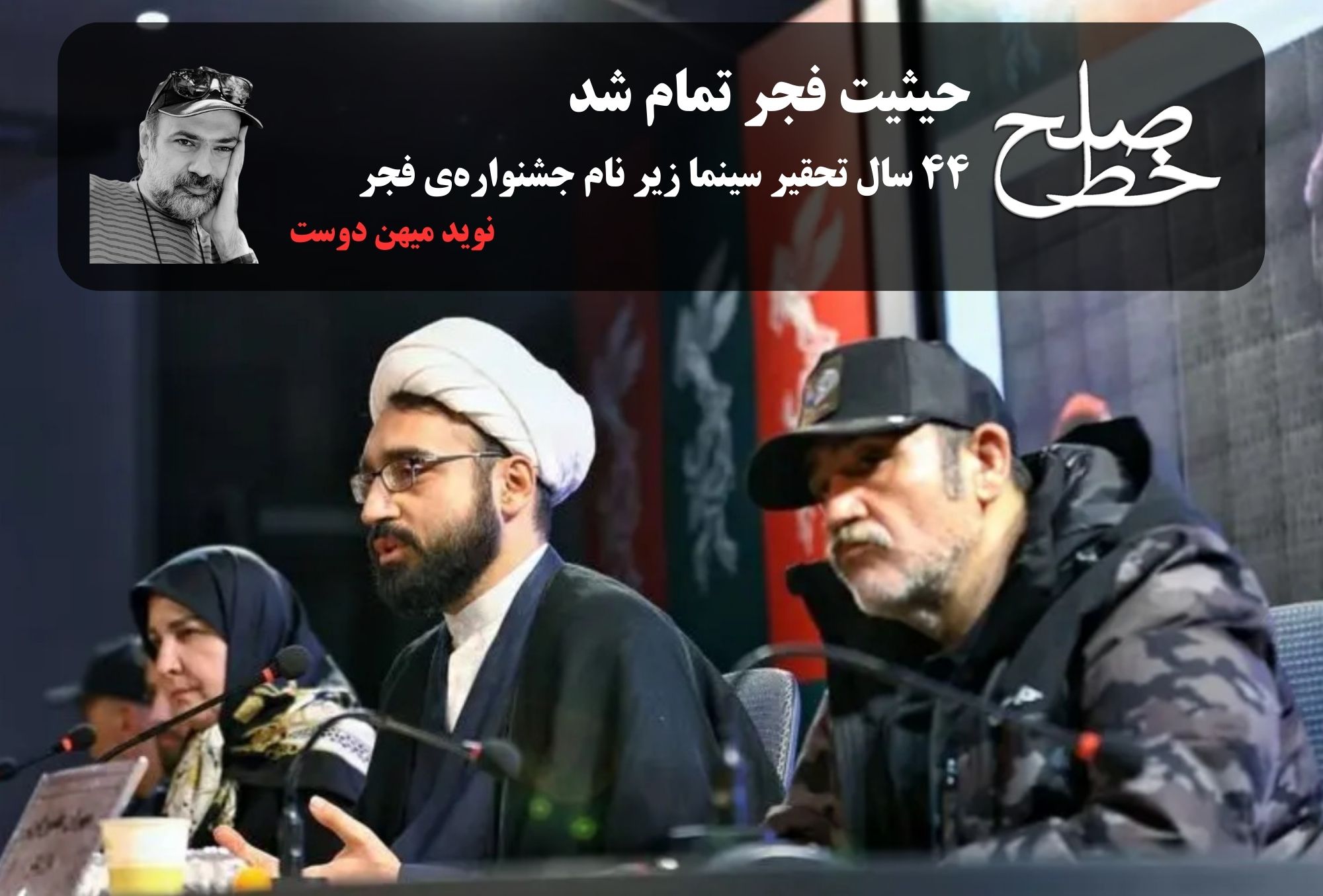
The Dignity of “Fajr Festival” Is Over/ Navid Mihandoust
Over its 44-year history, the Fajr Film Festival has gone through different periods which, based on the documented record of this state-run festival, I divide into three main eras: 1) the era of enmity and camaraderie; 2) the era of misery; 3) the era of disgrace.
The first era began in February 1983 (Bahman 1361). During this period, by placing films such as The Death of Yazdgerd (Bahram Beyzaei) and The Red Line (Masoud Kimiai) in a non-competitive section titled “Professional Films,” the festival’s policy of hostility toward Iran’s professional cinema—and, conversely, its support for slogan-driven, ideological cinema constructed by the Islamic government—became evident. Meanwhile, in the competitive section, films such as Alamdar (Mohammad Javad Moradi), On the Wings of Angels (Mahmoud Bahadori), Ya Zahra (Javad Shamghadari), and America Is Destroyed (Hassan Aghakarimi) were screened.
If the names of these so-called filmmakers are unfamiliar to you, do not worry about your cinematic illiteracy; they essentially were not, and are not, filmmakers. They were merely meant to string together incoherent images, pocket some money—which they did—and now no one knows where they are or what they are doing.
The era of hostility toward professional cinema and camaraderie with an inept inner circle continued in subsequent editions of the festival. For example, at the fifth festival in 1987 (1365), in the presence of films such as Captain Khorshid (Nasser Taghvai), Where Is the Friend’s House? (Abbas Kiarostami), and The Tenants (Dariush Mehrjui) in the competition section, which film do you think received the Golden Plaque for Best Film? The war film Flight in the Night (Rasoul Mollagholipour)—even though its director’s name was not among the five nominees for Best Director at the same festival. In fact, from the jury’s perspective, the title of Best Film was worthy of a film whose director was not even deemed qualified for nomination.
In the following edition (1988 / 1366), despite the presence of films such as Maybe Some Other Time (Bahram Beyzaei), Shirak (Dariush Mehrjui), and Gavkhar (Kioumars Pourahmad), the jury, in a memorable and “creative” move, deemed no film worthy of the Best Film title and, to avoid leaving the page blank, awarded the Special Jury Prize to the war film Kani Manga (Seifollah Dad).
Beginning with the seventh edition, since the number seven apparently held some special auspicious meaning, the festival’s awards changed from the Golden Plaque to awkward, glass statuettes named the “Crystal Simorgh.” But you would be mistaken to think that the festival’s overarching policies underwent the slightest change. In the eighth edition (1989 / 1368), despite the presence of films such as Hamoun (Dariush Mehrjui), Close-Up (Abbas Kiarostami), and Snake Fang (Masoud Kimiai), the Crystal Simorgh for Best Film was once again awarded to a war film: The Immigrant (Ebrahim Hatamikia).
Putting all this aside, allow me to add in parentheses that from 1990 (1369) until the late 1990s, as a university student and cinema enthusiast, I was a regular patron of the festival—though certainly not for Iranian cinema. Many young people of my generation have fond memories of the festival’s side sections. In those years—fortunately held away from the main sections’ commotion, in just a few cinemas such as Asr Jadid and Sepideh—there were sections like “Special Screenings,” “Festival of Festivals,” retrospectives of Bergman, Dreyer, and Kurosawa, and programs dedicated to specific periods in film history such as German Expressionism, French Poetic Realism, and Italian Neorealism. These sections gave us the opportunity to see films on the big screen that, in those harsh and exhausting Betamax and VHS days, were not easy to find.
That said, since experience has shown that nothing under the rule of the Islamic Republic can be properly carried out, we had to endure brutal cuts to important works of cinema history due to the Ministry of Culture and Islamic Guidance’s relentless censorship. Or, because festival officials were too incompetent to obtain proper copies, we watched films in Japanese, Danish, French, and Italian without English subtitles, guessing their themes and dialogue from the actors’ tones and voices—and we did not complain. Yet even this was a blessing in the Islamic Republic’s anti-cultural wasteland, though it did not last long. These engaging sections were gradually eliminated, leaving only the misshapen “Iranian Cinema Competition” section, which held no appeal for us whatsoever. We permanently gave up on this so-called festival.
After this period, we gradually arrive at the festival’s era of misery, when fewer and fewer important, non-governmental Iranian filmmakers were willing to screen their films at such a festival. This period, which began roughly in the mid-2010s (mid-1390s in the Iranian calendar), turned into a playground for government-aligned filmmakers such as Hatamikia, Mahdiyevian, and Narges Abyar, who in each edition would complain to festival officials about why their ridiculous slogan-driven films had not received the Simorgh awards they expected.
It reached a point where Mr. Hatamikia publicly admitted on stage at the closing ceremony in 2018 (1396): “I am a filmmaker affiliated with this system. For 30 years I have been coming onto this stage and leaving it. I received my main award from Qasem Soleimani, who cried while watching this film (Damascus Time).” This may be one of the world’s most unique festivals, where a filmmaker openly speaks of his affiliation with the ruling military institutions and even takes pride in it. As far as my knowledge of cinema history allows, I doubt that even an ideological filmmaker like Leni Riefenstahl spoke so explicitly about her devotion to the Nazi Party, Hitler, and his military apparatus. One wishes Hannah Arendt were here to see that her famous theory of the banality of evil applies not only in a place like the Nuremberg trials, but even at a state-run festival of the Islamic Republic.
This miserable era reached such depths that in 2022 (1401), a filmmaker named Kaveh Mazaheri produced a video—still available on YouTube—in which he threw the two Simorgh awards he had received for a short film and a feature film into a river. Can you imagine a greater humiliation for a festival than having villagers downstream retrieve its awards from the flowing waters passing through their village?
Now, in 2025 (1404), the festival has entered a period that can only be called disgrace. An era when even our country’s rivers no longer have enough water to throw a glass Simorgh into them. Instead, in the streets of Iran, a flood of the blood of the nation’s youth is flowing—one from which even the institutions of the Fajr Festival cannot escape. For this reason, day after day, they are confronted with actors and filmmakers who withdraw one by one from participation in this disgraceful festival.
This evident disgrace has now reached the point where the festival’s organizers no longer even dare to publicly announce their jury until the final days, and at the closing ceremony they are forced to repeatedly thank one another on stage for having managed to hold this edition of the festival despite every calamity and disgrace—even if, in an unprecedented event, none of the four winners of the leading and supporting actor and actress Simorgh awards are present in the hall to take home these worthless statuettes.
With deep regret, I must say that this disgrace will forever be recorded in the name of all participants and winners of its blood-stained Simorghs in the shameful history of this edition of the festival. Especially for that former political prisoner who repented and escaped the death sentences of the Islamic Republic in the 1980s, only to engage in buffoonery at a ridiculous closing ceremony 40 years after his release from prison, applauding the festival secretary for “riding the shah,” unaware that “Shahsavar” means a skilled horseman, just as “Shahrah” refers to a major thoroughfare—not a road that leads to a king.
 Created By: Navid Mihandoust
 February 20, 2026
Tags
Ali Hatami Dariush Mehrjoui Fajr Film Festival Film review Government cinema Masoud Kimiaie Movie Naser Taghavi Navid Mihan Dost Navid Mihan Dost translates to "the good news of homeland friend" or "the promise of a friend from the homeland." peace line Peace Line 178 ماهنامه خط صلح