


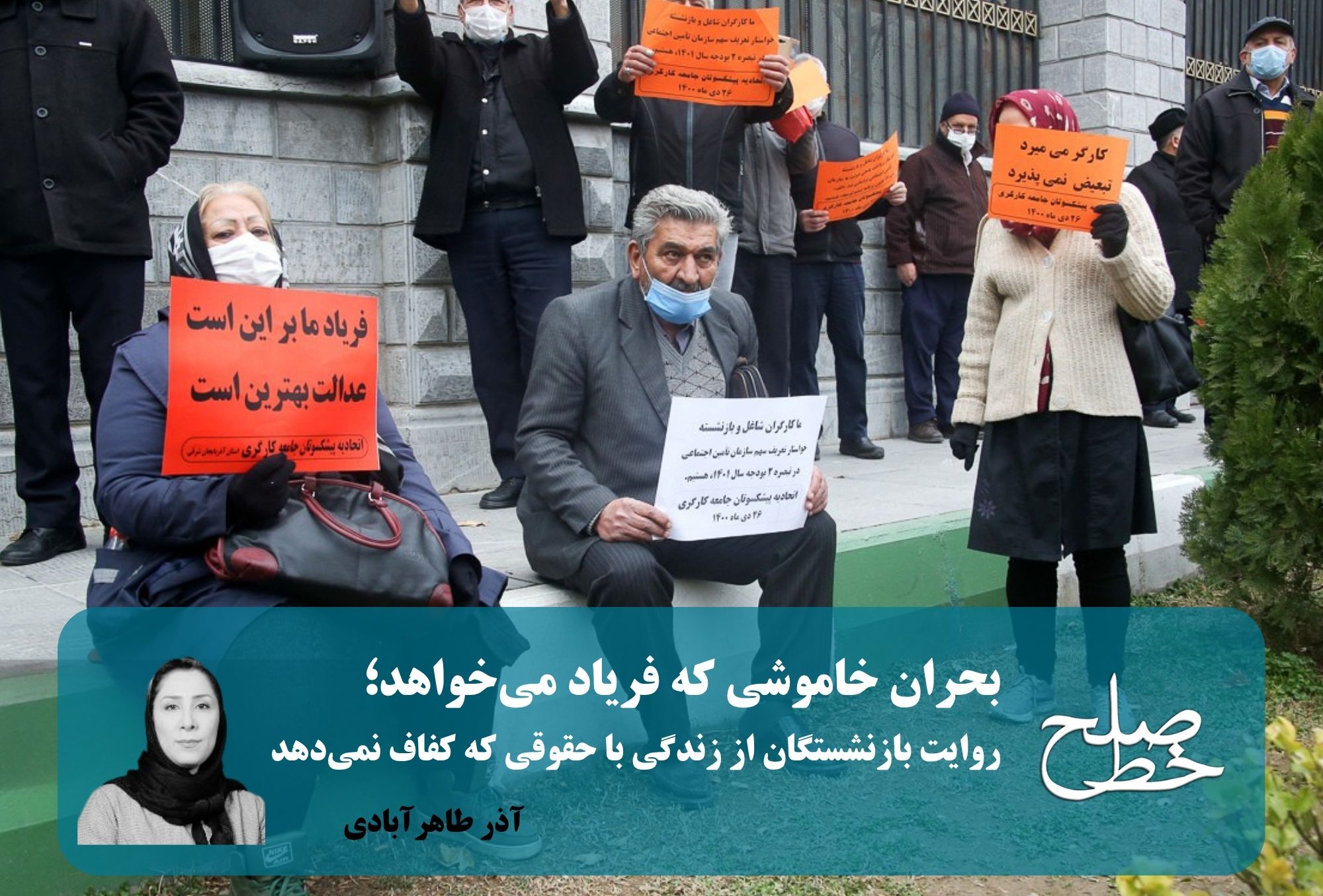
Retirees’ Accounts of Life with Inadequate Pensions/ Azar Taherabadi
Pension funds in Iran have been struggling with financial crises for years—a crisis that has now reached the brink of bankruptcy, leaving millions of retirees facing fear and economic instability. According to official data, the Civil Servants Pension Fund (CSPF), the Social Security Organization, and the Armed Forces Pension Fund cover a significant portion of the country’s pensioners, yet nearly all are grappling with budget deficits and accumulated debts.
Macro Statistics: CSPF and Social Security in the Red Zone
Civil Servants Pension Fund (CSPF): According to a parliamentary report, in 2023 (1402), the fund had 841,020 premium-payers and 1,715,656 pensioners; this means a support ratio (premium-payers to pensioners) of about 0.49. (1) The Iranian Students’ News Agency (ISNA) also reported that by the end of 2023 (1402), the number of pensioners receiving salaries from the fund was 1,715,656, of which 1,397,989 were retirees. (2) By the end of fall 2024 (1403), the fund had paid salaries to 1,757,731 individuals—81% of whom were retirees, 18% survivors, and 1% disabled. (3) Moreover, the Ministry of Education’s share of CSPF pensioners is significant: in fall 2024 (1403), the CSPF paid salaries to 757.1 thousand individuals, with the majority associated with the education sector. (4)
Social Security Organization: This organization covers more than 16,305,123 principal insured individuals, and the number of its pensioners is 8,528,000. (5) Other reports indicate that the number of principal Social Security pensioners at the end of last year was about 4,387,000, and in total has reached over 7 to 8 million. (6) Furthermore, published statistics show that in the recent period, about 2,800,000 new insured individuals have been added to the Social Security Organization. (7) Nevertheless, the organization is also facing an “imbalance of resources and commitments,” since despite the increase in the number of insured individuals, factors such as the pressure of pension payments, government debt, and the diversion of resources for operational costs pose serious threats to its sustainability. (8) When, in the CSPF, the number of pensioners is more than twice the number of premium-payers, and the Social Security Organization bears the burden of commitments to millions, the situation can no longer be called “manageable.” Fundamentally, whenever the “support ratio” drops below one, it indicates immense pressure on a fund’s resources.
Numbers and Narratives: Why Has the Situation Deteriorated?
Several micro and macro factors have exacerbated this crisis:
1- Decrease in the premium-payer to pensioner ratio: In the CSPF, the support ratio is about 0.5, meaning there are two pensioners for every premium-payer. This places a massive burden on the fund’s resources. (1)
2- High inflation and rising costs: This has caused the real value of pensions to be inconsistent with the annual inflation rate, so much so that in many cases, even implemented increases have not been enough to compensate for retirees’ declining purchasing power.
3- Cash handouts and resource withdrawals from funds: Some decision-makers have allocated fund resources to current expenditures or directed assets toward high-risk projects outside the funds’ mandate.
4- Dependency on the government and lack of managerial independence: If a fund’s manager is subordinate to government decisions rather than financial regulations, long-term management becomes impossible.
5- Increased demand for pensions and an aging population: The aging trend and the rising share of elderly individuals in the demographic structure have increased the demand for pensions and imposed further strain on the funds in meeting this growing need.
To gain a more human understanding of this crisis, we spoke with several retirees from different ministries to hear their personal accounts of post-service life.
“Gholamreza Hosseini,” a 63-year-old retiree from the Ministry of Oil with 35 years of experience in the technical unit of a refinery, tells Peace Mark Monthly Magazine: “When I joined the refinery, the Oil Pension Fund was one of the country’s most reputable financial institutions. We were confident our future was secured. But now, every month, I worry whether my salary will last until the end of the month.” He adds that severe inflation and stagnant salaries have made life extremely difficult: “My current income is about one-third of my actual expenses. I have to pay out of pocket for specialized medications, and supplementary insurance doesn’t cover many costs.” According to Mr. Hosseini, the fund crisis stems from “unprofessional mergers, politically motivated investments, and lack of financial transparency”: “They shouldn’t have turned the funds into the private playground of ministries. Our assets were spent on loss-making projects without effective oversight. Now, retirees are paying the price for decisions they had no part in.”
“Reza Shafiee,” a 59-year-old retiree from the Gas Company and a pipeline engineering expert, tells Peace Mark Monthly Magazine that he worked under harsh conditions in operational zones for years but is now deprived of even basic retirement rights: “We worked hard to retire with peace of mind. But the Gas Fund is now facing a severe deficit. Delayed payments and the removal of some benefits have left us in a critical state.” He, too, emphasizes that the root of the crisis lies in the funds’ flawed structure: “Over the past decades, governments have turned the funds into a source to compensate for budget deficits. Instead of long-term investments, resources were spent on short-term, high-risk projects. As a result, now the inflows don’t match the outflows.” From this Gas Company retiree’s perspective, the path to reform involves “restoring the financial independence of funds” and “drafting a transparent law for managerial accountability”: “A pension fund should be under the oversight of an independent, public body—not in the hands of ministries. Public trust will return only when the numbers are made transparent.”
“Abbas Nemati,” a 66-year-old retiree from the Ministry of Communications and Information Technology and a senior telecommunications expert, recalls his career days with pride in his conversation with Peace Mark Monthly Magazine: “In the 1980s and 1990s, our fund was organized and precise. But gradually, assets were merged into different accounts, and some segments were, so to speak, privatized. Financial management lost transparency, and we retirees became the last priority.” He sees the current crisis not as an accident, but as the outcome of years of financial mismanagement: “When funds deviate from their professional path and enter political projects or corporate ownership, this is the result. A fund should be a sustainable economic entity—not a tool in the hands of governments.” Nemati points to the experiences of other countries: “Globally, retirement is a multilayered system: a government base fund, supplementary insurance, and individual investment. But in Iran, the entire burden is on a semi-bankrupt fund. It’s no surprise that this disorder and chaos have emerged—and we retirees bear the brunt.” He believes the way forward lies in “transparency, independent auditing, and including retiree representatives on fund boards of trustees.”
“Fatemeh Karimi,” a 60-year-old retiree from the Ministry of Education and an English language and literature teacher with 32 years of service, speaks with emotion about her own situation and that of her colleagues: “We devoted our lives to educating generations, but today many retired teachers live below the poverty line. Our pensions have no relation to economic realities.” She complains about delayed end-of-service bonuses and inequality among different pension funds: “The education fund has always been underprivileged—both in budget and management. When I look at my colleagues, I see many are forced to return to work, even in retirement age.” This retired teacher sees the problem as not just financial: “Feeling worthless is worse than poverty. That after thirty years of service, society forgets you and sees you as a burden—it’s extremely painful. Retirement should be a reward, not a punishment.” She calls for “redesigning the pension system based on a real cost-of-living basket” and “securing stable financial resources for the funds”: “As long as the government views the funds politically, the crisis will continue.”
“Ali Moradi,” a 62-year-old retiree from the Ministry of Sports and Youth and a former provincial team coach and physical education expert, speaks about a particular group that is rarely seen: “We sports retirees neither receive real benefits nor have adequate supplementary insurance. Many of us worked under temporary contracts, resulting in incomplete insurance records. And today, unfortunately, no one is accountable.” He believes the sports sector has always been a victim of budget shortfalls: “When ministries are struggling with operating expenses, the first thing cut is insurance and pension fund contributions. This leads to sports retirees, after years of service, being unable to even afford medical expenses or rent.” Moradi also laments the lack of post-retirement empowerment programs: “In other countries, retirees are re-engaged in educational and social roles. But here, doors close after retirement. No institution utilizes our experience.” He concludes: “Pension funds aren’t just financial offices—they’re indicators of social justice. If a retiree lives in poverty, it means justice in the economic system has collapsed.”
Analyzing the interviews with these five retirees clearly shows that the crisis in Iran’s pension funds is not merely a financial issue—it has structural, managerial, and social dimensions. While successive governments have turned these funds into financial playgrounds, retirees—the pillars of the country’s administrative system—live in daily anxiety about their economic security and human dignity. The way out of this crisis lies in transparency, fund independence, reforming investment structures, and restoring public trust—a trust that may be the greatest lost capital.
When the “support ratio” in a pension fund drops below one, a serious alarm sounds. This indicator, which shows the number of premium-payers per pensioner, has now reached 0.6 for the Civil Servants Pension Fund and 0.5 for the Armed Forces Pension Fund—figures that signal the crossing of a crisis threshold and full dependency on government budgets for salary payments. The continuation of this trend outlines a dark future for the country’s retirement system and poses a serious challenge to its sustainability, potentially leading to social crises. To address this situation, “parametric reforms” such as raising the retirement age have been proposed for years. However, due to high social sensitivity, implementing such reforms has always faced major challenges and sparked concerns among retirees that the cost of inefficiencies may fall heavily on their shoulders. (9) Ultimately, the crisis in Iran’s pension funds is not merely a financial issue—it is a mirror reflecting distrust, instability, and the administrative system’s failure to respond to the needs of generations who devoted their lives to service. In Iran, retirement has become a season of anxiety rather than peace.
The Way Out: Path to Reforming Pension Funds
Based on data and retirees’ narratives, the following solutions are necessary:
Full transparency: Periodic publication of financial reports and independent audits is essential so that people know where their money has gone.
Appointment of independent and expert managers: Pension fund managers must be selected from among independent experts, not through political appointments.
Diversification of income sources: Instead of relying solely on insurance premiums, funds must look toward productive investments in economic projects, partnerships with the private sector, and non-inflationary revenues.
Review of pension calculation formulas: Pension calculations must consider real cost-of-living indicators and adjust in line with inflation.
Rebuilding public trust: Funds must implement mechanisms for citizen and civil society participation in oversight.
Targeted government support: The government must act as a responsible partner—clearing its accumulated debts to the funds and providing temporary, targeted support to ease liquidity pressures.
In conclusion, the bankruptcy of Iran’s pension funds is the result of three decades of mismanagement and disregard for expert warnings. Without serious reforms to their financial and managerial structures, not only will current retirees’ futures be at risk, but so too will those of younger generations—facing an even greater crisis. This silent crisis is the outcry of a generation that, with work and hope, looked toward a promised future—a future now faded under the shadow of debt and the government’s unfulfilled promises.
Footnotes:
1- Assessment of the Status of the Civil Servants Pension Fund (Challenges and Solutions), Research Center of the Islamic Consultative Assembly, March 3, 2025 (13 Esfand 1403).
2- 5% Increase in CSPF Pensioners / Average Pension at 11.5 Million Tomans, ISNA, August 2, 2024 (12 Mordad 1403).
3- Alarm Over CSPF Entering the “Bankruptcy Abyss,” Asr Iran Analytical News Website, March 1, 2025 (11 Esfand 1403).
4- Most CSPF Retirees Are from the Education Sector, Sobh-e-Tose’e Iran Newspaper, April 29, 2025 (10 Ordibehesht 1404).
5- Over 16 Million Main Insured and 8 Million Pensioners Covered by Social Security, IRNA, January 2, 2025 (12 Dey 1403).
6- Rapid Growth of Social Security Pensioners; A Sign of Population Aging, Eco Iran, February 22, 2024 (3 Esfand 1402).
7- Increase in Social Security Insured Individuals, Iran Online, August 13, 2024 (23 Mordad 1403).
8- Statistics on the Population Covered by Social Security Insurance, Tabnak, July 10, 2023 (20 Tir 1402).
9- Severely Critical Status of Pension Funds; Fund Deficit Equivalent to 1.8 Times the Public Budget, Etemad Online, March 4, 2025 (14 Esfand 1403).
 Created By: Azar Taherabad
 October 23, 2025
Tags
Azar Taherabad Elderly Insurance National Pension Fund peace line Retirees Retirement boxes Unemployment ماهنامه خط صلح