


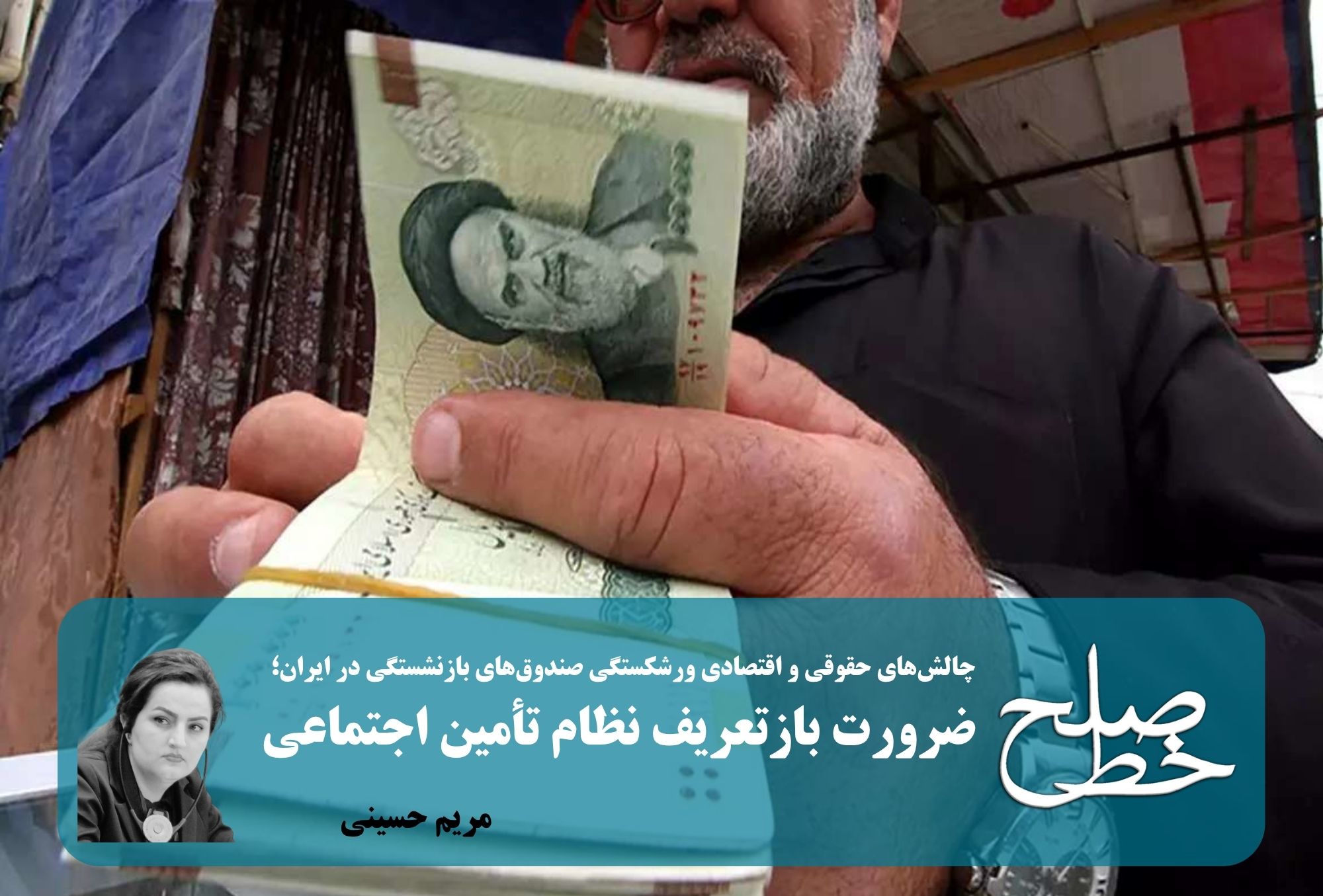
Legal and Economic Challenges of Pension Fund Bankruptcy in Iran/ Maryam Hosseini
Pension funds are the cornerstone of economic security and social justice in any country. These institutions, by collecting insurance premiums from workers and employers, allow retirees to enjoy a dignified life after the end of their working period. In Iran, multiple pension funds, including the Civil Servants Pension Fund, the Military Pension Fund, and the Social Security Organization, have faced financial crises for years. (1) This crisis not only threatens the economic sustainability of the social security system but also endangers the rights of retirees and their families. Funding shortfalls, wage arrears, and delays in pension payments are clear signs of bankruptcy. Reports indicate that the government has been forced to fund a significant portion of these funds from the public budget, (2) but without structural reforms, this approach is merely a temporary fix and does not resolve the fundamental problems. This article examines the economic, legal, and social dimensions of the pension fund crisis and analyzes the need to redefine the social security system in Iran.
Economic Dimensions of the Crisis
Iran’s pension funds are facing severe financial deficits. Estimates show that the government’s debt to pension funds exceeds 5,000 trillion rials (500 thousand billion tomans), (3) much of which has resulted from the government’s failure to pay its share of insurance premiums and the transfer of loss-making companies. (4) Moreover, the assets of the funds have often been invested in unproductive projects or loss-making companies that do not yield the required returns. Another contributing factor to the crisis is the declining “support ratio,” i.e., the number of active contributors relative to retirees. In some funds, this ratio has dropped to less than one to one, increasing financial pressure on existing resources. (5) Instead of focusing on risk management and smart investments, the funds are grappling with liquidity problems and budget deficits. Their dependency on the public budget has further complicated the issue. The government is forced to use public resources to pay pensions, which increases pressure on other budgetary sectors and the country’s financial obligations. This dependency creates a cycle that, without fundamental reforms, will keep the funds in an unstable condition.
Legal Challenges and Government Obligations
The right to social security and pensions is one of the fundamental rights of citizens. Article 29 of the Iranian Constitution emphasizes support for individuals during retirement, and the government is obligated to guarantee this right through appropriate policymaking. (6) The current crisis highlights the conflict between existing laws, budgetary constraints, and poor governance of the funds. The Law on the Structure of the Comprehensive Welfare and Social Security System mandates the government to ensure the financial sustainability of the funds, (6) but in practice, the lack of independent oversight and political interference has prevented full implementation of these obligations. From an international law perspective, as one of the founding members of the International Labour Organization (ILO), Iran is committed to upholding its fundamental principles and meeting minimum standards in the field of social security. These principles emphasize the need to ensure the sustainability of social support systems and provide everyone with minimum livelihood support. Therefore, the bankruptcy of social security funds could be interpreted as an implicit violation of Iran’s commitments to these international standards. (7) Ambiguity in responsibilities is another legal challenge. In times of crisis, it is unclear whether the government is directly responsible for paying pensions or whether the funds must act from their limited resources. This ambiguity slows decision-making and increases retirees’ dissatisfaction.
Social and Human Consequences of the Crisis
The pension fund crisis has far-reaching implications for society. By the end of 2021 (1400), the number of retirees in Iran was about 6.5 million, who are dependent on these funds. (8) Delays in pension payments exert financial pressure on families and reduce retirees’ quality of life. The impact is more pronounced among vulnerable groups, especially retired women and surviving spouses. Data from the Social Security Research and Studies Institute shows that the poverty rate among retired women is twice that of men, (9) as pensions are calculated based on lower wages or shorter insurance histories. The economic impact is also significant: reduced income for retirees leads to decreased purchasing power and consumption, negatively affecting the country’s economic growth in the long run. Moreover, the strain on the public budget to cover pension fund deficits diverts financial resources from development and public services, leading to broader public dissatisfaction.
Solutions and the Need to Redefine the Social Security System
Overcoming the pension fund crisis in Iran requires a vision beyond temporary reforms and budgetary injections. The experience of recent decades has shown that simply changing managers or promising financial support, without fundamentally redefining the social security structure, is not only ineffective but also imposes longer-term costs on the government and society. Redefining the social security system must adopt a multidimensional and interdisciplinary approach that simultaneously considers economics, public law, social policy, and intergenerational justice.
From an economic perspective, the first step is to return to the principles of financial transparency and independent auditing. In many countries, such as Chile and Turkey, pension reform succeeded when the real status of assets and liabilities of the funds was made public and accessible to oversight institutions. In Iran, too, the financial information of the funds must be removed from a confidential and inaccessible state and published within the framework of the Law on the Disclosure and Free Access to Information. (10) This transparency can facilitate public, media, and even parliamentary oversight and reduce recurring mismanagement.
The second step is to diversify the funds’ revenue sources. Sole reliance on insurance premiums and government support is no longer sufficient, given the labor market conditions and structural inflation. Targeted investments in sectors such as renewable energy, tourism, information technology, and social housing can offer more reliable returns while contributing to the country’s development goals. Of course, these investments must be supervised by specialized institutions and shielded from political interference, as in many cases, the bankruptcy of funds has stemmed from unprofessional and politically-driven investment decisions.
From a legal and institutional standpoint, redefining the social security system requires a review of fundamental laws such as the Civil Service Management Law and the Law on the Structure of the Comprehensive Welfare and Social Security System. A clear distinction must be made between the concept of “guaranteeing minimum livelihood” and “occupational benefit systems” to reduce pressure on the funds and fairly distribute the responsibility of social support among the government, employers, and workers. Additionally, the establishment of an independent regulatory body in the field of social security (similar to the Central Bank or the Communications Regulatory Authority) could play a key role in managing conflicts of interest, monitoring fund performance, and ensuring the rights of contributors.
In terms of social policymaking, the relationship between employment, insurance, and job security must be reformed. A large portion of the working population, especially women, informal workers, and service sector employees, lack pension insurance coverage. Creating flexible insurance systems for informal, freelance, or self-employed workers is one of the prerequisites for achieving intergenerational justice in the pension system. Insurance policies must also be gender-sensitive, as currently, women with shorter work histories and lower incomes receive smaller pensions, which contributes to the reproduction of poverty in old age.
Ultimately, sustainable reform requires a national dialogue between the government, workers, employers, and social rights experts. Behind-closed-doors decision-making based solely on budgetary pressures will only delay the crisis. Policymakers must draw inspiration from successful regional and global experiences to offer an indigenous model of social security that both preserves retirees’ dignity and is financially manageable for the government. Iran’s social security system must shift from the logic of “government-funded payments” to one of “participatory and sustainable resource management.” Only in this way can we prevent the gradual bankruptcy of the funds, increasing dissatisfaction among retirees, and rebuild public trust in social justice.
Postscript
The bankruptcy of pension funds in Iran is a multifaceted economic, legal, and social challenge. Resource shortages, lack of transparency, and legal conflicts have made the funds unsustainable and put retirees’ rights at risk. A sustainable solution lies in redefining the social security system, reforming managerial structures, increasing transparency, and revising pension parameters. These measures will reduce the financial burden on the funds while safeguarding the fundamental rights of retirees. Overall, without structural redefinition and reform, pension funds will continue to face instability, with ongoing risks of delayed payments and declining retiree living standards. Establishing a coherent, transparent, and sustainable system not only protects the interests of retirees but also contributes to the country’s economic and social stability.
Footnotes:
1- Majlis Research Center, 2020. Challenges of Pension Funds in Iran and Solutions for Financial Structure Reform. Islamic Consultative Assembly Research Center, March 3, 2025 (13 Esfand 1403).
2- 81% of the Civil Servants Pension Fund’s resources are provided by the government, IRNA, May 5, 2025 (16 Ordibehesht 1403).
3- Government debt to the Social Security Organization: 5,000 trillion rials, Setareh Sobh Online, February 27, 2023 (8 Esfand 1401).
4- Challenges and Solutions for Pension Fund Sustainability, Islamic Consultative Assembly Research Center, March 5, 2025 (15 Esfand 1403).
5- Pension fund support ratio has dropped below 1%, Iran Economist, December 23, 2017 (2 Dey 1396).
6- Law on the Structure of the Comprehensive Welfare and Social Security System, Islamic Consultative Assembly Research Center, May 10, 2004 (21 Ordibehesht 1383).
7- ILO Secretary-General’s message to the 8th National Labor Conference: The Islamic Republic of Iran is one of the founding members of the International Labour Organization, IRNA, May 27, 2025 (6 Khordad 1403).
8- Official number of retirees in Iran announced, Eghtesad Irani, July 15, 2025 (25 Tir 1403).
9- Challenges and Barriers to Gender Justice Policy-Making in the Field of Welfare and Social Security, Higher Institute for Social Security Research, 2023 (1402).
10- Law on Disclosure and Free Access to Information, Islamic Consultative Assembly Research Center, January 24, 2010 (4 Bahman 1388).
 Created By: مریم حسینی
 October 23, 2025
Tags
Elderly expensive Insurance Maryam Hosseini Paragraph peace line Retirees ماهنامه خط صلح