


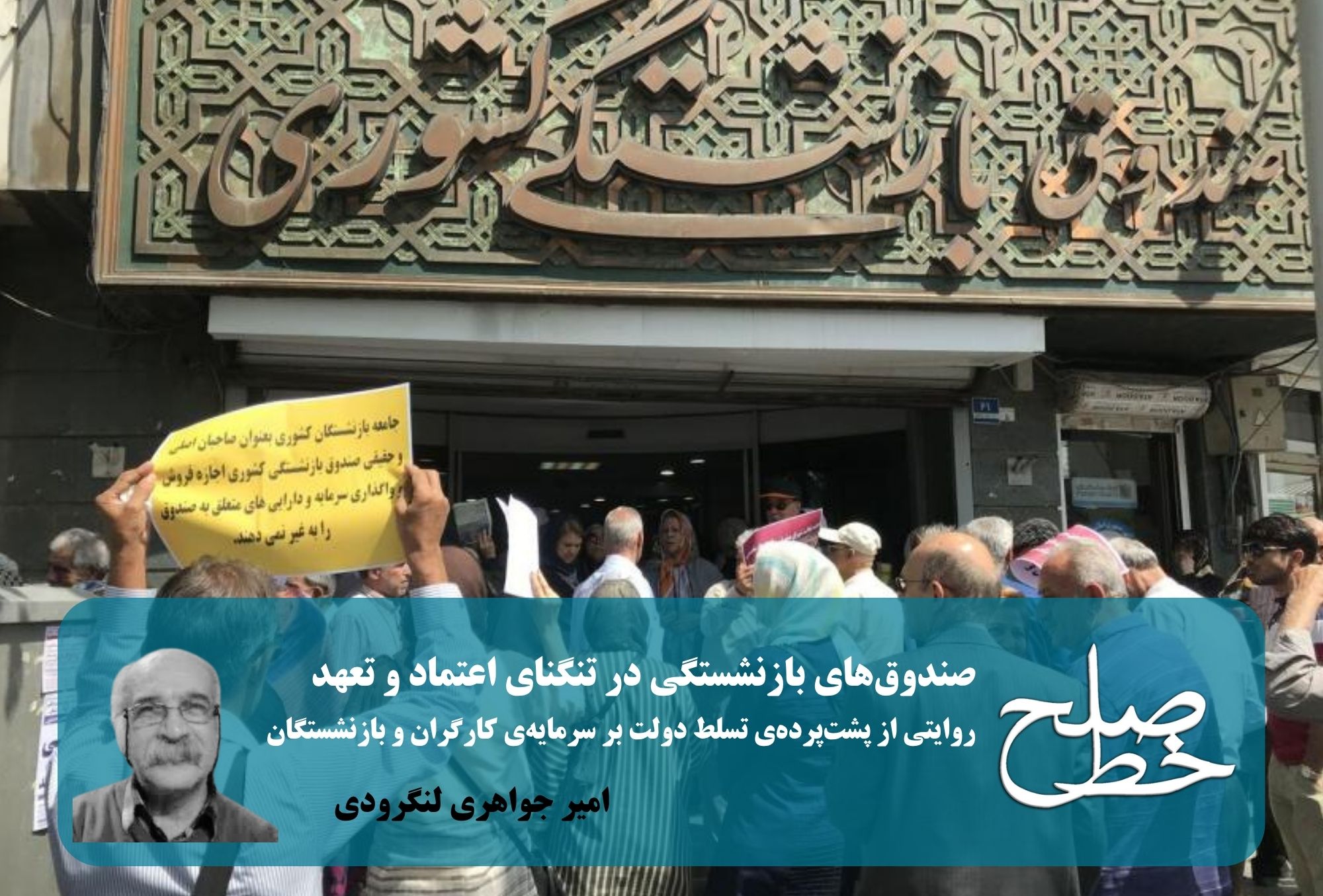
Pension Funds in the Strait of Trust and Obligation/ Amir Javaheri Langroudi
In recent years, the condition of pension funds—especially the Cultural Workers Reserve Fund and the performance of the Social Security Organization—has attracted the attention of many researchers, social activists, and fund members. The importance of this issue is evident not only in theory but also in practice, as its crisis-inducing consequences directly and significantly impact the financial sustainability of retirees and intergenerational trust. The crisis in pension funds stems from resource shortfalls, mismanagement, lack of transparency, and inadequate oversight. This situation has eroded public trust and raised intergenerational concerns. This article seeks to provide a comprehensive analysis of the pension fund crisis—institutions originally established to ensure the security of retirement for workers, teachers, and other wage earners, which today have become centers of distrust and dysfunction.
How the Intergenerational Institution Was Established in Iran
In 1946 (1325), the “Labor Law” was passed by the then Cabinet. According to this law, employers were required to establish two separate funds in each workplace in addition to complying with workers’ insurance regulations: a “Health Fund” to assist workers in illnesses unrelated to work, and a “Welfare Fund” for matters such as marriage, family allowances, unemployment, disability, retirement, maternity, and more.
In 1949 (1328), the Ministry of Labor was officially established. Article 16 of the Labor Law, passed on June 7, 1949 (17 Khordad 1328), stipulated that a fund called the “Workers’ Welfare and Insurance Fund” should be established for medical care and workers’ compensation. Later, in late 1952 (1331), during the premiership of Mosaddegh, the Law on Workers’ Social Insurance was passed for the first time, and under it, an independent body named the “Workers’ Social Insurance Organization” was established. This organization was tasked with delivering the benefits stipulated in the law to insured workers and employees. To this day, 79 years have passed since the establishment of this intergenerational organization. In its early decades, it was able to accumulate significant financial resources through investments in industry and real estate, but from the outset, heavy reliance on the government and political interference in its management paved the way for future crises.
In the 1990s and 2000s (1370s and 1380s), governments repeatedly used this fund’s resources to cover budget deficits, resulting in massive accumulated debts. According to official reports, the government’s debt to the Social Security Organization now ranges between 4,000 trillion and 7,000 trillion rials and continues to grow annually. (1) These debts have not only drained the fund’s resources but also severely restricted its ability to make stable and productive investments.
The Social Security Organization has seen the most frequent leadership changes among post-1979 governments—an indication of the power centers’ efforts to exploit this wealthy and far-reaching institution. Yet this organization, which covers more than half of the country’s population, plays a vital role in supporting the workforce and strengthening a sense of economic and social security. Providing support for workers and their families in the face of illness, accidents, unemployment, old age, and disability is among the organization’s core duties. Unfortunately, governments past and present have inflicted the greatest damage on this institution by exploiting its financial resources. This approach can be likened to the looting of assets belonging to a social class—assets over which they have been stripped of any meaningful oversight, intervention, or self-governance.
The accumulated wealth of the organization is held in institutions like Shasta and Bank Refah-e Kargaran. Bank Refah-e Kargaran, as a subsidiary of the Social Security Organization, is an institution whose entire shares belong to workers and retirees. One hundred percent of this bank’s shares are owned by the Social Security Organization, meaning all the bank’s assets and equity belong to workers and retirees. Even the bank’s name makes clear that it belongs to the working class.
What Is the Status of the Cultural Workers Reserve Fund?
The Cultural Workers Reserve Fund is a private economic institution founded in 1995 (1374) with the goal of improving teachers’ livelihoods after retirement. The fund’s financial resources are supplied through contributions from its members (teachers) and government support—though the government has long neglected its commitments to the fund. The fund’s mission was to encourage teachers to actively participate in economic activities and the capital market, thereby contributing more significantly to the national economy and achieving its primary goal of improving their post-retirement welfare.
With four holding companies—Petrochemical and Energy, Financial and Investment, Construction, and Services—and around 30 core subsidiaries under these holdings, the Cultural Workers Reserve Fund operates economically to generate profit and build wealth for its teacher-members. All its assets belong to the members. (2) A look at teacher slogans in protest gatherings reveals key demands: quality and free education, support for teachers’ and students’ legal rights, preventing interference with the fund, and full payment of end-of-service bonuses. Teachers emphasize unequivocally: “This fund was established with teachers’ capital and invested in various sectors; therefore, it is a private entity belonging to teachers and its management must not be under government or state institution control.”
How Many Pension Funds Exist in Iran?
In addition to the four major funds affiliated with the Ministry of Cooperatives, Labor, and Social Welfare, there are 14 exclusive pension funds in Iran, including the Armed Forces Social Security Organization, which currently operate independently of the ministry. Today, there are 18 pension funds in Iran: three are public (governmental), two are non-governmental public funds, and the rest are professional and exclusive funds. Except for the Social Security Organization—which is an open fund with diverse sources of new membership—the other funds are closed and serve specific groups.
The year 1975 (1354) was a turning point in the creation of pension funds in Iran. That year saw the founding of the Social Security Organization for workers and employers, and the Civil Servants Pension Fund for government employees. After the 1979 Revolution, the Comprehensive Welfare and Social Security Law was passed in 2004 (1383), leading to the establishment of the Ministry of Welfare and Social Security. Under its jurisdiction were the Social Security Organization, the Civil Servants Pension Fund, the Farmers, Villagers, and Nomads Insurance Fund, and the Medical Services Insurance Organization (later renamed the Iranian Health Insurance Organization under the Ministry of Health).
It’s worth noting that in 2012 (1391), the Steel Workers Pension Fund was also added to the list of funds under the Ministry of Cooperatives, Labor, and Social Welfare. Currently, 18 pension funds operate in Iran:
The Social Security Fund for workers and private sector employees
The Civil Servants Pension Fund for government employees
The Armed Forces Pension Fund
The Farmers, Villagers, and Nomads Fund for the rural population
14 other funds for employees in other sectors
About 90% of insured individuals in the country are members of the Social Security Organization and the Civil Servants Pension Fund. (3)
Corruption and Lost Opportunities in the Social Security Organization
Corruption in the Social Security Organization is not limited to consulting contracts. Numerous reports show that many subsidiaries of this organization—operating under the umbrella of Shasta (Social Security Investment Company)—have become the private playgrounds of governments and political factions. With over 180 companies active in oil, petrochemicals, pharmaceuticals, and construction, Shasta is one of the country’s largest economic holding companies. But instead of directing the profits from these investments toward improving retirees’ lives, a large portion has been diverted to the political and economic interests of specific groups.
The Role of the Ministry of Cooperatives, Labor, and Social Welfare and the Social Security Organization in the Escalating Crisis Facing Workers and Retirees
The claim that the Social Security Organization is bankrupt is a red herring. The organization is not bankrupt; rather, it is the country’s sick and corrupt economy that is collapsing. The government that caused this crisis is now reaching for the last remaining assets in the retirees’ pension fund—a fund that has already been looted by influential and well-connected elites. These looters, aiming to delay pension payments, are using a scheme to cycle the same funds into next month’s wages. Amid such conditions and internal government rivalries, it has been revealed that more than 2,000 managerial positions in pension funds and the Social Security Organization are under the Ministry of Labor’s control. “In just four pension funds managed by the Ministry of Labor, in addition to the Social Security Organization, there are 1,599 board positions and 432 CEO positions. These numbers reveal the full extent of the ministry’s influence in economic decision-making.”
It is now also revealed that: “The Social Security Organization alone owns 413 companies, all directly managed through appointments by the Minister of Labor. These companies produce 30% of polypropylene, 13% of urea, 41% of sponge iron, 70% of tires, 45% of tubes, 100% of hoses, 20.7% of dairy products, and 10% of domestic and international flights in Iran.” (4) These statistics show that the Ministry of Labor, despite controlling one of the largest economic networks in the country, pays little attention to the livelihoods of workers, retirees, and the insured.
The Ministry of Cooperatives, Labor, and Social Welfare—originally established to support workers—has today become one of the country’s largest economic players and a silent empire at the heart of Iran’s industrial structure. This reality raises two fundamental questions:
Why are workers not benefiting from the profits of such a massive enterprise?
Why are they kept unaware of the nature and scale of its assets?
Conclusion
Today, pension funds in Iran have become a mirror reflecting the broader state of the country’s political economy. Public trust in these institutions can only be rebuilt if people, workers, and retirees are given a real role in managing and overseeing their own assets. Otherwise, the continuation of rent-seeking policies and the spread of corruption and embezzlement will only intensify the crisis and gradually dismantle the foundations of the country’s welfare system. All efforts must be directed toward enabling people to organize and mobilize collective protests so they can, in an organized, unified, and nationwide manner, demonstrate their awareness and collective strength from the ground up. This goal will only be achieved if we unite and organize.
Footnotes:
1- Government’s Debt Crisis to the Social Security Organization: A Wound That Deepens Daily, Asr Khabar, September 27, 2025 (5 Mehr 1404).
2- Cultural Workers Reserve Fund, Persian Wikipedia.
3- An Overview of Iran’s Pension Funds, Farhad Barzafkan and Hamid Gomari, Social Welfare and Security Studies Group, Saba Retirement Strategies Institute, First Edition, November 24, 2019 (3 Azar 1398).
4- The Ministry of Labor: Iran’s Most Hidden Economic Giant, Fars News Agency, October 9, 2025 (17 Mehr 1404).
 Created By: Amir Javaheri Langaroudi
 October 23, 2025
Tags
Amir Javaheri Langroudi expensive Increase in retirement age Ministry of Labor National Pension Fund Paragraph peace line Poverty and inequality Retirees ماهنامه خط صلح