


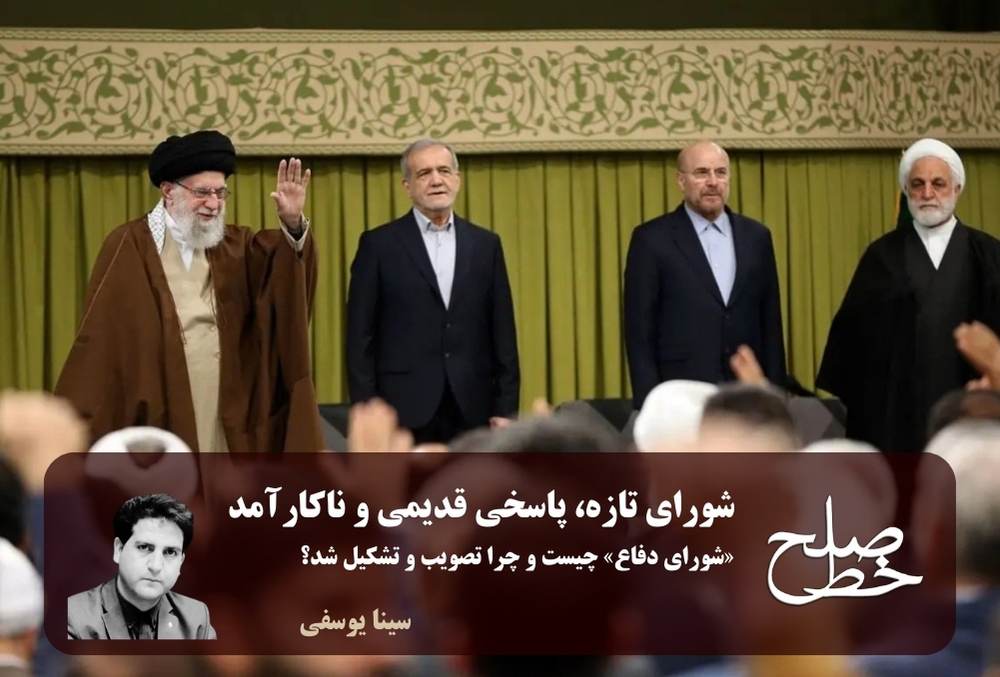
What is the ‘Defense Council’ and why was it approved and formed? / Sina Yousefi
In the month of Khordad of this year, Iran witnessed one of the shortest and most expensive military confrontations, known as the 12-day war. This war not only targeted vital infrastructure of Iran, including sensitive nuclear facilities and defense systems, but also exposed deep-rooted weaknesses in the structure of the Islamic Republic’s defense and security. It showed that there was a lack of coordination among military, security, and intelligence institutions for a quick and cohesive response. Instead of working within a common framework, these organizations often operated as separate islands and even provided conflicting information and assessments. The consequence of this gap was a decrease in efficiency in predicting threats, delays in major decision-making, and failure to make optimal use of available capacities. These weaknesses ultimately led to the loss of a portion of Iran’s deterrence and security credibility.
In response to these challenges and considering the security evaluations that indicate a high probability of a renewed confrontation and the beginning of a new war between Iran and Israel, the formation of the “Defense Council” as one of the subsidiary councils and subordinates of the Supreme National Security Council, based on Article 176 of the Constitution of the Islamic Republic of Iran, was put on the agenda. According to this article, the Supreme National Security Council has the authority to form subsidiary councils such as the Defense Council and the National Security Council, in accordance with its duties. In fact, this council has been formed with the aim of concentrating and coordinating major defense decisions, creating a mechanism for rapid response to threats, and promoting synergy between the armed forces and security institutions. The council is headed by the President and its composition includes the heads of the three branches of government, two representatives from the Supreme Leader, the Minister of Intelligence, the Chief of Staff of the Armed Forces, the Commander of the Islamic Revolutionary Guard Corps,
From a structural perspective, the Defense Council is almost the same as the structure of the Supreme National Security Council, with the only new member being the commander of the Central Headquarters of Khatam al-Anbiya. This headquarters, known as the highest operational authority of the armed forces during times of war, plays a central role in coordinating between the Islamic Revolutionary Guard Corps and the Iranian Army, and is essentially considered the “thinking brain” of the country’s defense management in times of war. During the 12-day war, the strategic importance of this institution was such that Israel targeted its command as one of its main objectives. The addition of the Central Headquarters of Khatam al-Anbiya to the Council can be seen as a significant move aimed at enhancing operational coordination and decision-making at the highest level of defense and ensuring unity of command in times of crisis.
From a political perspective, the formation of the Defense Council cannot be simply seen as an action to improve the country’s defense efficiency, but rather it must be evaluated within the overall framework of strategic decision-making of the Islamic Republic. In a situation where the public and civil society expected the government and authorities to prioritize economic, welfare, and diplomatic decisions alongside security and military structures, the chosen path went against these expectations. Not only was there no effective action taken to improve people’s livelihoods, resolve energy crises, and prevent widespread water and electricity shortages, but a series of unstable and destructive economic decisions have pushed the country’s economy to the brink of collapse. In the realm of fundamental freedoms, there has been an increasing trend of restrictions and widespread arrests of civil, media, and political activists. In foreign policy, negotiations for reducing tensions and achieving sustainable peace have faced failure, and instead, the complete breakdown of European countries has led to the activation of the “trigger mechanism” and the referral of Iran’s
Ultimately, the formation of the Supreme Defense Council, rather than being a response to a structural necessity, is a sign of illogical prioritization of security and military interests at the national level. The concentration of power and decision-making in this council, without any connection to economic, social, and diplomatic policies, poses a risk of widening the gap between the government and society, increasing public dissatisfaction, and weakening social capital. In a situation where the country is facing economic and energy crises and widespread restrictions on civil liberties, focusing solely on strengthening defense and military mechanisms not only means preparing for external threats, but also leads to strengthening security institutions to suppress internal protests. Blatant violations of human rights and restrictions on fundamental freedoms in such circumstances strengthen the tool of silencing the voice of society and instead of responding to the demands of citizens, it expands the space for suppression and security control. This approach, in addition to its domestic consequences and increasing pressure on society, also raises the sensitivity of foreign actors and indicates
 Created By: Sina Yousefi
 August 23, 2025
Tags
Peace Line 172 Sina Yousefi The war between Iran and Israel. Twelve-day war