


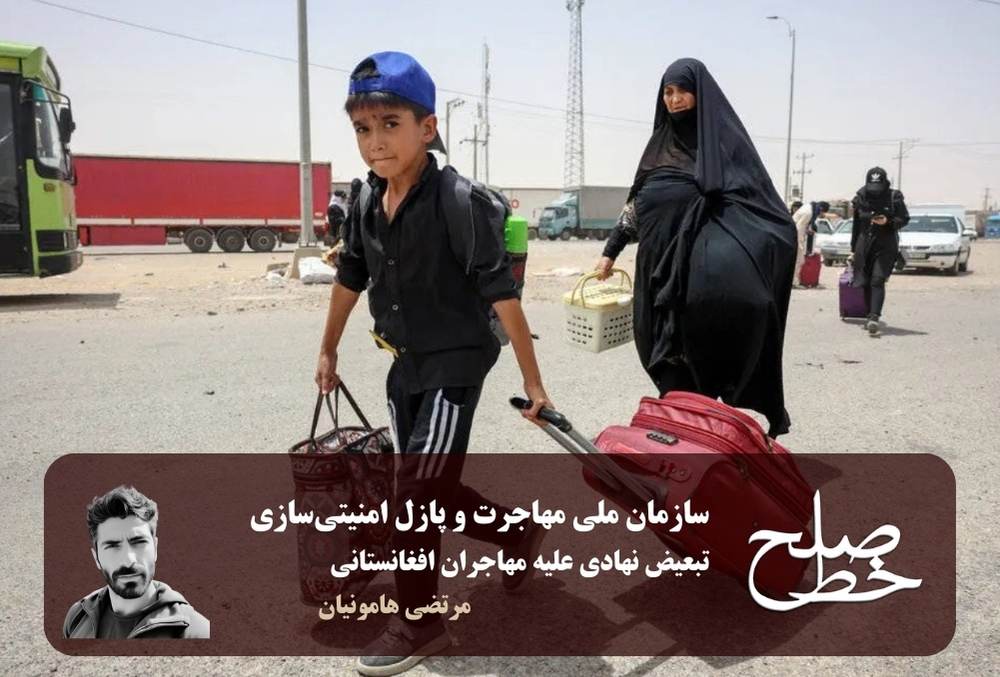
National Organization for Migration and Security Puzzle/ Morteza Hamounian
Migration is a historical subject that has always been a problem for governments. It can create issues for governments and can also turn into an opportunity. Sometimes, it is used as a tool by governments to manipulate and pressure others. Migration, especially in the 20th and 21st centuries, in a world where modernity is at the forefront, has multi-layered consequences that can manifest in economic, political, social, and security dimensions. This is a more serious matter for neighboring countries that share cultural and historical roots, and for lands that have been separated from each other throughout history. This is especially true when it comes to Iran and Afghanistan. Afghanistan has been in a state of war for decades, and Afghan migrants have seen Iran as their second home since the aftermath of the Iranian Revolution in February 1979. They have worked and toiled there, generations have been born and raised there, but they are still considered second-class citizens. Migrants and refugees whose rights cannot be compared to the
Migration from Afghanistan to Iran has ancient roots and is not limited to recent decades. For example, Taher Ahmadzadeh, a political activist and fighter, had Afghan origins before and after the 1979 revolution. His father had gone to Mashhad before his birth and had married there. Once, Amanullah Shah, the king of Afghanistan, had visited their house in Mashhad during Taher Ahmadzadeh’s childhood. (1).
After the occupation of Afghanistan by Soviet forces following the 1957 revolution, another wave of migration to Iran began. In the religious and revolutionary discourse of that time, these migrants were considered guests. Their presence in schools, universities, and the job market was accompanied by less strict measures, and even Afghan fighters in the form of a battalion named “Abu Zar Battalion” went to the battlefields of Iran and Iraq. Two thousand of them lost their lives in this war. However, in 1986, with the loss of some of the members of this battalion, they did not receive much support and the commanders decided to disband it. The members of the Abu Zar Battalion still remember that day as one of the saddest days of their lives. Additionally, these Afghan migrants never became Iranian citizens and remained as migrants.
During the 1970s, while Afghanistan was experiencing internal wars and the rise of the Taliban, another wave of migration to Iran took place. Afghan migrants, as a result of the war, occupation by the United States, and the presence of fundamentalists in Afghan politics, left their country in search of a better life. The attitudes towards migrants gradually changed, and the once respected brothers and sisters of faith became viewed as hardworking laborers, even being referred to as “Afghan” became a derogatory term. This trend continued in the 1980s and especially in the 1990s, with a focus on security. Afghan migrants were no longer seen as former religious brothers, but rather as a security issue, facing restrictions on their lives, residence, work, and travel. In the midst of this, legal changes only added to the troubles of Afghan migrants. In 2016, the Islamic Republic government implemented a program to register the information of migrants, with goals such as
Here, in order to understand the theoretical perspective of these discriminations and the situation of these immigrants, two key concepts must be taken into account. The first concept is “institutional discrimination”. This discrimination occurs when laws and official structures are designed or implemented in a way that restricts a social group’s access to opportunities. (5) This institutional discrimination is evident in the specific case of Afghan migrant citizens in Iran, in terms of limitations on education, employment, housing, and similar opportunities. The other concept is “securitization of migration”. According to the first definition by the Copenhagen School theorists: “Securitization is a process in which governmental actors transform simple political issues into security issues and, as a result, allow for the use of extraordinary measures in the name of security.” (6) This concept and securitization has also been accompanied by “othering” in the case of Afghan migrants. This means that Afghan migrants are not seen as workers or individuals seeking knowledge
The first issue regarding Afghan immigrants, which is institutional discrimination, has been a reality for years and is officially experienced by Afghan immigrants every day, by the government’s official and legal discrimination and sometimes by the people’s racist behavior. However, the second step, which is to provide security for these others who are responsible for whatever happens, has been taken. Another step has been taken, with the nickname of an organizational formation called the “National Migration Organization”.
In late Tir month of 1404 (June/July 2025), after the difficult days of the 12-day war, suddenly the representatives of the parliament come to the conclusion that they must approve the review of the bill on the structure, duties, and authorities of the National Migration Organization in the Joint Commission of National Security and Foreign Policy, as well as the country’s internal affairs and councils. There is so much urgency that Article 85 of the Constitution of the Islamic Republic of Iran is brought forward. This article allows for the delegation of the authority to enact certain laws or permanent approval of the bylaws of government organizations and institutions to internal commissions of the parliament, in which case the approved laws will be implemented for a specified period of time as a trial, meaning there is urgency for this organization to start its work quickly. All of this is happening while the official and unofficial propaganda of the government is blaming the Afghan migrants for the damages and consequences of the 12-day war. Ahmad
The claim is that the National Immigration Organization, with the aim of organizing the affairs of immigrants, coordinating between agencies, managing migration challenges, and providing services to foreign nationals, is formed. In other words, this organization is an official institution responsible for the affairs of foreign nationals and its duties include organizing the residency status of foreigners, coordinating with educational and health agencies, and formulating migration policies. On the surface, it is a good thing that an organization is dedicated to handling the affairs of immigrants. However, when it comes to the so-called Article 85 – which was explained above – the situation is different. Article 85 means that laws become subject to confidentiality. Before this, the law on chastity and hijab was subject to this process, which was eventually stopped by the order of the National Security Council. In fact, from the very beginning, transparency in this matter remained only as a slogan. The history of non-transparency in the structure of the Islamic Republic system is clear. In
“Of course, Shahed Azghib and Nader Yarahmadi, the head of the National Immigration Organization, justify the recent wave of expelling Afghan citizens from Iran by referring to the law and openly stating that a person who has come to Iran for medical treatment, has been successful in obtaining residency? Has he been successful in using other identity and residency documents? If he has not been successful, simply being present in our country for several years cannot be a valid reason for continuing his residency.” (9).
The process is clear. First, they advertise that all the problems of the country are caused by Afghan immigrants. Then, using the excuse of war, they blame all the security issues and troubles on them and convince society that these Afghan citizens were the ones who played a role in Israel’s infiltration into Iran. Their next step, along with the approval and establishment of a new institution, the National Immigration Organization, for security monitoring of non-Iranian citizens, is the widespread expulsion of foreign nationals, specifically Afghans, from Iranian soil. This expulsion is accompanied by disrespecting their dignity, tearing up their identity documents, confiscating their properties, and security measures. Momeni, the Minister of the Islamic Republic, announced in mid-July 1404 the expulsion of 400,000 Afghan nationals from Iran, and as mentioned above, the head of the newly established Immigration Organization is leading the police to deal with what he calls illegal immigrants in Iran. In fact, the National Immigration Organization
The National Migration Organization is a new organization. It was approved by the Supreme Administrative Council in Ordibehesht 1397 (April/May 2018). However, the draft of its structure, duties, and authorities has recently been sent to the parliament and has been subject to Article 85. The process of finalizing it is being carried out in a secure and fast manner. This organization, in its current state, is a part of the process of securing immigrants in Iran and giving the wrong address to the people of Iran. This wrong address, this time, is being used to further non-democratic nationalism and is being fed by it. This, of course, is similar to other government plans to manipulate public opinion and will only leave behind ashes in this game, along with the government’s drumming against immigrants.
Notes:
1- Memories of 60 years of struggle.
National-Religious News Base.
9 Azar 1396.
2- A narrative of the presence of 2,000 Afghan martyrs in the Sacred Defense.
Defa Moghaddas News Agency.
October 6th, 2022.
3- Forced expulsion, structural discrimination: systematic elimination of the lives of Afghan migrants in Iran.
We.
July 31, 2025.
4- Dr. Taghi Azad Ermaki: The Iranian society is an incomplete society.
Origin 20.
July 9th, 2025
5- Institutional discrimination, Institute of Culture, Art and Literature.
Ministry of Culture and Islamic Guidance.
January 1st, 2020
Fellow countrymen.
July 22, 2023
7- What is behind the scenes of the National Migration Organization bill?
East Network
July 22nd, 2025.
8- The establishment of an immigration organization increases transparency and security.
IRNA News Agency.
July 19th, 2025
9- The head of the National Organization for Migration of Iran has warned that hiring unauthorized foreign workers will no longer be easy.
Khabar Online.
August 14, 2025.
10- Resolution of the Supreme Administrative Council regarding the establishment of the “National Organization for Migration of the Country”.
The Center for Research of the Islamic Consultative Assembly.
, May 5th, 2018
 Created By: Morteza Hamounian
 August 23, 2025
Tags
Afghanophobia Fire extinguisher Morteza Hamounian Peace Line 172