


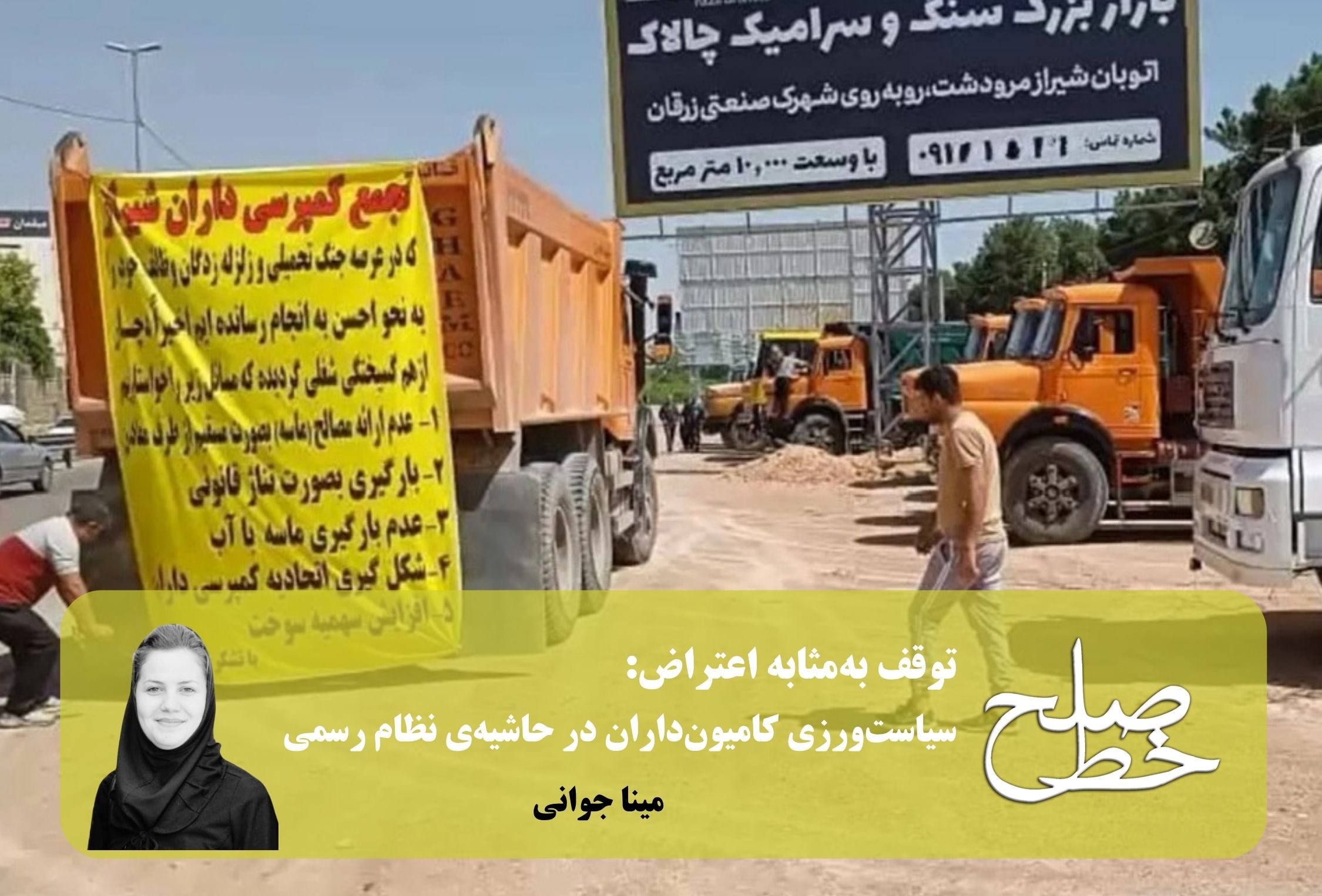
Stopping as Protest: The Political Practice of Truck Drivers on the Margins of Iran’s Formal System/ Mina Javani
In recent decades, strikes—as one of the main forms of collective action in contemporary societies—have become more than merely a professional response. They have transformed into powerful tools for expressing demands in contexts where institutionalized and formal participation is limited or blocked. In Iran, too—where structures for labor and trade union organization face legal, political, and security constraints—various forms of workplace protest have emerged. Though largely muted in the media, they carry significant symbolic and practical power. Among these, the truck drivers’ strikes hold a distinct position—not only because of their critical role in the supply and transportation chain, but also due to their method of organization, persistence, and demand-driven nature.
Truck drivers, as part of the largely unorganized and self-employed labor force, have launched several wide-scale strikes in recent years. While these have often focused on livelihood-related demands such as freight rates, fuel costs, and insurance, they also reflect broader dissatisfaction with economic conditions and structural inequality. These strikes, relying on the high potential of halting economic circulation in the country, have become one of the few remaining methods for the lower classes to exert pressure.
This article, focusing on the truck drivers’ strike as a form of informal political action, seeks to go beyond a purely economic analysis of the phenomenon. It explores the strike in connection with concepts such as the right to collective expression, forms of resistance within constrained institutional settings, and grassroots politics. The central question is how a professional action, in the absence of formal platforms for representation and participation, becomes a form of political language—a language that operates not through official discourse but through absence, refusal, and interruption in the ordinary flow of the economy, thereby gaining the potential to disrupt and effect change in the social field.
Truck Drivers, the Transportation Economy, and Barriers to Institutionalizing Demands
Truck drivers in Iran—especially independent owner-operators—play a vital yet complex role in the national economy. From a sociological perspective, this group is part of the unorganized and semi-independent working class, situated between private ownership and wage labor. This dual condition places truck drivers in a precarious position, as they benefit from neither the privileges of employers nor the protections typically afforded to organized workers. This structural liminality exposes them to extensive economic and social risks, manifesting in the form of cost fluctuations, job insecurity, and weak social safety nets.
Iran’s transportation economy is dominated by state and quasi-state institutions, creating a space where the ability of truck drivers to negotiate or influence decisions is severely limited. Policies on fuel pricing, freight tariffs, insurance, and repairs are largely top-down, leaving truck drivers with little real opportunity to participate in the decision-making process. This centralized structure, driven by rentier mechanisms, creates an imbalanced field that renders truck drivers a vulnerable group against market volatility and macroeconomic policies.
Furthermore, the absence of strong, independent trade organizations capable of offering sustained and genuine representation of truck drivers’ demands has weakened their organizational capacity. Existing official bodies mostly serve state and power structures, distancing themselves from the daily needs and concerns of truck drivers. This institutional gap has deepened their sense of distrust and social alienation, prompting their protests and demands to take shape primarily through informal, decentralized networks.
Despite geographical dispersion and the decentralized nature of their profession, truck drivers have managed to cultivate solidarity and organization through informal networks—particularly via social media and roadside gathering points. This fragile but functional structure enables coordinated collective action and strikes. It functions as a form of “politics from below” that can exert meaningful influence on both social and political spheres.
Informal Political Action: A Tool for Social Resistance in the Absence of Representation
In Iran’s political and economic context—where formal structures for professional representation or dialogue with power are severely restricted or entirely blocked—the truck drivers’ strike cannot be seen merely as a reaction to rising part prices or reduced diesel quotas. This action carries political implications, as it becomes an alternative language of expression, presence, and delineation of dissatisfaction when official avenues for participation are closed. Truck drivers, even if they do not identify as “political actors,” reproduce a space of resistance through work stoppage, disruption in the flow of goods, and the symbolic representation of absent bodies in the formal political field.
Sociologically, such strikes can be interpreted through the lenses of everyday politics and silent resistance. Truck drivers, relying on social networks and interpersonal trust, form a kind of “operational solidarity” that lacks a hierarchical structure but is effective in coordination. Their action lacks grand slogans or theoretical platforms, but precisely because of this, it can remain resilient and effective under repressive conditions. The truck strike also functions symbolically: trucks parked on highways become markers of refusal to participate in unequal relations. Even without direct articulation, this action forces the state to respond, as disruptions in the distribution chain are directly linked to economic security and the legitimacy of the governing order. Here, the economic body of the strike becomes a political body.
These actions, in the absence of unions, political parties, or free media, form part of what might be called the “underbelly of civil society”: forms of activism that, while temporary, local, and sometimes fragmented, possess the potential to redefine the people’s relationship with power. These actions not only challenge labor relations but also, by disrupting the logic of economic discipline, compel power to respond and, in some cases, to retreat.
Thus, the truck drivers’ strike carries three meaningful layers: first, it should be seen as a form of economic resistance motivated by livelihood concerns; second, as a form of informal political action operating in the absence of formal representation; and third, as a symbolic movement aiming to reconstruct the relationship between political order and working bodies. In the final analysis, what renders this strike a socio-political action is not only its demands, but its form, timing, networking, and indirect impact on the balance of power in the public arena.
The Lived Experience of Strike and the Biopolitics of Truck Drivers
In formal contexts, a strike is often defined as a refusal to work or disruption in economic flow. But on a more human level, it can be seen as the suspension of a body in motion. For truck drivers—whose identity is shaped by work and movement—the strike places them in a liminal, suspended state: not on the road, not at home, neither in action nor at rest. This suspended state is both painful and political. The drivers’ bodies—accustomed to long routes, sleeping in cabins, and constant exposure to roads and danger—are suddenly subject to stillness and waiting. The strike becomes a lived experience intertwined with economic anxiety, security threats, and moral preoccupations.
In this condition, the driver’s body is not merely that of a protesting worker; it becomes a silent battleground where political decisions, economic constraints, and the rhythms of daily life converge. What appears as truck stoppage is, in fact, a disruption in the biopolitical order of everyday life. When the truck doesn’t move, there is no income; when there’s no income, the household table shrinks, debts go unpaid, school is dropped out. Thus, the strike is not just a political or professional decision—it is a total movement at the level of the body and life. At the same time, this suspension can provide a space for reflection, dialogue, and the reconstruction of solidarity. During these days of stoppage, truck drivers stand together, talk, exchange work stories, share grievances, and in these moments, a collective memory takes shape. Even temporary halts at gas stations, roadside rest areas, or city entrances become sites where politics emerges from daily life.
When truck drivers stop working, the decision is not merely a professional refusal but a reconfiguration of their relationship with power. In the absence of independent parties, formal unions, or institutional bargaining channels, the driver’s own body becomes the primary arena of political action—a body that halts, anchors in space, and by this stillness, creates disruption in capital circulation and everyday order. This voluntary stoppage is, in fact, a form of action born of passivity—a “negative resistance” that finds meaning not in slogans, but in the suspension of economic rhythm.
In such a situation, previously unimaginable spaces—like roadside rest areas, highway margins, or gas station queues—become sites where politics from below is born. In these spaces, truck drivers are not just stopped bodies, but carriers of collective memory, shared suffering, and sometimes, a deferred dream. A kind of silent solidarity—perhaps the most direct form of political unity in the current closed environment—is forged in these very stoppages. In this sense, the strike is not an exceptional moment in a truck driver’s life, but a rupture that reveals the hidden layers of their biological existence in relation to naked power.
Conclusion
Examining the truck drivers’ strikes in Iran introduces us to a particular form of political practice that arises from within closed and repressive conditions—a politics that emerges not through formal institutions, but through their absence, and not through public, loud representation, but in silence and the void of speech. This kind of action must be analyzed within a broader theoretical framework that views power not only as a top-down structure but as a dispersed, life-based, and everyday relationship—and, conversely, sees resistance not as an exceptional event but as a disruption of the normalized order of daily life.
In this sense, the truck drivers’ strike is a prominent example of “politics from below,” in which the actors fight not only for professional rights but to redefine their position in the hierarchy of power. The act of stopping becomes a foundational gesture that goes beyond a simple refusal to work. This stoppage removes the worker’s body from the orbit of obedience and turns it into a disruptive element in the normal circulation of capital, goods, and social order. Such an act can be understood in line with what has been called “the hidden transcripts of the subaltern”—a politics that, rather than direct and loud civic protest, forms through layers of routine, evasion, suspension, and delay.
What emerges from this analysis is the need to rethink our models for understanding politics, activism, and resistance. In a society where political expression is severely constrained, politics is embodied not in institutions, but in peripheral places, and not in discourse, but in halted and worn-out bodies. In this sense, the truck drivers who park their trucks by the roadside are not merely demanding fairer wages—they are producing an alternative form of politics, one that speaks loudly through suspension, stillness, and silence.
References:
Bayat, A. (2010). Life as politics: How ordinary people change the Middle East. Stanford University Press.
Card, D., & Olson, C. A. (1995). Bargaining power, strike durations, and wage outcomes: An analysis of strikes in the 1880s. Journal of Labor Economics, 13(1), 32–61. https://doi.org/10.1086/298367
Kallas, J. (2025). Deepening our understanding of labor action: Examining how workers organize different types of strikes in the United States. Industrial Relations. https://doi.org/10.1111/irel.12393
Scott, J. C. (1990). Domination and the arts of resistance: Hidden transcripts. Yale University Press.
 Created By: Mina Javani
 June 22, 2025
Tags
CivilSociety InformalPolitics Labor protests LaborStrikes Paragraph peace line PoliticalResistance Poverty line in Iran SocialMovements Truck drivers TruckDrivers Truckers' strike Workers' strike ماهنامه خط صلح