


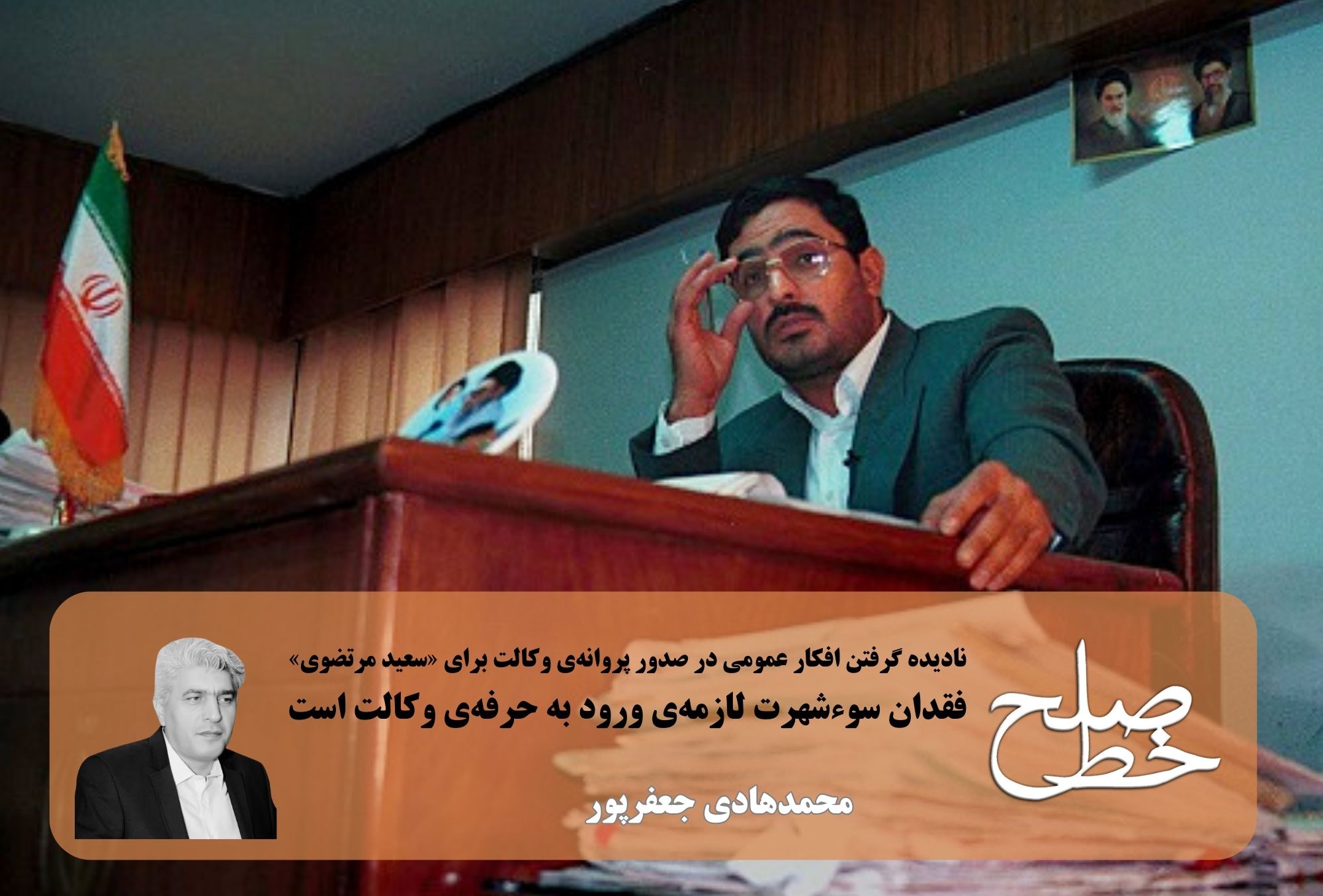
Ignoring public opinion in issuing a power of attorney for “Saeed Mortazavi” / Mohammad Hadi Jafarpour
Referring to the decision of the Bar Association of Yazd regarding the issuance of a lawyer’s license for Saeed Mortazavi (former judge and government employee), and considering the reaction of the legal community and lawyers’ protest against the performance of the board of directors of the Bar Association of Yazd, this decision is subject to legal and professional scrutiny.
Considering the fact that Saeed Mortazavi’s record during his tenure as the head of the judiciary and the Social Security Organization is in line with the provisions of Article 6 of the Independence Act and Article 69 of the 1400 Executive Regulations, which explicitly mention the oath of lawyers to uphold justice and defend rights, it is subject to analysis. This is because a judiciary lawyer is prohibited from behaving or expressing anything contrary to the dignity of the profession and judgment, and in carrying out this matter, takes an oath. According to the protesters against the issuance of the mentioned lawyer’s license, the decision of the mentioned association is against the general principles of the Lawyers’ Act and contrary to the provisions of the lawyers’ oath and the executive regulations and the Independence Act of the Bar Association, especially since “loss of good reputation” is mentioned as one of the important professional conditions of the legal profession. Therefore, it is possible to provide evidence for a request for a court order to annul
It should be noted that in the process of issuing a license for judges, there are two legal documents; one is the Law on the Independence of Lawyers and the other is its executive regulations. Article 9 of the Law on Independence specifies which individuals should not be granted a license. Paragraph 6 of this article also emphasizes that those who have behaved against the dignity of judges and lawyers, or have misconduct in dealing with lawyers, should not obtain a license. The objection and criticism that the community of lawyers has towards issuing a license for Morteza is based on the fact that he has had a judicial record in both positions as a judge and a government employee, and despite his acquittal, many lawyers believe that Morteza, based on his past, does not have the necessary qualities and reputation for obtaining a license.
In bar associations, there are procedures in place that, when judges request a license to practice law, the association’s board of directors will inquire about the applicant’s reputation from other lawyers. This information is also announced on the association’s website and other communication channels. If the board’s decision results in the denial of a license, the applicant can appeal to the Supreme Disciplinary Court of Judges. If this judicial authority, after reviewing the individual’s case, agrees to issue a license, the bar association will proceed to issue the license based on this decision. This is the best way to oppose the issuance of a license to judges who, during their tenure, have acted against the general laws and resolutions of the Council of Expediency, which recognizes lawyers and judges. In addition to the legal and customary flaws in the process of issuing this license, a noteworthy point in challenging the issuance of a license for Saeed Mortazavi is the disregard for the public’s perception of the legal profession.
Despite the fact that for years, the legal community has been struggling with the problem and challenge of government agencies’ blacklisting against the legal profession, the occurrence of such events will only add to the volume of blacklisting and, in other words, will undermine efforts to revive the social foundation of the legal institution. A noteworthy confirmation of this claim is the signature of tens of thousands of citizens in a campaign against granting a license to Saeed Mortazavi. In this campaign, created by a group of lawyers, significant points have been mentioned, as stated by the campaign organizers:
“We, as attorneys, are the guardians of independence and dignity in the legal profession. The presence and role of a “judicial attorney” in the process of litigation is essential and prominent. If the litigation, from its initial stages, is not carried out with the presence of independent, free, noble attorneys with a good reputation, its credibility is compromised and the establishment of justice and upholding of rights, without the presence of independent attorneys in the litigation, will be doubtful and minimal.”
“A lawyer” should, more than anyone else, be adorned with good morals and behavior and be free from dishonesty and misconduct. Protecting justice, which is the fundamental principle of the legal profession, requires many qualities, one of which is having a good reputation, and certainly, “infamy” and “notoriety” cannot be associated with the professional character of a lawyer.
Referring to the term “bad reputation”, the most important points that have been raised based on Saeed Mortazavi’s judicial-administrative records, as a common point among protesters against issuing a lawyer’s license for him.
 Created By: Mohammad Hadi Jafarpour
 February 19, 2025
Tags
7 Peace Treaty 1667 Bar Association Judge Judicial attorney Kahrizak Mohammad Hadi Jafarpour peace line Revolutionary Court Saeed Mortazavi Yazd Bar Association ماهنامه خط صلح