


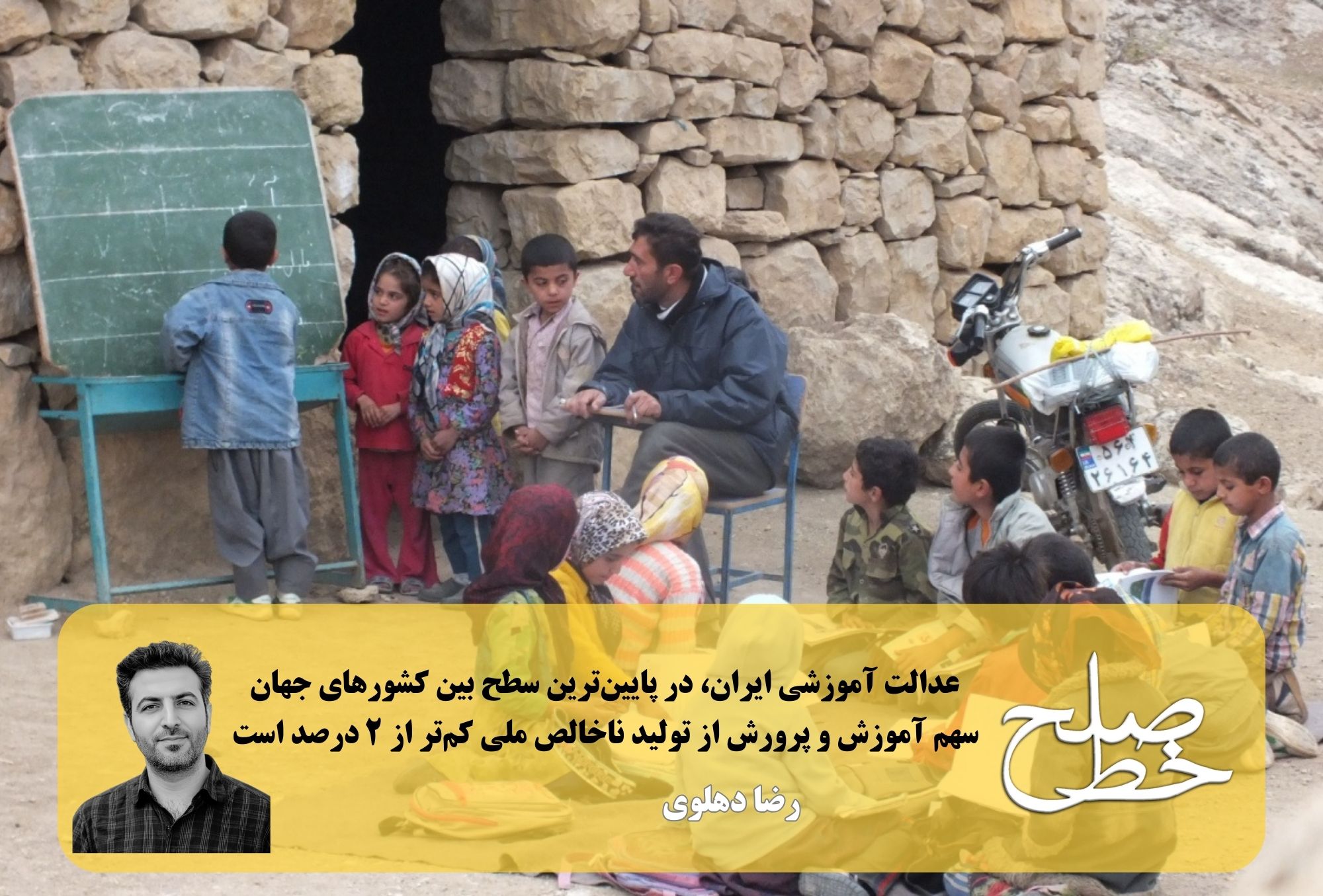
The Share of Education in the National GDP Is Less Than 2% in Iran/ Reza Dehlavi
Social justice, as a subset of the principle of justice, means equal rights for all people—regardless of race, color, language, social status, or similar factors—so that each person can attain what they rightfully deserve. Justice in education, as the most critical pillar of national progress and development, refers to the availability of “opportunities” and “educational resources” for all citizens. Educational justice is considered a subset of social justice. Since education and schools are components of social institutions, achieving justice in this area is a critical issue. Educational justice is realized through the equal distribution of resources for all learners across the country. Article 30 of the Iranian Constitution emphasizes the government’s duty to provide “free” and “equal” educational facilities. However, over the past four decades, this mandate has not been fulfilled. The establishment of specialized schools under various forms and names (private schools, gifted student schools, etc.) has widened the educational gap in Iran, leading to a stark class divide in the education sector. The lack of appropriate budget allocation and the government’s neglect of the importance and necessity of investment in this sector have posed serious challenges to the country’s educational system. According to official statistics, nearly one million children were deprived of education in the past academic year, and the quality of education in public schools has visibly declined.
This article seeks to answer the following questions: Has the Islamic Republic succeeded in achieving educational justice over the past 46 years? Do decision-makers and officials within the system have the will to implement educational justice in Iran?
Frequent Emphasis on Educational Justice by the Supreme Leader
The highest-ranking official in the Islamic Republic has frequently emphasized educational justice. He insists that justice in education must be implemented nationwide:
“I have repeatedly spoken about educational justice. There should be no difference in educational quality between a student in a remote area and a student in some district of Tehran. The standard of public schools must be raised to a level where students feel confident, and their families do not feel like they are abandoning their children in a place without support.” (1)
The Statistics Tell a Different Story
The establishment of specialized schools after the revolution, particularly in well-off provinces like the capital, has been one of the main contributors to educational injustice. Meanwhile, neglect of schools in border areas, rural regions, and urban slums has reached a point where, after 46 years since the 1979 revolution, underprivileged regions still rely on container classrooms, hut schools, multi-grade classes, and double-shift schedules. The variety of public school types and the emergence of fee-based schools have brought education to a point where, in the 2024 national university entrance exam (Konkur), only three out of the top 40 scorers were from public schools. In other words, the exam has become a competition between private schools and gifted student institutions. During the 2024 entrance exam, only 7% of top scorers came from public schools, a decline compared to previous years. The dominant share of top scorers came from gifted student schools (SAMPAD) and elite institutions. (2)
Specialized schools “handpick top students years before the Konkur, train them under specialized programs, and charge exorbitant fees,” effectively turning public schools into a last resort for other students. “Under these circumstances, motivation for competition diminishes for both students and qualified teachers.” (3) This systemic discrimination against border provinces and underprivileged populations suggests that the government intends to keep these regions impoverished, exploiting the situation to advance its ideological goals.
The unchecked increase in specialized schools, often established by regime affiliates, has turned these institutions into profit-making enterprises. The growth of private schools from 20,000 in 1989 to today illustrates that talk of educational justice in official speeches is little more than rhetoric. Data reveals that the number of gifted student schools has grown from five units in 1979 to 708 units today—a 141-fold increase—while the number of gifted students has risen from 938 to 124,487, a 132-fold increase. Similarly, the number of students in private schools has jumped from 620,068 in 1979 to 1,870,614 in 2021. (4)
The number of students deprived of education across primary, middle, and high school levels has reached 929,798. Among them, boys outnumber girls, with 489,574 boys being left behind. (5) Additionally, Alireza Kazemi, the current Minister of Education, reported a shortage of educational facilities, highlighting the absence of efforts to achieve educational justice over the past four decades: “The education sector requires nearly 14 million square meters of new educational space.” (6) This shortage is most pronounced in border provinces.
Budget Allocation for the Educational System
Socially advanced countries consider investment in education as the most crucial tool for comprehensive national development. Policymakers in these countries believe that free public education not only drives national progress but also prevents social stratification and injustice. Experience shows that leaders in less developed nations have achieved remarkable progress by investing in this sector.
For instance, “Singapore, which ranked first globally in education in 2020, began as a poor island with high illiteracy rates. In less than 50 years, it became an economic powerhouse. The country allocates 28-30% of its public budget to education, with an average expenditure of $11,000 per student.” In contrast, Iran ranks 51st among 76 countries, with per-student spending at just $600, compared to the global average of $9,313—indicating that other governments spend 15 times more on each student than Iran does. Even African countries with lower global rankings spend more. For example, South Africa spends $3,371 per student annually, while Iran spends just $600. (7)
On November 23, 2020, Mohammad Vahidi, a member of Parliament’s Education and Research Committee, stated: “Globally, 14% of public budgets are allocated to education, while in Iran, it’s only 8.9%. Regarding the share of education in GDP, it’s 4.6% worldwide, while in Iran, it’s less than 2%.” (8)
Gross Domestic Product (GDP) is a key indicator for measuring economic growth. It allows countries to compare their economic performance with others and helps policymakers allocate resources to various social sectors based on priorities. Countries that prioritize education dedicate a significant portion of their GDP to this sector. Unfortunately, Iran’s allocation is less than one-third of the global average.
According to Mojtaba Gholipour, a faculty member at the Strategic Studies Research Institute of the Ministry of Science: “The average proportion of educational spending to GDP in the first years after the revolution was around 6%. Over the past decade, it has fluctuated between 2.8% and 3.9%. Comparatively, the figure is 4-5% in Germany, 5-6% in Saudi Arabia, Oman, and France, 6-7% in Finland, 6.5-7.5% in Sweden, 7-8% in Denmark and Norway, and 9-14% in Cuba. In 2017, the global average was about 4.5%, which is still more than half a percent higher than Iran’s best-performing years in the past decade.” UNESCO expects countries to allocate at least 4-6% of their GDP to education annually, but Iran still falls short of even this minimum benchmark.
In Iran, less than 10% of the public budget is allocated to education—around 8.9%—compared to the global average of 14%. In 2013, this figure stood at 18%, before a governmental shift toward privatizing education. A notable point is that “98% of the education budget is spent on salaries, with only 2% dedicated to improving quality, which is managed centrally by the ministry.” (9)
This piecemeal approach to funding the education sector, where nearly all resources go toward salaries, has reduced the possibility of improving the educational system or achieving justice in this sector to nothing more than empty slogans frequently uttered by officials during various occasions.
Teacher Shortages and Diversity: Another Dimension of Educational Inequality
Currently, Iran has approximately one million teachers. However, according to a report by the Parliamentary Research Center, “the education system is short by 300,000 teachers.” (10) Research indicates that teachers are one of the most critical pillars of an effective education system. Farhangian University, the primary institution responsible for training educators, produces “17,500 teachers annually.” (11) Yet, statistics on retirements in the education sector show that, on average, 45,000 teachers retire annually from 2013 (1392) to 2024 (1403):
- 23,049 in 2013 (1392),
- 29,910 in 2014 (1393),
- 25,892 in 2015 (1394),
- 37,899 in 2016 (1395),
- 37,575 in 2017 (1396),
- 42,796 in 2018 (1397),
- 40,120 in 2019 (1398),
- 26,471 in 2020 (1399),
- 65,499 in 2021 (1400),
- 43,637 in 2022 (1401), and
- 50,000 in 2023 (1402).
According to Alireza Kazemi, “this year, 70,000 teachers are set to retire.” (13) A simple comparison between the influx and outflow of teachers in Iran’s education system demonstrates that with each passing year, the number of vacant classrooms continues to grow. The imbalance between teacher retirements and the capacity of Farhangian University has forced the Ministry of Education to adopt alternative, temporary measures to address this crisis:
- Rehiring Retired Teachers
The Minister of Education has advocated for rehiring retired teachers as a short-term solution to fill empty classrooms. On August 27, 2024 (5 Shahrivar 1403), he stated during a governors’ conference: “Using retired teachers is one of the best solutions for addressing the teacher shortage. I’ve told provincial education directors that if we invite these teachers and ask for their help, they will surely assist us.” (14) Rehiring retired teachers is seen as economically viable for the Ministry of Education, as these individuals are typically hired on a part-time basis, minimizing financial strain. However, this approach exacerbates youth unemployment among educated graduates. - Contract Teachers (Kharid-e Khedmat)
According to data from the Parliamentary Research Center, “the majority of teachers recruited in the past five years were employed through the Kharid-e Khedmat (contract-based) system, with the highest number of such hires occurring in the 2020-2021 academic year.” (15) Contract teachers are not directly employed by the Ministry of Education. Instead, private contractors sign agreements with the ministry to supply teachers, and the ministry pays these contractors, who then deduct their share and allocate the remainder as salaries for the teachers. According to the ministry’s spokesperson, “26,300 contract teachers are currently employed in the education system.” (16) - Part-Time and Hourly Teachers (Haghol-Tadris)
The Ministry of Education has never disclosed the exact number of part-time teachers. However, some officials acknowledge that “employing part-time teachers is a way to address the teacher shortage.” (17) These teachers are subject to systemic exploitation. They are excluded from benefits such as insurance and retirement plans, and according to a 2020 (1399) report by the Parliamentary Research Center, “the highest salary for a part-time teacher with 18 years of experience was 800,000 tomans (approximately $30).” (18)
Systematic Mismanagement and Broken Promises
Over the past 46 years, misguided policies and unscientific decision-making have not only failed to achieve educational justice but have also pushed the education system to the brink of collapse. Today, educational justice has become a tool for officials in the Islamic Republic to project an image of fairness, often referenced in speeches when the need arises. For instance, Masoud Pezeshkian, a long-time official who has held key positions since the early years of the revolution and has been among the highest-ranking officials from 2008 to 2024, criticized the issue on January 13, 2025 (24 Dey 1403), during the 31st anniversary of the establishment of educational councils:
“We must not overlook educational injustice. Under no circumstances should we allow educational inequality and unfairness to emerge in our country.” (19)
During this event, Pezeshkian positioned himself as a vocal critic of the existing disparities in the education system, conveniently ignoring the fact that he himself has been part of the governing structure responsible for these issues.
A Deepening Educational Divide
The current state of Iran’s education system reveals that over four decades of governance have resulted in widening class divisions and growing educational inequality. Challenges such as teacher shortages, unequal distribution of educational resources, declining quality in public schools, privatization policies, the commodification of education through the establishment of specialized schools (private schools, gifted student institutions, etc.), insufficient budget allocations, lack of equitable access to public education, rising student suicides, and inadequate salaries for teachers paint a grim picture.
These realities demonstrate that since the Islamic Revolution, not only has educational justice failed to materialize, but the very concept of justice in education has progressively faded. A stark reminder of this systemic failure is the fact that nearly one million children were excluded from education in the past academic year. This alone underscores the extent to which Iran’s education system has failed to achieve even the most basic standards of “educational justice.”
Footnotes:
- Supreme Leader’s Views on Educational Justice, Mashregh News, September 1, 2020 (11 Shahrivar 1399).
- Untold Facts About the 2024 Entrance Exam: Public Schools’ Small Share Among Top Scorers, Hamshahri Online, September 5, 2024 (15 Shahrivar 1403).
- Ibid.
- Education in Iran from 1979 to 2021 in Numbers, Tasnim News, February 10, 2022 (21 Bahman 1400).
- Education in Numbers, Setareh Sobh Online, October 16, 2023 (24 Mehr 1402).
- Provincial Rankings Based on Educational Justice Indicators: Need for 14 Million Square Meters of New Educational Space, ISNA, October 9, 2024 (17 Mehr 1403).
- Iran’s Global Education Ranking: Why Is Our System Consumption-Based? Daneshjoo News Agency, October 29, 2020 (7 Aban 1399).
- Education’s Share of the Public Budget Drops from 18% to 8%, Tasnim News, October 24, 2020 (3 Aban 1399).
- Ibid.
- The Education System Is Short 300,000 Teachers, Parliamentary Research Center, October 1, 2020 (10 Mehr 1399).
- A Shortfall of 79,000 Teachers, Asr Iran, October 28, 2023 (6 Aban 1402).
- Statistics on Retired Teachers (2013-2023), Amar Fact Website.
- 30,000 Retired Teachers Ready to Teach, Tasnim News, August 27, 2024 (5 Shahrivar 1403).
- Ibid.
- Contract Teachers: The Majority of New Recruits in the Last Five Years, Tasnim News, October 19, 2023 (27 Mehr 1402).
- Permission Granted to Employ 26,300 Contract Teachers, ISNA, August 30, 2024 (8 Shahrivar 1403).
- Part-Time Teachers: A Solution for Addressing Teacher Shortages in Technical Schools, Parliamentary Research Center, August 4, 2018 (13 Mordad 1397).
- The Education System Is Short 300,000 Teachers, Parliamentary Research Center, October 1, 2020 (10 Mehr 1399).
- Pezeshkian: Educational Injustice Must Not Be Overlooked, Mehr News Agency, January 13, 2025 (24 Dey 1403).
 Created By: Reza Dehlavi
 January 20, 2025
Tags
Deprived areas Education and training Educational inequality Educational justice Privatization Social justice State schools Students Teacher shortages Teachers ماهنامه خط صلح