


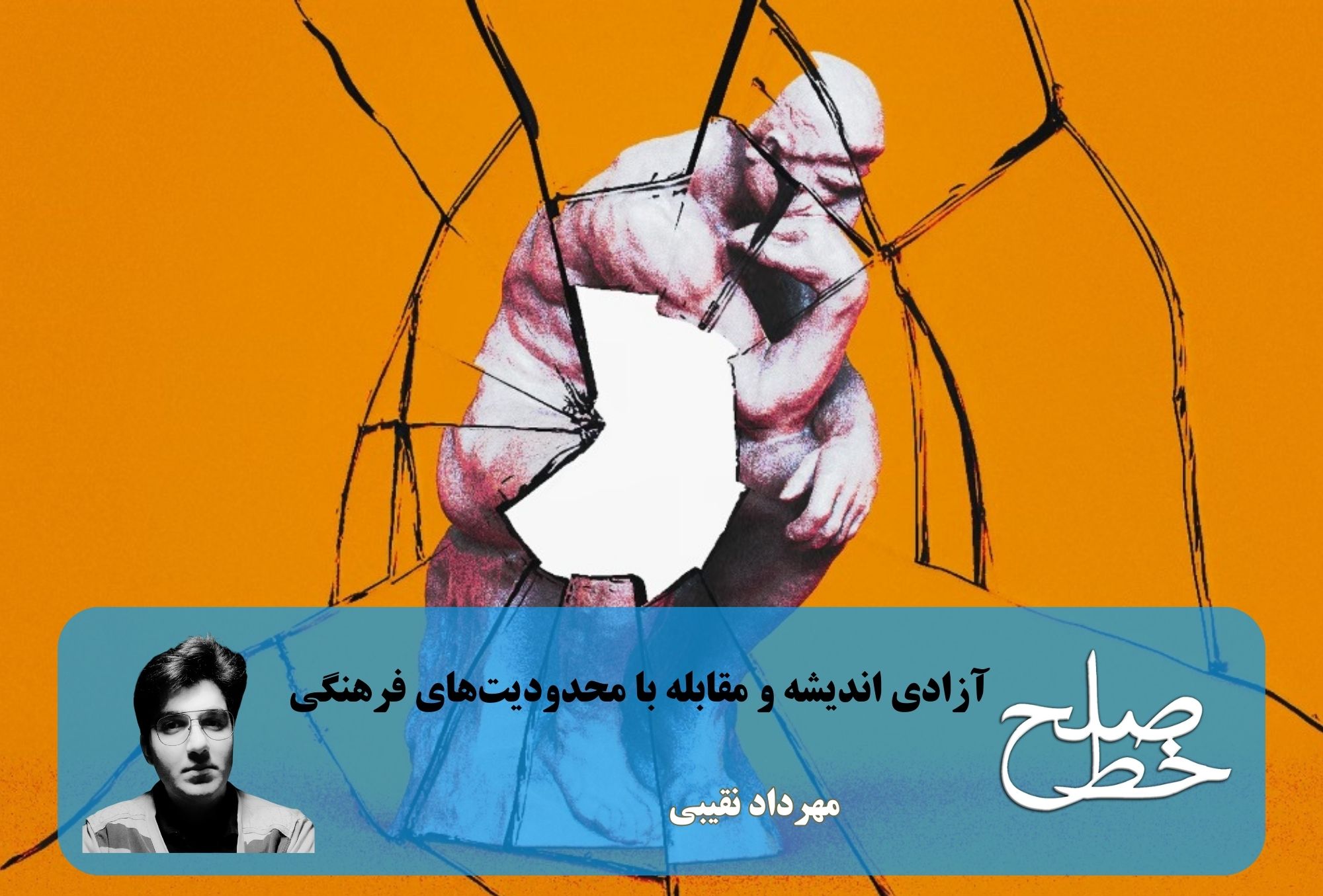
Freedom of thought and resistance against cultural limitations / Mehrdad Naghibi
The dismissive and belittling approach towards independent intellectuals was not limited to the post-revolution and the rule of the Islamic Republic, but even before the revolution, independent intellectuals were also subjected to ridicule and threats from the ruling government.
The approach of negating intellectualism has not only been promoted and justified by the government, but also by a significant portion of the general public. They have used various excuses to attack and discredit intellectuals, and have deemed their presence in social and cultural spheres unnecessary. As a result, intellectuals have been perceived as an extra layer in society since the beginning of their activism, and all failures and shortcomings have been attributed to their presence and actions.
In the face of such terrible conditions, few have dared to criticize in order to examine the various reasons behind cultural mechanisms, as intellectuals have been expelled and rejected for a hundred years for striving for freedom, intellectual independence, and cultural advancement.
The phenomenon of enlightenment in our society can be summarized in three major issues:
1- The first method is the type of approach of governments. Authoritarian governments, before and after the revolution, have prevented the formation of critical thinking through authoritarian measures and policies, and have prevented the organization of democratic institutions in society, and with the help of censorship and oppression, they have been able to eliminate “others” in various fields.
2- The second method is one that has been emphasized in the past few decades, in line with the policies of global neoliberalism and right-wing extremism, and focuses on the discourse of “depoliticization and utopianism”. In some cases, it strives to discredit critical sociological functions by creating baseless and fundamental concepts. In such an environment, the mainstream media seeks to replace neutral experts and celebrities with independent intellectuals and to trap society in anti-intellectualism. In this method, right-wing thinkers have been able to achieve their desires by using tools of power, directly and indirectly. These desires have been completely reactionary and their only achievement has been authoritarianism in various fields.
3- The third method stems from the despotic culture of society. In a society where there is no foundation of tolerance and critical thinking, critical intellectuals have always been introduced as a dangerous element in society, and in order to reduce this danger, they must be eliminated in all areas.
In light of the mentioned perspectives, various political groups, self-governing governments, and the general public beat the drum of anti-intellectualism and claim why intellectuals should be outside the ruling system and not cooperate with the dominant regime?
Poets and writers who were committed to the ruling policies were always engaged in activities outside of the ruling system. This was because the ruling system acted against democratic policies and oppressed intellectuals. This denied the government officials and the general public the right to criticize and threaten intellectuals who stood against non-democratic policies.
Many of these mentioned groups argue that if intellectuals accept the invitation of power institutions to collaborate, what is presented as “developmental order” will become executable. However, they forget that the “developmental order” is in the interest of preserving independence, organizing democratic formations, promoting freedom and social justice, which makes the process of development possible in society and guarantees its dynamism.
The tangible conditions and historical events show that the ruling powers in Iran have not been and are not committed to these principles, and have attempted to suppress independent organizations. While agents and experts affiliated with the power consider committed intellectuals as non-self and redundant, intellectuals continue to emphasize honesty and cultural superiority. In the perspective and orientation of governments and some political groups – whether in favor or against the government – the basis of dealing and critical expansion should be reduced to compromising and cooperation approaches, as intellectual compromise is considered necessary in the expansion of authoritarian government policies. Intellectuals should not hinder the authoritarianism of politicians with critical-radical slogans. This approach has been pursued persistently both in the past and in the present time. For example, during the Shah regime, independent and free-thinking intellectuals who were not willing to cooperate with the government were always under severe pressure, and the government used baseless accusations to create a false legitimacy in order to suppress intellectuals. The Shah regime did not tolerate the protests and democratic demands of
Many have tried to separate the cultural functions of imperialism from the overall policies of the government in order to bring intellectuals into power. But the fundamental question is, can the hellish police-security apparatus of Savak be separated from the overall regime of the Shah and be focused on cultural functions? An institution that, during its reign, was directly responsible for the suppression, torture, imprisonment, and execution of committed intellectuals. Additionally, can the military-security institutions of the Islamic Republic be separated from the overall government and focused on cultural activities within government-affiliated associations and organizations that operate within the framework of cultural activities? Institutions whose activities are solely focused on expanding and infiltrating the cultural structure and pressuring for the suppression and elimination of independent intellectuals.
On one hand, defenders of the government and political groups claim that intellectuals have always been outside of society and have no understanding of its existence. However, the tireless efforts and sacrifices made by intellectuals such as Farrokh, Eshghi, Karimpour Shirazi, Vartan, Saadi, Pouyan, Sha’ayian, Dehghani, and Darvishian before the revolution, and intellectuals such as Paknejad, Rahimi, Sultanpour, Miralai, Hosseini, Mokhtari, Pouyandeh, Duani, and Abtin and others after the revolution, as well as many others who have paid a heavy price in both historical periods, discredit and invalidate this claim.
With these interpretations, it can be understood that compassion and critical thinking are derived from a cohesive social system that adopts a rational approach when dealing with events. (4) In contrast to cooperation and accommodation with despotic governments that reject the main components of intellectualism and deny critical thinking. Since compassion and critical thinking have no place in the social sphere and society is still under the influence of old despotic structures, (5) cultural mechanisms continue to hold onto their past power.
Neutral experts and government officials described their conciliatory and passive approach in collaborating with the former monarchy and religious government as “comprehensive development”, while existing facts and results prove otherwise.
All independent intellectuals have objected to the imposition of authoritarian policies in historical periods, which did not allow for the development of independent culture and the expansion of democratic rights in society. Therefore, it is not surprising that mainstream media and a significant portion of the public refer to intellectuals with derogatory terms such as self-serving servants, instigators of chaos, conspirators, deceived, and in some cases, even terrorists.
The efforts of oppressive and tyrannical forces in the issue of intellectualism are aimed at preventing the masses from connecting with intellectuals and depriving thinkers of the ability to criticize culture and identify social inefficiencies. The plans and policies implemented are in fact aimed at ensuring the survival of the ruling system as a whole and reproducing traditional culture. Restricting critics within discriminatory structures that dismiss independent functions undoubtedly hinders the role of everyone in cultural development. Affiliated experts believe that the role of intellectuals should be transferred to the community within bureaucratic and top-down frameworks. This policy was also pursued during the Shah regime and the Islamic Republic regime also defines its cultural mechanisms with such an approach. From the perspective of bureaucratic-governmental policies, remaining silent and acting non-politically is the best option. Therefore, the most important demand and request of committed and freedom-loving writers and poets – namely, unlimited and exceptional freedom of expression for which they have been fighting for years – has no meaning or concept for their rulers
Is mass confiscation of various media and publications, massacre, disappearance of dissidents, and granting of freedom of expression present in the government of the Islamic Republic? With these interpretations, are intellectuals to blame for all the existing misfortunes? Intellectuals who have been belittled under the domination of their own arrogance and the limitations of their traditional culture, and are still subject to the most severe insults for standing up for their ideals, and in some cases, have even been horrifically murdered. Therefore, it is impossible to demand and expect the progressive demands of intellectuals for the abolition of censorship and guaranteeing freedom of expression, and to accept the superficial concerns of the dominant regime. Why should intellectuals serve a system of tyranny that is fundamentally opposed to collective reason?
During the reign of the Shah, the spread of corruption, social inequalities, poverty, and absolute oppression created a terrible situation in which some committed intellectuals laid down their pens and adopted other methods of struggle due to the injustices that had pushed society to the brink of decline. (6) In the Islamic Republic, all cultural spaces are exclusively controlled by security institutions. However, despite the suffocating atmosphere, intellectuals do not give up the fight for freedom of expression and continue to strive for it.
As long as tyranny and oppression reign, revolutionary struggles will continue to exist in society. Intellectuals will therefore not stand in the ranks of moderation and compromise, but rather in the ranks of efforts for cultural development. However, it is obvious that the measures taken by previous governments and the current ruling government, on one hand, and the superficial concerns of the general public, on the other hand, have led to the widespread promotion of anti-intellectualism and its normalization in social discourse. A clear example of this is the increasing suppression of poets and writers who uphold the principles of independence and commitment, while a significant portion of the public remains indifferent to their oppression by the ruling government and even remains silent in some cases, or even aligns with the dominant regime.
Notes:
1- Mokhtari, Mohammad, Tamarin-e Modara, Mashhad: Botimar Publications, 2nd edition, Winter 1395.
2- Same (1).
3- Naghibi, Mehrdad, Why is cultural privatization important?, Khat-e-Solh Monthly, Issue 149, Fourteenth Year, October 1402, p. 18.
4- Same (1).
5- Same (1).
6- Naghibi, Mehrdad, who fired the first bullet?, Daily News website, 7 Khordad 1402.
 Created By: Mehrdad Naghibi
 January 21, 2024
Tags
Enlightenment Freedom of belief Freedom of speech Intellectuals Mehrdad Naghibi Monthly Peace Line Magazine peace line Peace Line 153 Tyranny