


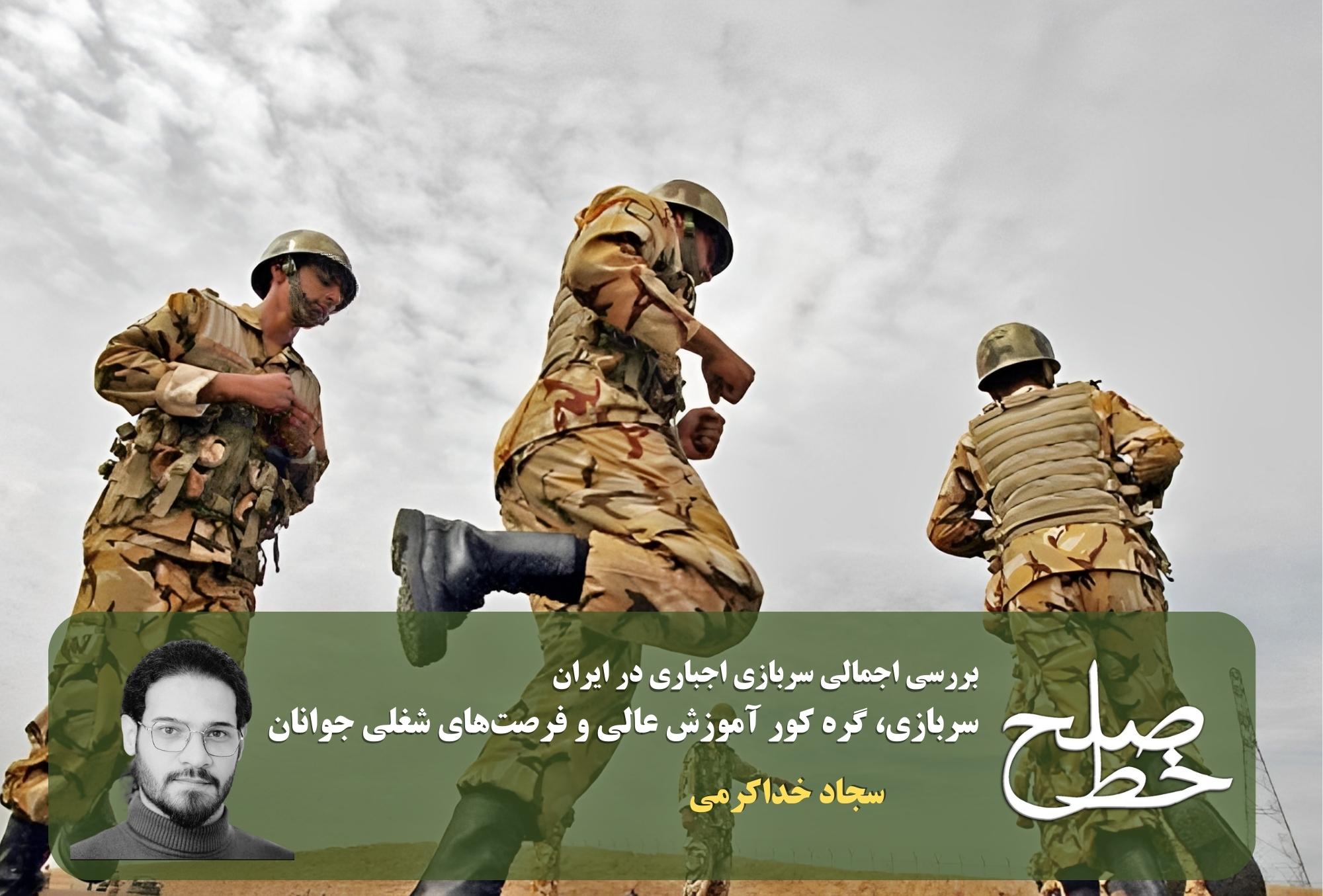
Military service, a blind knot of higher education and job opportunities for young people / Sajjad Khodakarami
It has been more than a century since the issue of mandatory military service in Iran has been ongoing. This compulsory service in the country’s military has, of course, revealed its flaws after such a long period of time. Flaws that have become a knot in the lives of many young people and a strong barrier against their higher education and employment. From the very beginning of the story of mandatory military service during the Nasser era until now, the rules and regulations of mandatory military service in Iran have undergone various changes; changes that have always been accompanied by slogans of improvement, but have been met with difficulty. In the continuation of this process, now both the government and the Islamic Republic’s parliament have once again raised the voice for change with the slogan of improvement; although everyone knows that the fate of mandatory military service in Iran is not in the hands of these two institutions, but in the hands of the Supreme Leader of the Iranian Armed Forces, Ali Khamenei.
On the pretext of this repeated murmur about changes in the conditions of military service and conscription, we have taken a look at the mandatory military service in contemporary Iran and examples of experiences in some countries that have said goodbye to compulsory military service. We have also examined the impact of compulsory military service in Iran on the state of higher education and employment of young people.
Types of military in the world
As far as history shows, since the time of Napoleon Bonaparte, the Emperor of France in the 19th century, the issue of conscription and military recruitment has always been a constant topic of discussion and challenge in societies around the world. Throughout modern times, countries have used various methods to organize their armies, but when it comes to conscription, countries are generally divided into three main categories: voluntary conscription, compulsory conscription, and a combination of the two previous methods.
In voluntary military service, citizens choose to join the army and no one is forced to serve. In this case, the army can become a profession. On the other end of the spectrum is compulsory service, where certain individuals (usually adult men, but may also include women) are required to serve in the army for a period of time in certain countries.
Another option, which lies between these two, has various types, but generally, in this situation, capable individuals within a specific age range are required to register in a specific system so that they can be available for service during a certain period of time if needed. In this case, similar to mandatory military service, not everyone is required to join the army.
Compulsory military service in Iran; background and current situation.
Compulsory military service in Iran has a history of approximately one and a half centuries. The traces of discipline and order in the military forces of present-day Iran and the formation of a new philosophy in providing military forces, known as conscription, date back to the year 1244 AH (1868 CE). This was when Mirza Mohammad Khan Sepahsalar compiled the “Military Law” booklet, which was officially recognized with the signature of Naser al-Din Shah Qajar.
In the first section of the mentioned booklet, which is written in two parts titled “Government” and “Servant”, it is mentioned about the length of military service, which is 10 years. After two years of service, the soldier is granted a two-year leave and in total serves for 6 years. In some sections of this law, provisions are made for desertion or disobedience of orders, such as “flogging” and “imprisonment”. In the second part of the book, points are considered regarding the encouragement and rewards for soldiers and those who are injured or killed in service.
But at the beginning of the new solar century, Reza Khan, as the Minister of War, took action in the army and established a branch called “Conscription” or “New Recruitment” and set regulations for military service. When he was the Prime Minister of Iran, on June 6, 1925, the National Council passed a law with 32 articles for compulsory service. This law became the basis for military service as it is today. In February of the same year, the branch of “Conscription” was changed to “Compulsory System Department” and “Compulsory” became synonymous with “military service”.
This recruitment system was initially established based on criteria such as promoting discipline, strengthening the national commitment of young people, and strengthening the armed forces of the country, and it continued. After the 1979 revolution, it was also strengthened as a means of strengthening the connection between young people and the Islamic system and utilizing their abilities to serve the Islamic system.
After the formation of conscription during the Naseri era and its appearance during the first Pahlavi era, the law of compulsory military service was once again reviewed on 29 Khordad 1317 and in nineteen chapters, it took on a more precise form and appearance. However, it also underwent many changes afterwards. Although the law of compulsory military service did not undergo significant changes during the second Pahlavi era, after the 1979 revolution and with the change in the government structure and the Iran-Iraq war, the law of military service underwent changes on 29 Mehr 1363. 27 years later, in Aban month of 1390, under the pretext of empowerment, improving social status, and improving the conditions of military service, the law of military service was once again reviewed.
According to the latest changes in the conscription law, public service duty in Iran is 30 years and includes four periods of necessity (2 years), reserve (8 years), first reserve (10 years), and second reserve (10 years). During peacetime, it is allowed for this period to be reduced to 18 to 24 months.
The work that is being delayed!
The impact of mandatory military service on Iranian youth is multifaceted. Mandatory military service in Iran, according to statistics and the opinions of experts, has been and continues to be a serious obstacle for young people to access higher education and job opportunities.
One of its main effects is the delay in entering the job market and the decrease in job opportunities for the young population. After completing their military service, young people’s employment is delayed due to the time they have spent in this period, and they usually enter the job market at a later age. This can lead to a decrease in job opportunities and tougher competition for them.
One of the important factors in the impact of compulsory military service on the job opportunities for young people is the inability to determine a career path for a significant portion of young people after completing their service. After completing their military service, young people often face challenges such as delays in entering the job market and lack of relevant work experience in their fields of expertise. This issue causes young people to reach their desired jobs later and experience delays in their professional paths.
In countries where military service has been abolished or limited, young people can enter the job market freely and without the problems of mandatory military service, which forces them to spend their best years in it. They can gain work experience related to their specialties. In these countries, the absence of mandatory military service has led to an increase in job opportunities and the creation of healthy competition in the job market.
Examining the statistics and figures related to the employment and unemployment rates among young people after completing their mandatory military service can demonstrate the impact of this compulsory duty on the job opportunities for young individuals. The statistics show that a significant portion of young people face unemployment issues after completing their mandatory military service.
According to official statistics, the unemployment rate among young people after completing military service is higher than those who have not completed this service. This indicates a delay in entering the job market and a decrease in job opportunities among young people. In practice, some young people are looking for a job and a basic income after completing military service, but due to tougher and more competitive job market, they are unable to achieve the expected success.
Higher education in service of mandatory military service.
But the story of compulsory military service in Iran has another chapter, and that is the negative impact it has on the higher education of young people. Many young people, after completing their military service, face problems such as cutting ties with their academic progress, lack of training skills, and decreased motivation. Additionally, their access to universities and opportunities for higher education is also affected by their compulsory military service.
After completing their military service, young people may have less opportunity to pursue higher education due to delayed enrollment in university. Additionally, fatigue and lack of motivation resulting from their time in the military may lead to limitations in accessing higher education. After completing their military service, young people may face difficulties such as dropping out of school and not having the financial means to pay for university tuition. These factors prevent many talented young people, as well as those who are interested in continuing their education in various fields, from being able to enter university properly and directly.
According to statistics and figures related to access to higher education and the number of students before and after mandatory military service, important results can be extracted. These statistics indicate that young people mostly face difficulties in accessing higher education after completing their military service.
Higher education and access to university are important for many young people. Despite mandatory military service in Iran, some boys who should be studying at university are forced to delay their education or even give it up altogether. Currently, access to university in Iran still faces challenges and mandatory military service can exacerbate this problem.
The result of abandoning compulsory military service in countries.
Some countries have made the decision to either abolish or reduce mandatory military service over the years. There are various reasons for these decisions, some of which can be mentioned:
Social and cultural changes
In societies where values and social attitudes have changed, compulsory military service may conflict with new values and priorities. For example, emphasis on individual freedom, attention to human rights, promotion of gender equality and social equity can lead to a decrease in the importance of compulsory military service.
Technology and Innovation
With the advancement of technology and the use of modern military systems, the need for human resources has decreased in some areas. For example, the use of advanced military systems, artificial intelligence, and robotics may require fewer human soldiers to perform military tasks.
Change in security threats
In some cases, the security threats of countries have changed. For example, some countries are facing non-military threats such as terrorism, human rights violations, and cyber threats. In such situations, the need for experienced and specialized human resources in related security fields may increase, making mandatory military service unnecessary and impractical. For this reason, some countries decide to reduce or eliminate mandatory military service.
Studying the experiences of other countries that have abolished or limited military service can demonstrate various methods and impacts on higher education and job opportunities for young people. For example, in countries like Germany, Canada, and New Zealand, mandatory military service has been abolished and young people are free to participate in higher education, and job opportunities have improved for them. In Germany, with the abolition of mandatory military service, the higher education system has improved and talented young people can freely participate in top universities. Additionally, job opportunities for graduates have increased and they can directly work in their desired fields of expertise.
Other examples – which can mostly be found in Scandinavian countries – relate to military service in countries such as Finland, Sweden, Norway, and Denmark. For example, Finland is one of the countries that has changed its conscription system and instead of mandatory military service, it has focused on a national service system. In this system, young people can fulfill their national service obligations by doing relevant work during their years of study, instead of mandatory military service. Denmark is another country in Northern Europe that has made reforms in the area of mandatory military service. In 2004, the country abolished its mandatory military service system and replaced it with a system known as national service. In this model, young people can fulfill their national service obligations by participating in social and community projects during their years of study. This has allowed young people in this country to gain valuable work experience while studying at university and improve their social connections.
Compulsory military service, which is carried out during a very sensitive time in life and isolates young citizens from society for several months, no longer holds meaning in these countries. As Elizabeth Braw, senior researcher at the Royal United Services Institute, says, “What sets today’s Cold War apart is that countries no longer need everyone to serve. They don’t need a massive infantry army.”
Notes:
1- Azar, Masoud, “A Century with Putin and the Soldier’s Cap, from ‘Qibla-ye Alam’ to ‘Vali Amr'”, BBC Persian, 20 Farvardin 1401.
2- Youth Unemployment and Employment Report, Statistical Center of Iran, 1399.
3- Statistical report of universities and students, Ministry of Science, Research and Technology, 1399 (2020-2021).
4- Institute of Cultural and Social Studies, Youth and Job Opportunities, 1398.
5- Smith, J., The Impact of Mandatory Military Service on Higher Education and Employment Opportunities for Youth: A Comparative Study, International Journal of Educational Research, 2021.
6- Segal, David, and Fior, Peter, end of military service? A comparative analysis of military recruitment policies in Western democracies, 2001.
 Created By: Sajad Khodakarami
 June 22, 2023
Tags
Compulsory military service Conscription Duty system Higher education mandatory Military Monthly Peace Line Magazine Occupation peace line Peace Treaty 146 Sajjad Khodakarami Suicide Tell me about the military.