


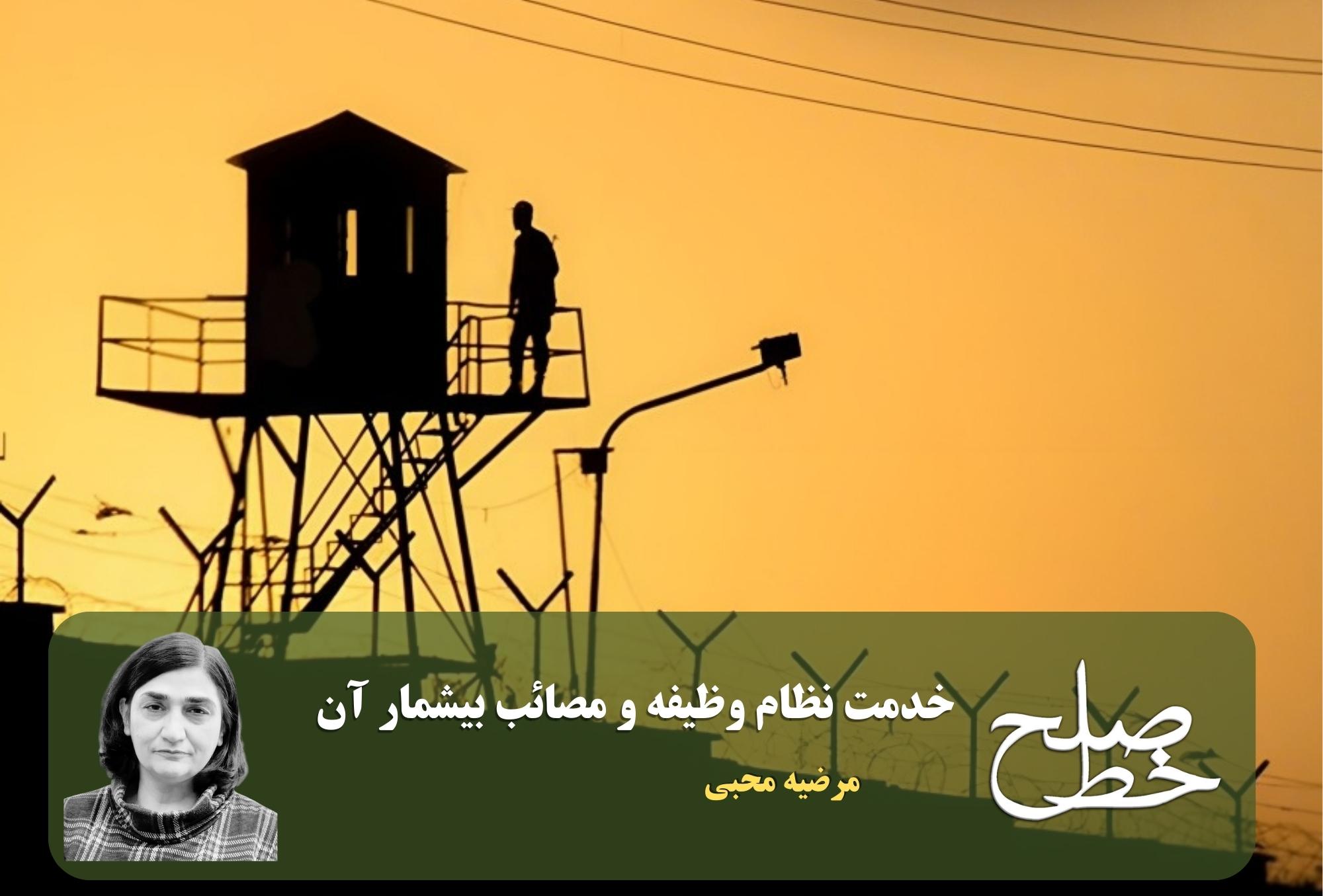
Serving the duty system and its countless hardships / Marzieh Mohabbey
Existence, identity, and destiny of humans in the modern era are determined by their relationship with walls. With the emergence of the concept of modern state in the realm of human life, border walls, like the invisible blades of a historical knife, have separated humans from each other and considered each of them as a subject of a state, branding some with the mark of statelessness.
Then, the structures and ideological foundations of governments began to construct nations as a whole, under a specific order and law. The separation of people due to borders also created necessary grounds for hostile situations between neighbors, and thus the idea of containment became the focus of many military activities. In this way, armies and arsenals were formed, and humans, alongside other objects necessary for border security, became pawns on the chessboard of time.
In other words, border walls were a prerequisite for any political and legal order and any form of identity, including labeling certain groups as soldiers. To justify their killing, they used ideological titles such as serving the sacred and seeking profit.
In the past hundred years in Iran, the law of mandatory military service has remained on the same path and from the time of the formation of the first government in Iran and the time when the process of the creation of the modern concept of the Iranian nation took shape and the drawing of borders highlighted the relationship of friendship and enmity with neighboring countries, mandatory military service has still maintained its original foundation and the principles and relationships governing it and the relationships between individuals have remained the same after almost a century and two revolutions.
During the Islamic Republic, however, military service became a dual duty, both religious and national.
The Public Service Law requires that “defending the independence and territorial integrity of the Islamic Republic of Iran and the lives, property, and honor of its people is the religious and national duty of every Iranian citizen, and in fulfilling this duty, all male citizens of the Islamic Republic of Iran are obligated to perform public service according to the regulations of this law, and no individual can be exempt from public service except in cases specified in this law.”
Just a few lines reflecting the dominant security discourse of the Islamic Republic, which has been ongoing since the first day and in which preserving the system is considered a priority over protecting the people, and religious duty is prioritized over national duty.
Compulsory military service, in the past hundred years in our country, has been like a dark and terrifying pit, affecting all young men and their families and disrupting any plans for their lives. The continuation of social problems caused by forcing young people into military service and the large number of individuals whose lives have been taken over by their military duties has turned the duty of service into a major issue in the political and social sphere of the country, which unfortunately, in the current circumstances, expecting a fundamental solution for it is futile.
Compulsory service has kept various social classes occupied in different ways. Poverty makes service harder and more burdensome. Children from low-income families, who are deprived of the usual facilities for education, are the most vulnerable in the military system. Those who are mostly stationed at problematic borders, whenever tensions arise between Iran and its neighbors, become the first victims for the sake of the interests of the ideological order, which secures its own benefits by sanctifying the blood shed by soldiers and assigning them titles like “martyr”. These soldiers are heavily humiliated in barracks, their identity is erased with violence and their existence is reduced to insignificant objects. Military service consumes the first two years of their youth and causes mental and physical stress, delaying or even depriving them of employment and education opportunities, and causing serious losses and damages to their families. Middle and upper-class families always dream of their children being exempt from military service, and they invest their family’s capital in non-governmental universities to prevent their
Soldiers who have considerable education, spend their military service as two years of unemployment in various institutions and openly waste their time and human capital.
According to another research, which focuses on the problems of individuals with higher education during their military service, the most common complaint of soldiers is the waste of time and rigid structures of military service that have not changed significantly in a century and have caused soldiers to face numerous physical and mental challenges.
Loneliness, isolation, and systematic oppression of soldiers, insecurity in service spaces, and government indifference towards their safety, and the perception of futility in military equations of today’s advanced systems have made the period of service so unbearable that the increase in suicide rates has become a serious issue.
However, certain parts of the vast military apparatus in the Islamic Republic continue to beat the drum of security and review the forgotten story of social cohesion, but do not give in to creating change in the public service system. Even though the values that the system relied on to control the people have collapsed, the new identities of the youth, formed through their interactions with the world and access to communication, do not succumb to coercion and exploitation. Military service is now faced with an increase in desertion and numerous crimes committed by soldiers.
This situation is indicative of the widespread crisis of legitimacy and the mismatch of structures with social changes, which has gripped the Islamic Republic and dragged people to the streets. This has caused the system to cling to its duties and responsibilities more than ever before, and the discord of its collapse can be heard loudly. The Islamic Republic, which gains its identity from enmity with other governments, can no longer use the lives of young people as a capital for its policies. On the other hand, the system of the Islamic Republic, which spends a large portion of the country’s budget on equipping its arsenals and claims that its missiles can disrupt world security in a matter of minutes and its drones can affect the balance of power in the East and West, what need does it have for the presence of young people who have no equipment, no training, and not even proper nutrition and health during their service?
The system, today, has no solution other than making military service a profession and creating a specialized army, because it can no longer rely on its human resources. Therefore, it has put changing the military system on its agenda, as it knows that soldiers are the same young people on the streets whose presence in barracks could jeopardize the security of the system. As a result, it is seeking loyal soldiers who, according to him, will also be deserving of high incomes.
Footnotes:
1- Eskandari Nezhad, Alireza and Ghaffari, Gholamreza, Analysis of Military Service Deferral and Retention at Universities (Case Study: Students of University of Tehran), Quarterly Journal of Social Studies and Research in Iran, Vol. 11, No. 3 – No. 43, October 2022, pp. 623-593.
2- Sayyedi, Sayyed Mohammad Reza and others, An Empirical Study of the Service of Duty System from the Perspective of Soldiers with Advanced Education, Strategic Research Journal of Security and Social Order, Volume 5, Issue 3 – Serial Number 14, November 2016, pp. 86-67.
3- Bakhtiar, Marzieh, and Rezaeian, Mohsen, A Review of Suicide Behavior in Iranian Military Forces: A Systematic Review, Rafsanjan University of Medical Sciences Scientific Journal, Vol. 16, No. 11, November 2017, pp. 1065-1080.
 Created By: Marziye Mohebbi
 June 22, 2023
Tags
Compulsory military service Deserter soldier Duty system Marzieh Mohabbi Military Military service Monthly Peace Line Magazine peace line Peace Treaty 146 Service duty Soldier's Suicide Tell me about the military.