


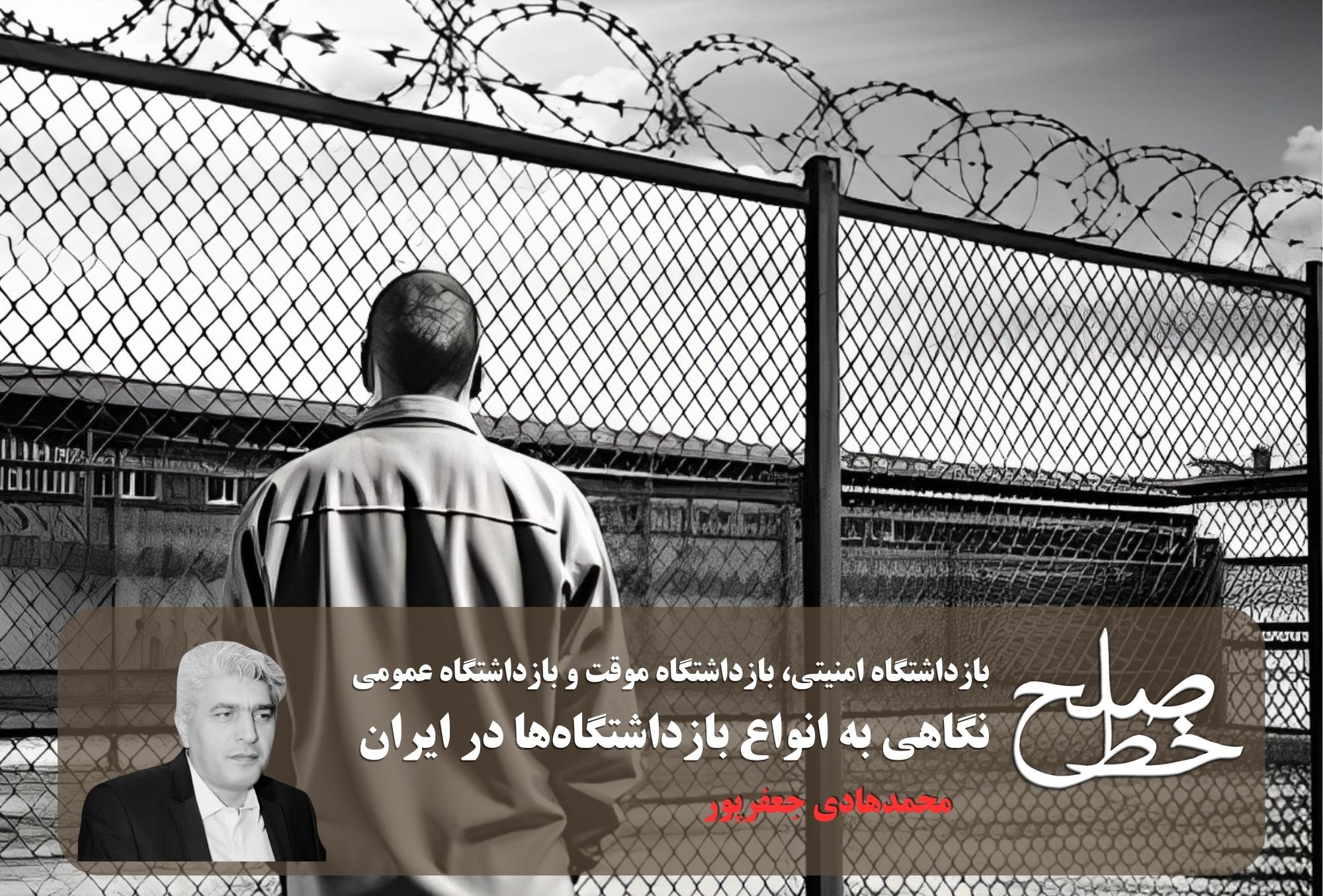
A Look at Different Detention Centers in Iran / Mohammad Hadi Jafarpour
Most legal systems have drawn upon religious ideas or based on certain principles and theories presented by social scientists and even philosophers, the term “punishment” and “penalty” have been interpreted as a social reaction defined by the government. From ancient times to the present, various forms of punishment against violators of civil rights and moral obligations have been considered, based on existing inscriptions of the Code of Hammurabi. Humans have always tried to defend what is referred to as human rights or civil rights by dealing with violators and aggressors who violate these boundaries, and the use of punishment and penalties has emerged as a common social reaction in political and judicial systems. Execution and imprisonment are also among the oldest forms of punishment defined in all legal schools. The ultimate goal and purpose of defining imprisonment as a punishment is to achieve noble goals such as reforming and rehabilitating the offender, intimidating others, providing comfort for the victim, and the like. Punishment and penalties have been referred to as a weapon
Along with social changes and transformations in judicial systems, theories of certain schools such as the school of social justice, modern social justice, and others, as well as institutions such as probation and semi-open prisons, gave rise to a new field of knowledge called prison science in the 18th century. Following these theories and the thoughts of their proponents, disciplines such as criminology emerged and the need to identify the personalities of criminals and investigate the reasons for their crimes was discussed. In the third International Congress on Criminal Law in 1933, the term “prisoners’ rights” was also introduced. According to Professor Klar, in the implementation of reform and rehabilitation programs for prisoners, prison administration should revive and enforce prisoners’ rights to the extent that it does not conflict with prison regulations.
Imprisoning criminals as a common reaction by various societies over the past two centuries has always been criticized and studied by experts in the field of criminology and criminal law. In the Iranian penal system, the organization of prisons and correctional measures is responsible for implementing the punishment of imprisonment, in accordance with the defined principles and regulations for carrying out this type of punishment. This organization has a department called “prison classification” which operates within the framework of these principles and regulations. Generally, individuals may be sent to prison for two reasons. The first reason is “detention” (temporary arrest) which is carried out by the investigating authority or the prosecutor during preliminary investigations. The second reason is due to “conviction” for a crime. From this perspective, a person sentenced to imprisonment falls into two distinct categories; those sentenced to imprisonment and those who are in prison for specific legal reasons.
Separating suspects from convicts is one of the effects of new ideas in criminal law and criminology, and this separation is emphasized in international regulations and binding documents. Article 8 and Article 851 of the Law on Compliance with Minimum Standards of Behavior with Prisoners stipulate that: Unconvicted prisoners are kept separate from convicted prisoners. In current Iranian regulations, there are three types of detention centers that can be divided into: “security detention centers”, “temporary detention centers” and “public detention centers”. According to Article 1 of the Regulations on the Management of Security Detention Centers, approved in November 85, a security detention center is a place of detention for suspects who are referred there by competent authorities in writing due to security and military sensitivities and is managed by the Prisons, Security and Correctional Measures Organization of the country. Article 7 of the Regulations for the Establishment and Management of such detention centers – which are usually established in the central prison of each province –
Unfortunately, the regulations do not specify the criteria for the type of individuals who can be held in these detention centers, which can lead to the perception of any crime committed by a party mentioned in paragraph B of Article 1 of this regulation or related to it as a security threat and consequently result in harsh treatment for the accused. Article 1 of the executive regulations of the management of security detention centers stipulates that these centers are organizations and institutions that have specific duties in ensuring the security of the country, including the Ministry of Intelligence, the Revolutionary Guards Intelligence, the Police Force Intelligence, and the Armed Forces Intelligence. Furthermore, Article 3 requires that a security detention center be established in the central prison of each province, taking into account the classification of the accused based on their affiliation with security centers and the special conditions of their detention. In the event that it is not possible to establish such a detention center in the central prison due to lack of physical space, the aforementioned security centers are obligated to provide
In 2006, the executive regulations for temporary detention centers were also established. In these regulations, the term “ordinary protection” refers to the lack of necessity for building watchtowers or using barbed wire around the center, as stated in Article 12. Article 1 of the executive regulations introduces these temporary detention centers under the supervision of prison administrations, and Article 2 states that this is a designated place for holding suspects whose detention has been ordered and their maximum stay in such an environment is one month, as mentioned in the footnote of Article 2. If after one month the conditions for the release of the suspect are not met, they will be transferred to a public detention center. The structure of a public detention center is the same as a prison and there is not much difference in conditions.
It is necessary to mention that the legal meaning and concept of a local detention center is for temporary custody, and therefore, keeping individuals in these places for an excessive and prolonged period is against general regulations. It is important to note that in some provinces, there are centers defined as central detention centers which do not have significant structural differences from prisons. Another point to mention is that some security and law enforcement institutions also have such places where suspects are detained for a limited period of time – usually less than a month – based on a judicial order.
Therefore, in terms of structure, the only criterion for distinguishing detention centers in practical procedures is between secure and insecure detention centers. As stated and observed in practice, there should be no difference between Evin Prison and Rajai Shahr or Adel Abad Shiraz with Qazalhassar or Dastgerd Isfahan with a certain prison in a certain city, unless conditions are taken into account in the internal regulations of these prisons that others are unaware of, except for prisoners. Although according to Article 14 of the Prison Regulations approved in 2005, these centers are places where suspects and convicts are kept before and after or during the execution of their sentences, or independently of them, “until the situation that puts them at risk of committing a crime in the future is resolved” by order of the judicial authority. However, these centers, like correctional and rehabilitation centers and vocational and occupational therapy institutions, have not taken the name of prison and are not places where
On the other hand, there are three types of regular or public prisons. Some prisoners are sentenced to imprisonment instead of monetary fines, and these financial convicts are referred to as financial debtors, which are not mentioned in the 1984 regulations. This type of prison includes both male and female convicts, but there is no specific prison for women in Iran. Article 5 of the new prison regulations divides prisons into closed and open or vocational centers. Vocational and rehabilitation centers and camps are a type of prison and, to be more precise, are similar to prisons designed for specific individuals.
But the important point is the classification of prison security. According to the severity of punishment or imprisonment, based on Article 5 of the 2004 Prison Regulations, prisons are divided into “closed prison”, “semi-open prison” and “open prison”. Contrary to the appearance of Articles 8 and 10 of the Regulations and the analysis of some intellectuals, the criterion for their separation is not the type of criminal conviction, but the amount or duration of imprisonment, which is contrary to the principles and regulations that define the separation of prisoners for imprisonment.
Despite the acceptance of the necessity of separating prisoners based on the type of crime and the reason for their imprisonment, such conditions do not currently exist in prisons (or correctional facilities) in Iran. The only distinguishing factor among prisons is in some provincial centers where the described prisons are for drug-related offenses, and the majority of individuals involved in such cases, who are accustomed to using drugs, are held in these facilities.
Despite the fact that according to the 1384 regulations, the issue of dividing prisoners and prisons is not a priority, it is necessary to consider such separation from a criminological perspective. Convicts who are sentenced to deprivation of freedom should be kept in places where their reasons for conviction, type of crime, social background, etc. are taken into account based on their individual circumstances. Currently, according to Article 6 of the mentioned regulations, the only division that we encounter in practice is the division of prisons into closed, semi-open, and open prisons. The most important distinguishing feature of closed prisons is the presence of walls and fences, armed guards, and natural and artificial barriers around the prison such as mines, barbed wire, etc.
Although the ultimate goal of establishing regulations governing the imprisonment and detention of individuals was to differentiate between those who are detained solely due to their inability to pay bail or provide a guarantor, and those who have been detained upon the issuance of an arrest warrant, until the judicial system and prison administration have the necessary hardware facilities to enforce such regulations, the expectation of the implementation and execution of the law is essentially futile.
 Created By: Mohammad Hadi Jafarpour
 May 22, 2023
Tags
Barbed wire Detention center Detention center for security purposes Mohammad Hadi Jafarpour Monthly Peace Line Magazine peace line Peace Line 145 Political prisoners Prison Prisoners Public detention center Temporary detention Temporary detention center Watchtower