


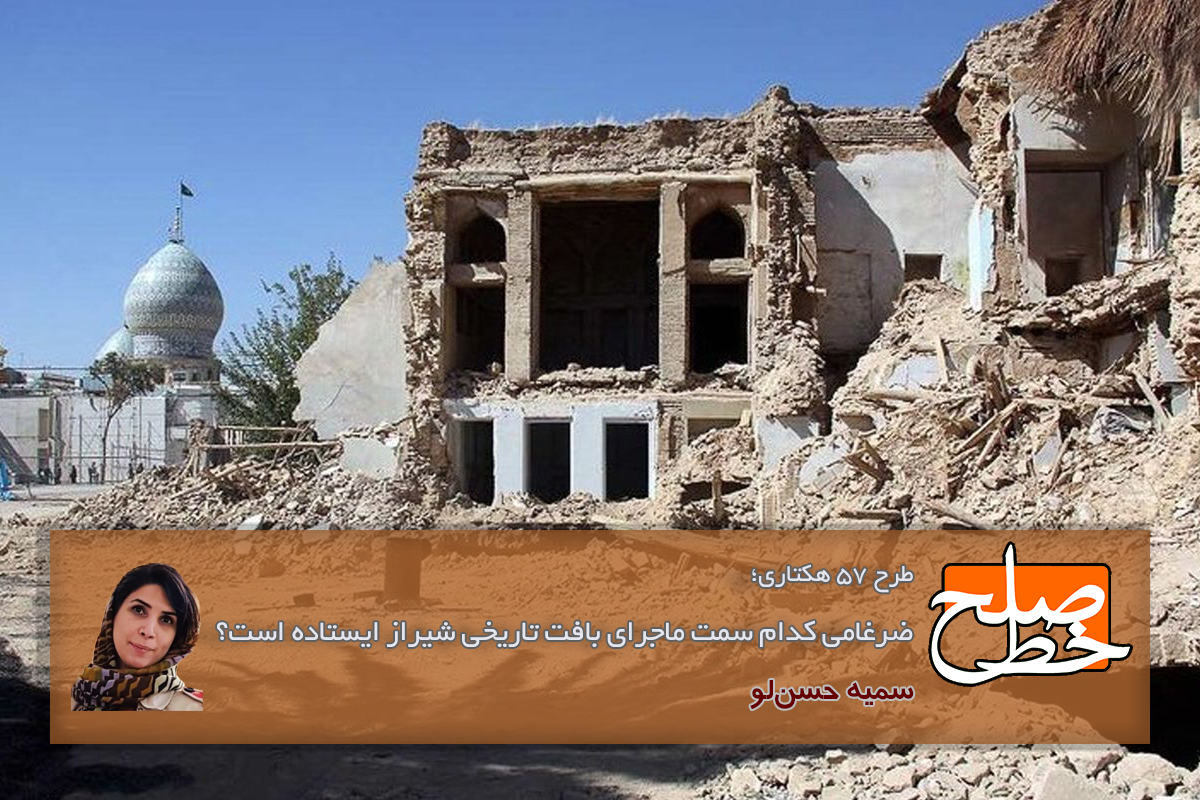
Which side of the Shiraz historical fabric is Zarghami standing on? / Samia Hassanlu
In every corner of the city of Shiraz, there is a historic house that has been acquired, scattered and neglected. Most of these houses have been bought by the shrine of Shahcheragh; houses that are often empty and abandoned. Recently, the municipality has also joined this trend and is trying to acquire some of these houses to build an underpass. A year ago, the Fars Province Road Administration also began buying a number of other houses around the shrine of Shahcheragh. It seems that the historic fabric of Shiraz is being devoured from all sides.
The story goes back to Mehr month of 1400 (2021), when President Seyyed Ebrahim Raisi, during his trip to Shiraz, approved the “Development of Shahcheragh Shrine” project as a provincial trip resolution. This project had been halted in 1394 (2015) by the order of the then Minister of Roads and Urban Development. Now, the project is renamed as “Organizing the Surrounding Area of Shahcheragh Shrine”.
Based on Ahmad Nejabat’s statements, representative of Shiraz people in the parliament, that resolution has determined that “a committee consisting of representatives from the Ministry of Cultural Heritage, Shiraz Municipality, and Fars Governorate should take action to review the heritage status of 200 houses around the shrine, and the decision of this three-member committee is mandatory.”
However, so far, representatives of these three institutions have not taken the burden of the content of this resolution and have even considered it as a media and rumor-making issue. For example, Azatollah Zarghami, the Minister of Cultural Heritage, Tourism, and Handicrafts, after the disclosure of the review of 200 historical houses in Shiraz, a few days after the government’s provincial trip to this city, told reporters in October 2021 that “everyone comes and takes sides and causes conflicts. One says they want to destroy this place, on the other hand, another person says this is not historical and it’s just an ordinary house. Another one says we live here, we have become miserable, we just have to see what it is. Another person says this is a historical fabric and it must be preserved. We have different opinions and we need to sit down as a tourism family (Ministry of Cultural Heritage, Tourism, and Handicrafts) and
Mohammad Hadi Emani, the governor of Fars province, also reacted to the protests that were sparked in response to the review of the historical status of 200 houses in Shiraz. He stated, “We are against any damage to the historical fabric and destruction of valuable houses in this area. The rumor of destroying some of the valuable houses in the historical fabric of Shiraz has no basis. It seems that some are trying to turn this rumor into a social issue for their own reasons.”
However, in the month of Khordad 1401, a letter from a university professor to the governor of Fars confirmed that the “Expansion Plan of Shahcheragh Shrine” has been approved by the Fars Province Department of Roads and Urban Planning, with the ownership of a number of registered houses around this shrine. According to the decision of the provincial government’s trip in Mehr 1400, the “Authority to approve the detailed plan around Shahcheragh Shrine from the Supreme Council of Urban Planning and Architecture to the Planning and Development Council of Fars Province” was delegated, and the ownership of houses in an area of 57 hectares began accordingly.
This was while, according to the statement of Peyvand Hanaei – who was the Deputy of Urban Planning and Architecture of the Ministry of Roads and Urban Development from 1392 to 1396 and played a role in the improvement and specialized management with the aim of preventing the destruction of the historical fabric in the development plan of the famous Shahcheragh Shrine known as the 57-hectare plan – “delegating authority over fabrics such as Shiraz to provinces and local authorities is fundamentally illegal and, according to the law, the duties of the Supreme Council of Urban Planning cannot be delegated and if the Minister of Roads and Urban Development has signed such a thing, he has actually signed an illegal order and the legislator has not given such authority to the Minister to make decisions on behalf of the members of the Supreme Council of Urban Planning; because according to the law, the Supreme Council of Urban Planning is the highest authority for approving laws and regulations of urban planning and its duties cannot
Therefore, Rostam Qasemi, the late Minister of Roads and Urban Development, in a letter addressed to the Governor of Fars on October 13, 2021, raised the concern that “due to the importance of the mentioned project in providing the needs of the holy provinces while safeguarding the property rights of residents and neighbors and protecting the historical fabric of Shiraz, and considering the emphasis of the esteemed leader on the necessity of providing services to pilgrims and neighbors and preventing the consequences of damage to other pilgrimage cities”, requested that although this project has been delegated to the governorate, “the proposed plan should be presented to the executive organization of government and public buildings and facilities in the first meeting of the Article 5 Commission of the province and the result should be sent to the Deputy of Urban Planning and Architecture of the relevant ministry for review and approval as soon as possible.”
Finally, the commission of Article 5 is formed on the 25th of Ordibehesht month in 1401, and the plan “Detailed Structure around the Shrine of Shahcheragh (AS)” is approved while being signed by the governor of Fars, the mayor of Shiraz, the director of roads and urban planning of Fars, the head of the Agricultural Jihad Organization of Fars, the director of cultural heritage, tourism and handicrafts of Fars, and the head of the Islamic City Council of Shiraz. Based on this, a pilgrimage route has been defined within the 57-hectare historical fabric of Shiraz, between “Tabalioun Mosque” and “Shahcheragh Shrine” to the north of “Seyed Aladdin Hossein Shrine”. At the same time, the plan for the network of streets, the organization of 8 Imamzadehs, and the communication route between them has been approved.
This resolution, which was made public about 10 months after its approval, intensified concerns about the destruction of historical fabric in Shiraz; this was expected to be prevented by the Ministry of Cultural Heritage, Tourism and Handicrafts and the Cultural Heritage and Tourism Research Institute, who were consulted on the development plan for the Shah Cheragh Shrine, at a time when more destruction of historical fabric in Shiraz was expected. At the very least, during this time, they should have taken steps to register the valuable fabric and structures in the national heritage list.
While during this time, the extreme reaction of the Ministry of Cultural Heritage, Tourism and Handicrafts – which should originally be a supporter and protector of historical structures and buildings – after the public announcement of the Commission’s decision on Article 5 and the discussion of the issue of the “research line of the Cultural Heritage and Tourism Institute” which identified the destruction of buildings in the 57-hectare area around the Shah Cheragh Shrine, was to reject and deny the proposed line and area, which would lead to the destruction of some buildings; Mosib Amiri, the head of the Cultural Heritage and Tourism Research Institute, told the Iranian state newspaper that “we have not proposed a line for the destruction of historical structures in Shiraz and no registered building will be destroyed.” While he had previously told other media outlets: “That plan (organizing the area around the Shah Cheragh Shrine) is currently in the Supreme Council of Urban Planning and Architecture and I can confidently say that there will
Ezzatollah Zarghami, the Minister of Cultural Heritage, Handicrafts, and Tourism, who has repeatedly questioned the preservation of the city of Shiraz and has always avoided giving a clear answer, this time, after the recent warnings about the potential destruction of the historical fabric of Shiraz, shared a video of his provincial trip in October 2021 on his personal Instagram page. He protested against the destruction of the historical fabric of Shiraz and linked it to settling political scores, saying: “Regardless of what our ancestors have done and who is to blame, this is the current situation that we see. The thirteenth government is determined to solve the problem. Social problems are also affecting the fabric of the city. Unfortunately, there is no good view for tourists, especially foreign tourists. The struggles of the people in this region are the subject of settling political scores between different factions, and the ultimate victims are the people themselves.”
Afterwards, he also poured water for hand washing like this: “We don’t have the money to renovate these houses, nor do you specify their responsibilities.”
The Minister of Cultural Heritage, Tourism, and Handicrafts responded to the demand for the registration of historical structures in Shiraz on the National Heritage List, saying to reporters: “We are following the process of evaluation and registration of national heritage, and it is not a directive or order from the Minister.” This is while according to Farhad Nazari, the former director of the Registration Office of the same ministry, the Minister, according to the executive regulations of the 1309 law, can register a structure and the General Office of Registration of Heritage in the Ministry of Cultural Heritage, Tourism, and Handicrafts can take charge of preparing the file. It should be noted that in 1399, one year before Zahra Ahmadinejad took over the Ministry of Cultural Heritage, Tourism, and Handicrafts, the director of the Historical Structure Database of Shiraz (Hassan Abbasi Mehr) had announced the preparation of a comprehensive file for the registration of a
 Created By: Somayeh Hassanlou
 March 21, 2023
Tags
57-hectare plan 9 Peace Treaty 1439 Aladdin Ancient artifacts Between the two holy shrines Cultural heritage Development Ezzatollah Zarghami Historic texture of Shiraz Historical texture Monthly Peace Line Magazine peace line Rostam Qasemi Samia Hassanlu Shahcheragh Shrine Shahcheraq Tabalian Mosque The Forbidden City of Aladdin The Shrine of Sayyid Alaa al-Din Hussein ماهنامه خط صلح