


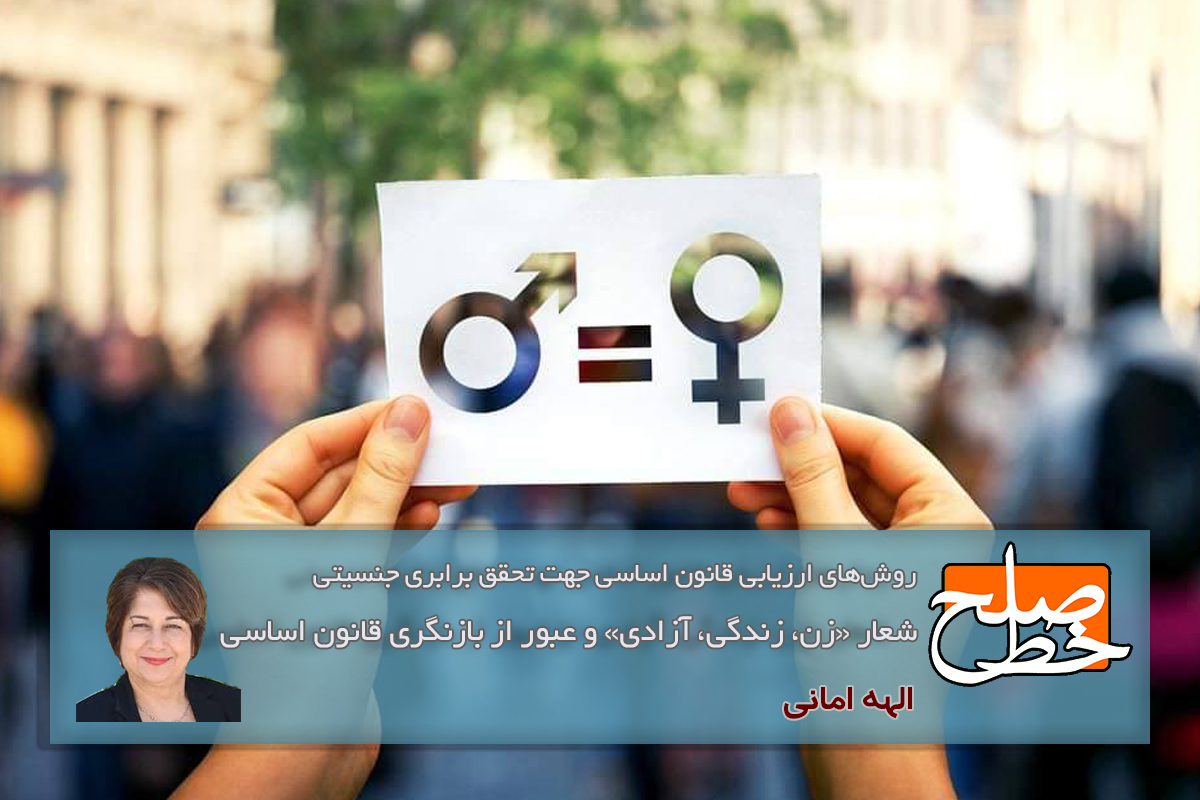
The slogan “Woman, Life, Freedom” and overcoming the revision of the Constitution / Elaheh Amani.
The wave of protests in recent years, especially with the unprecedented rise of popular movements in Iran, where women and youth are at the forefront with the slogan “Women, Life, Freedom”, has pushed for a review of the current constitution and the drafting of a new one that does not have the challenges of the current one, from the margins to the center of political and judicial discussions. Women and youth demand that fundamental rights be based on the general spirit of the 21st century world, the foundations of democracy and foresight, freedom, social justice and gender equality be formulated and implemented. Over the past four decades, collective wisdom dictates that there is no political will to amend and review the constitution with the intention of addressing deficiencies, contradictions and ambiguities within the current framework.
The Constitution is a living document and a national process that, with sufficient support from the people, can and should be drafted, reviewed, and revised. American philosopher John Rawls, while examining the Constitution and the concept of justice, also sees democracy in the light of this concept. The Constitution belongs to all members of society and must ultimately be accountable to citizens. Therefore, its drafting, review, and revision should consider gender equality as one of its most important goals.
Gender equality is the foundation of a democratic and fair society. The process of revising or drafting a constitution is an extraordinary opportunity for women and advocates of gender equality to create laws that guarantee gender equality and social justice, and offer hope for a future where all members of society can benefit from equal opportunities in economic, social, and political spheres. In some countries around the world, including Bolivia, Nepal, Tunisia, Chile, and Cuba, forward-thinking forces, advocates of gender equality, and human rights defenders have taken advantage of opportunities in revising and amending the constitution to transform their country’s constitution into a powerful tool for democracy and the implementation of justice.
In the constitution of a country – as an important and fundamental document – the rights and obligations of all citizens of the country, including women’s rights, must be clearly addressed. For this purpose, many constitutional laws include articles and principles that refer to women’s rights and obligations. One of the most important indications that a country’s constitution can have for promoting women’s rights is creating a suitable framework for protecting women’s rights against discrimination, which includes supporting women’s rights in areas such as employment, education, health, and social security. Additionally, many constitutional laws include articles that address women’s rights in areas such as property rights, inheritance rights, divorce and custody rights, health and medical rights, rights to access natural resources, and more. Furthermore, a constitution can provide public programs to promote awareness and empowerment of women in society to ensure their rights. Educational, training, and cultural programs to increase transparency and information about women’s rights and the importance of supporting them can also be guaranteed by the constitution.
Almost all of the fundamental laws that were drafted after World War II include articles on gender equality and non-discrimination. However, in the fundamental laws written in the past two decades, specific provisions regarding women’s rights have been officially recognized. Perhaps the most important trend in drafting and amending fundamental laws in recent decades has been inclusivity, participation, non-elitism, and openness. In many societies, women are excluded from the process of drafting the constitution due to lack of experience or legal knowledge, and even women themselves may hold this belief at times. However, drafting a constitution is not only for politicians and high-level lawyers; all citizens should be able to participate in the drafting and content of the constitution. Women and sexual-gender minorities, ethnic, national, religious, and racial minorities, and even individuals with physical disabilities should have a voice in the drafting of the constitution and monitoring its implementation mechanisms.
In the Middle East, several countries have taken steps towards gender equality in their constitutions. One of these countries is Tunisia, which has taken important steps towards gender equality in its constitution. The Tunisian constitution, adopted in 2014, was the first constitution in the Arab world to recognize gender equality as a fundamental right. This law guarantees women’s rights to participate in political life – including the right to run for elections and hold government positions. It also recognizes women’s rights to inherit and own property and prohibits gender-based violence. The Tunisian constitution also mandates affirmative action to promote gender equality in all areas of public life, including education, employment, and political participation. It also recognizes women’s right to access reproductive health services, including family planning. It should be noted that in July 2022, a new proposed constitution was presented by the Tunisian president and passed by popular vote, but many people in the country are opposed to it. Other Middle Eastern countries that have made progress in promoting
In Asia, several countries have taken steps towards gender equality in their constitutions, but the most progressive in this area is Nepal’s constitution. The Nepali Constitution (2015) guarantees gender equality and prohibits discrimination based on gender. This law recognizes women’s rights to inherit and own property and requires the government to take action to eliminate violence against women – including sexual violence. The Nepali Constitution also includes provisions for gender equality in elected government positions, requiring at least one-third of all elected officials, including parliament members, to be women. Additionally, the constitution mandates that there must be at least one woman in each of the various constitutional bodies, including the Supreme Court and the National Human Rights Commission. India is another Asian country that has made progress in promoting gender equality in its constitution. The Indian Constitution has a provision for gender equality and affirmative action for women in education and employment. In 2022, India also passed laws granting reproductive rights and access to abortion for single women and criminalizing marital rape
In Africa, some countries have made progress in promoting gender equality in their constitutions, but the most progressive in this regard is the constitution of Rwanda. The constitution of Rwanda, adopted in 2003, was the first in the world to reserve at least 30% of government positions for women. This provision has significantly increased women’s political participation, with women holding 61.3% of seats in the lower house and 36% in the upper house, the highest rates of female political participation in the world. The constitution of Rwanda also includes provisions for gender equality in education, employment, and property ownership. It recognizes women’s rights to inheritance and property ownership and prohibits discrimination based on gender. The constitution also mandates the government to take measures to prevent and punish all forms of violence against women, including sexual violence. Other African countries, such as South Africa, have also taken important steps towards gender equality in their constitutions. South Africa’s constitution includes a provision prohibiting discrimination based on gender.
In Latin America, several countries have taken important steps towards gender equality in their constitutions. However, the most progressive constitution in Latin America regarding gender issues is that of Ecuador, which was approved in 2008. The Ecuadorian constitution has been praised for explicitly recognizing women’s rights and its commitment to gender equality. It recognizes gender as a concept and requires the creation of policies and mechanisms to prevent and punish all forms of violence against women. It also guarantees equal rights for equal work and obligates the government to promote women’s participation in all areas of public life. The constitution of this country also includes provisions for recognizing and protecting the rights of LGBTQI+ individuals, including the right to marriage and adoption.
From other Latin American countries that have made significant progress in terms of gender equality in their constitutions, we can mention Bolivia and Chile. The 2009 Bolivian Constitution guarantees gender equality in all elected positions and recognizes the rights of indigenous women. It is worth noting that in 2022, the people of Cuba, in a national referendum, overwhelmingly approved the new Family Code. This law, written with the consultation of the general public, recognizes marriage and equal rights of adoption regardless of gender identities, and recognizes domestic work as a legal and recognized profession for women.
Perhaps one of the most prominent processes of drafting a constitution in the world, which unfortunately could not be successful for various reasons, was the process of drafting the constitution in Chile. Chile held free elections in 1989, but dictator Pinochet left a constitution in place that prevented any amendments. Even Michelle Bachelet, who was a progressive president, proceeded cautiously with amending the constitution. However, the popular uprising and widespread protests in October 2019, although not armed, paralyzed the country. Following that, the process of drafting a new constitution began in November 2019, and the Constitutional Convention started its work with equal representation of women and indigenous Chileans for the first time in world history. Of the 155 members of the Convention, 77 seats were allocated to women, 17 seats to indigenous Chileans, and 6 seats to citizens with gender diversity. The average age of the elected members of the Convention was 45 years, and at least six of them were
Perhaps taking a look at the efforts of the people of Chile and the process of drafting a new constitution – which has been lengthy and complex – could be valuable. The process of drafting a new constitution in Chile has been accompanied by deep political polarization, with different political factions and interest groups competing for influence and power. This has made it difficult to reach consensus and make progress on key issues. Lack of trust is also another challenge in the drafting of the new constitution. Many Chileans are skeptical of those in political power and are disillusioned with the current political system. This lack of trust has made it difficult to garner widespread support for the new constitution and ensure transparency and inclusivity in the process. The COVID-19 pandemic has also had a significant impact on the process of drafting the new constitution in Chile. The pandemic has made it harder to hold public meetings and consultations, forcing the convention to delay its timeline and deal with new challenges. Additionally, some groups in Chile have resisted efforts to draft a new
In any case, there are methods for evaluating the constitution that can achieve gender equality in today’s world. The following questions are among the general evaluations that have been formulated for the drafting and revision of constitutions in the world today and can contribute to cultural development in this area.
1- Does the constitution use gender-neutral language and terms? Are the terms used to describe citizens and government officials impartial or gender-biased?
2- How many women participated in writing the constitution? Is the role and services of women recognized?
3- Is commitment to gender equality enshrined as a value in the preamble of the constitution?
4- Does the constitution specifically recognize and support women’s rights?
5- Is discrimination defined?
6- Is discrimination based on gender explicitly prohibited?
7- Are there any provisions that hold the government accountable for gender equality?
Is discrimination and unfair treatment based on issues that may contribute to different forms of discrimination prohibited?
9- Does the Constitution include a list of prohibited forms of discrimination?
10- Are special measures being taken to accelerate gender equality?
11- Does the Constitution state that fundamental rights such as the right to non-discrimination based on gender and sex must be recognized in both the private and public spheres? Are fundamental rights not only recognized between the government and individuals, but also between individuals – within the family and between private organizations such as businesses and individuals?
12- Does the Constitution state that customary and traditional practices and customary laws must respect sexual and gender equality and non-discrimination?
13- If religious laws are recognized in the constitution, does the constitution state that there must be respect for sexual and gender equality and non-discrimination?
14- Does the constitution recognize multiple discrimination?
15- Does the Constitution state that women are entitled to equality in various aspects of life, including political, economic, and social spheres?
16- Is the right to equal rights and wages for women mentioned?
17- Are there any provisions for supporting women’s rights in commerce, employment, or other economic activities?
18- Is women’s right to own and inherit property recognized?
19- Is equality recognized in marriage?
20- Is women’s right to education recognized? Is there support for women and girls’ right to education?
Is the right to access to food security and drinking water recognized?
22- Is the right to health and healthcare recognized? Is the right to reproductive choice and control over women’s bodies recognized?
23- Is the right to terminate pregnancy (abortion) mentioned?
24- Is maternity leave with pay considered?
25- Is women’s right to a free and safe life, free from state violence, recognized? Is women’s right to be protected from violence inflicted by non-state actors such as family members, employers, or private organizations recognized?
26- Has human trafficking been prohibited?
27- Is there a mention of sexual work and sexual exploitation?
28- Has speaking and giving speeches with the intention of harming women been prohibited?
29- Can women and men acquire, change, or retain citizenship under equal conditions?
30- Is dual or multiple citizenship allowed?
31- Can women independently transfer citizenship to their children?
32- Can a female citizen transfer her citizenship to her spouse – under the same conditions that a male citizen can?
33- Are fundamental rights and freedoms considered for all people – not just citizens – respected? If these principles are only recognized for citizens, does it not seem reasonable in a democratic country to respect international obligations?
34- Have the benefits of women’s political participation and representation in political parties been considered?
35- Is the electoral system desirable for women?
36- Are there any provisions that guarantee or facilitate women’s participation in the legislative branch?
37- Is full participation of women in the legislative branch supported?
38- Are there any provisions that prioritize gender in government policies?
39- Are there any provisions for guaranteeing and facilitating the appointment of women to positions in national services and independent organizations?
40- Is the importance of women’s presence in government recognized?
41- Are the provisions stated that security forces (police, army, intelligence forces) must respect human rights?
42- Is there any provision that guarantees that women can reach the highest positions in the executive branch?
43- Is the importance of women’s presence in the judiciary recognized? Do the mechanisms of judicial appointments at all levels of courts – especially the Supreme Court – facilitate the appointment of women?
44- Is the importance of gender diversity recognized in security forces? And are mechanisms in place to ensure the presence of women among these forces?
Is it clear that human rights must be respected at all levels of government?
46- Does the constitution establish independent commissions and oversight bodies? Are mechanisms in place to ensure the presence of women in these commissions?
47- Does the constitution establish a National Commission for Women or Gender, or other organizations and institutions that include gender structures?
48- Are there any laws in place for “standing” (a basis for an individual to challenge a law or government action in court) that are open and accessible so that all individuals on the margins of society or who are disadvantaged can access justice?
49- Are there any government legal aids available for individuals who cannot afford them? Is this applicable for both criminal and civil cases?
50- Are there any mechanisms for implementing the constitution?
51- Are there any guidelines for interpreting the provisions of the Constitution or for judicial review that create a basis for progressive interpretation of the provisions of the Constitution?
Is the right to gender equality protected from unreasonable legal limitations?
53- Do courts and other institutions have the permission to consider the laws of other countries when interpreting human rights provisions?
54- Are courts and other organizations encouraged to consider international laws when interpreting human rights?
55- Are international human rights treaties directly effective?
In hopes that the women and girls of Iran, who are not only a valuable and honorable asset to Iran but to the region as well, will pursue their historical efforts and realize the slogan of “Woman, Life, Freedom” in Yemen, and take effective, forward-thinking and sustainable steps towards gender equality, social justice, democracy and freedom. True democracy cannot exist without gender equality. This hope reflects the wisdom and political and social awareness of Article 4 of the Minimum Demands Charter of Independent Trade and Civil Organizations in Iran, which states: “Declaration of complete equality of women’s rights with men in all political, economic, social, cultural and family spheres, elimination and abolition of discriminatory laws and forms against sexual and gender identities and recognition of the diverse society of “LGBTQIA+”, eradication of all sexual and gender identities and adherence to all women’s rights over their bodies and destiny, and prevention of male-dominated control.”
Woman, life, freedom; until equality.
 Created By: Elahe Amani
 February 20, 2023
Tags
Constitution Constitution of Chile Equality Gender equality Gender rights Goddess Amani Monthly Peace Line Magazine peace line Peace Line 142 Sexual rights Woman, freedom of life Women's rights