


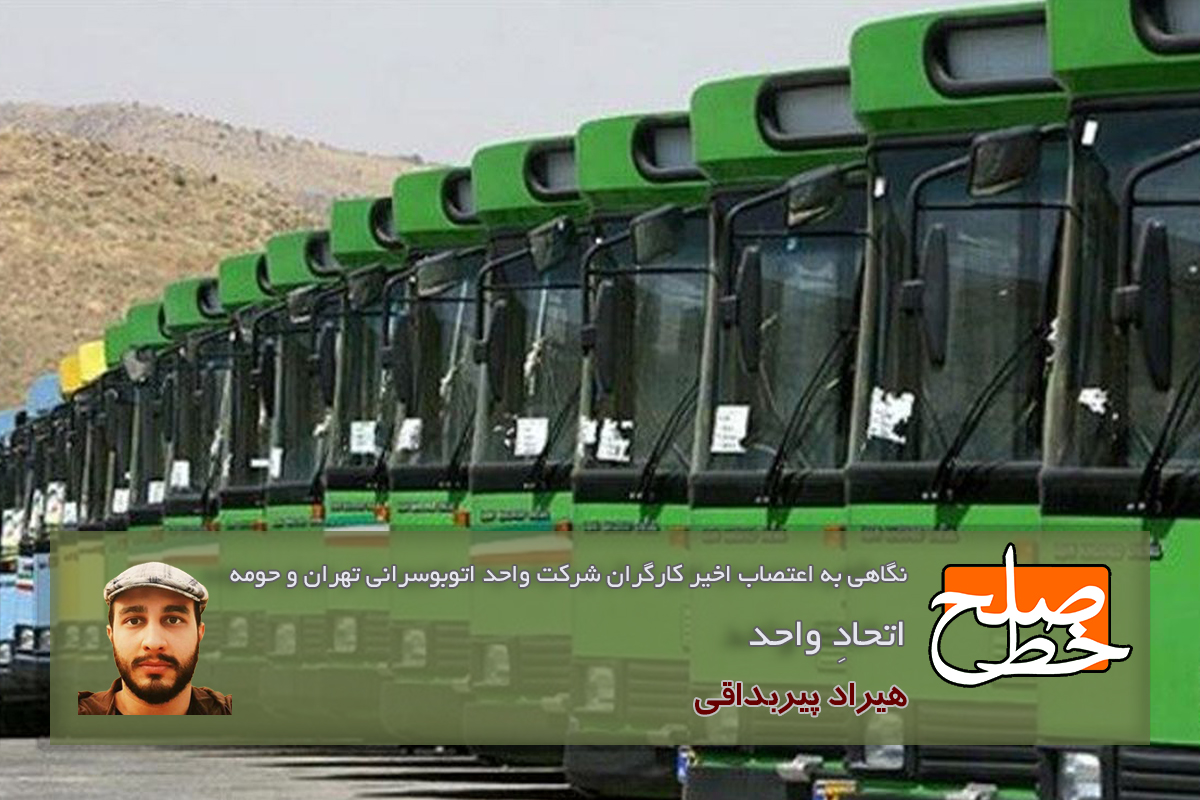
A Look at the Recent Strike of Workers at the Tehran and Suburbs Bus Company / Hirad Pirbodaghi
Unity.
The strike of retired and employed workers of the Tehran and Suburbs Bus Company in the final days of the month of Ordibehesht this year is so important for the labor movement in Iran that we cannot allow it to be overshadowed by the daily events and protests that we pass by so easily. For this reason, the writer intends to take a look at the characteristics of this strike; from its formation to its impact on society.
On Tuesday, 26th of Ordibehesht, Tehran had taken on an extraordinary atmosphere. The streets were extremely crowded and the public transportation network was filled with astonished and frustrated crowds heading towards bus lines, the metro, taxis, and other routes. In certain parts of the city, buses were stopped or abandoned on the side of the road, and the initial groups of striking workers were forming. The communication and traffic routes in the capital were locked and the transportation system had completely shut down. The government had given the municipality the order to ignore the decision of the Supreme Council of Labor and to not only neglect the workers’ wages in terms of welfare and inflation rates, but also to illegally increase them by only 10%. This news was enough for all the lines of the Tehran Bus Company, from Tajrish to Nazabad and from the west to the east, to declare a strike and effectively paralyze the city. The united voices of the drivers’ protests and their confrontation with the government
One station before.
The ruling government, in order to escape from its crises and suppress the increasing protests in society, is pursuing neoliberal policies and programs under the project of “economic surgery” with more speed and intensity. Its main goal is to weaken large sections of society, especially the working class, and implement policies of impoverishment. Maintaining the government and maintaining its authoritarian power requires that the cost of this surgery falls on the shoulders of the government’s class enemies, namely the working class and the reserve army of the unemployed. The issue of wages is the most prominent class challenge in this situation, as the government, under the pretext of budget deficits and controlling inflation, has allowed itself to once again neglect the livelihoods of workers and retirees. The fist of protest is raised; in a recent incident, social security and overtime payments have been cut off in some systems, and pensioners are not receiving their payments, making it difficult for workers to make ends meet. Like hundreds of other workers’ centers, the job classification
Features and achievements.
Although the bus drivers’ strike was short and benefited from insignificant analytical coverage, and even faced major left-leaning tendencies with apathy and carelessness, it emerged with outstanding and intelligent characteristics that can generally be counted as:
Providing specific content and exposing the political government and police.
Not following up on a demand until obtaining all or part of it and holding the employer accountable.
The emergence of agitators* and the flourishing of organizers within the heart of the rebellion;.
Exposing and rejecting all types of anti-labor tricks based on negotiation, intimidation, and division.
Progress in cooperation and connection between public transportation personnel in Tehran and its suburbs.
Extensive use of communication and coordination channels;
Support and follow-up of detained workers until their release.
Advanced and defensive forces.
We are talking about a method of protest that, with a small number, rises in the form of a city; a strike that instills fear and chaos in all branches of government and catches everyone off guard, shutting down all educational and administrative units and many businesses, and in the midst of nationwide street protests, makes a show of itself. Such strikes – like the Haft Tapeh strike in 2018, which led to the shutdown of the city of Shush, or the strike of the textile workers in 2006, which took control of Sanandaj – bring society to a new phase of confrontation with the ruling class and demonstrate that the force capable of creating fundamental and final changes and leading public struggles is the united working class. Despite the severe suppression in Iran and the fact that leading parties and organizations are not allowed to emerge, the achievements and experiences of movements shine like rays of light in the darkness, albeit at a great cost.
Looking at the history of strikes within the company itself, we can see that they have brought about significant achievements, especially in the mid-1980s, for the workers’ movement. They imposed an independent union on the company’s management, pushed back repressive forces and yellow organizations, and brought the censored resistance of Iranian workers to the global stage once again. According to this writer, a fundamental point in all of these strikes is the demonstration of the power and political weight of the united workers’ movement. The government and security institutions are well aware of this and constantly plan to exploit labor forces and create divisions between workers and employees, between employed and job seekers, between trade and political demands. The function and glory of these strikes were such that immediately after the law enforcement and security police to the Revolutionary Guards and the Ministry of Intelligence were called upon to break the strike. This gave Tehran Mayor Alireza Zakani the confidence to not show up at the gathering and to spread false statements about
According to Walter Benjamin, “strikes are the most extreme form of violence at the height of non-violence.” Demands in the form of strikes or protests will always be accompanied by a degree of violence, as the fight against capitalism and its vital elements, such as strikebreakers and political police, involves a high level of friction and conflict. Defenders of the capitalist order are constantly looking for excuses to suppress the working class, and this is more evident in authoritarian and third world countries. However, for workers, the struggle is a means of awareness and class consciousness, which will demonstrate alternative tools and methods of protest and lead to organized action. In this sense, the recent strike by workers of a single company, if it teaches transportation workers and learns from massive and persistent strikes in the labor movement, will once again give itself the ability to organize and lead to the holding of public meetings for direct involvement in life and work. Just as the labor movement has achieved through years of continuous resistance and
Note:
Agitator: Someone who engages in activities such as advertising, public speaking, or media to encourage people to participate in social and political goals. Agitators are often found in communities where there are no independent organizations.
 Created By: Hirad Pirbodaghi
 June 22, 2022
Tags
8 Peace Treaty 1348 Boycott of BRT (Bus Rapid Transit) Driver strike Hirad Pirbodaghi Monthly Peace Line Magazine Monthly transportation peace line The Tehran and Suburbs Bus Company. Workers' strike