


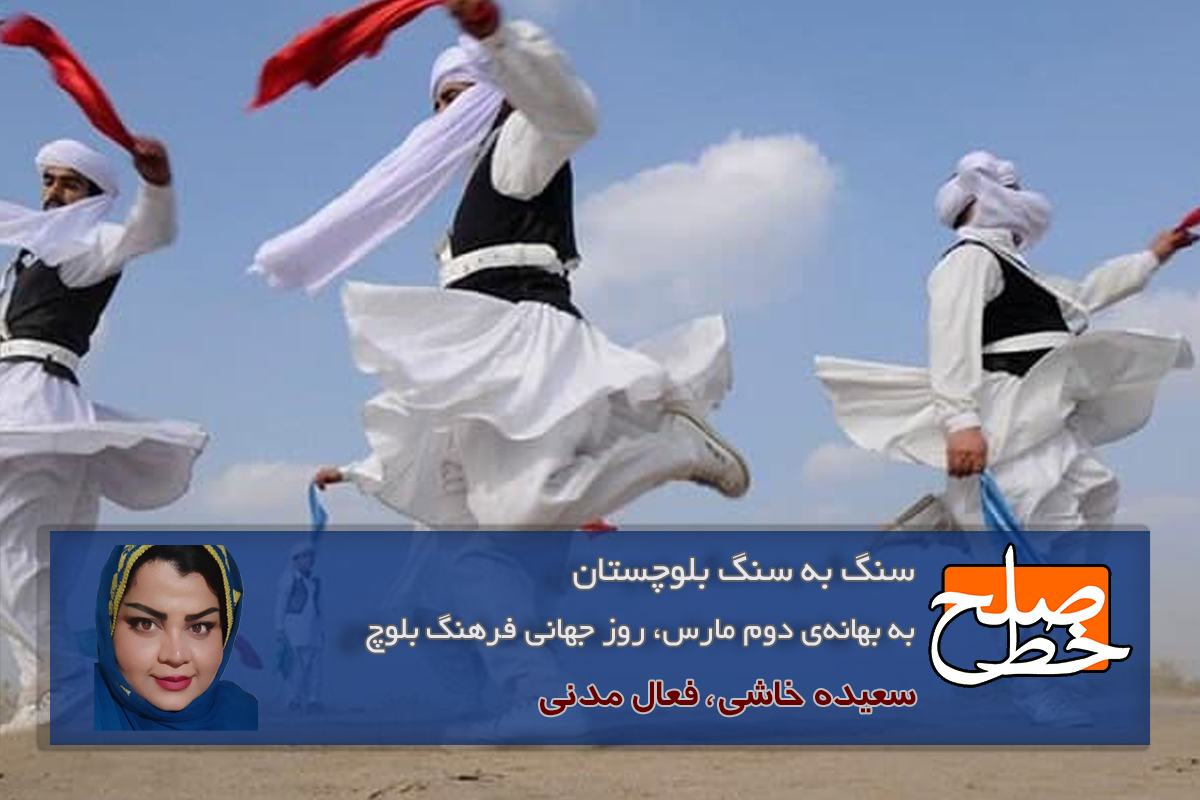
On the occasion of March 2nd, World Baloch Culture Day / Saeideh Khashi
You walked through the stones of Balochistan, at a time when you stayed in mud and brick houses, under sturdy black tents, in sunlit courtyards, and spent long nights in conversation with the ever-awake stars. You witnessed the sunrise in its most humble form, and sat in the company of wheat-carrying women, finding peace under the shade of the ever-shining sun. You drank in the sight of love-struck eyes, taking in the needle, thread, color, and pattern. You saw the border men, rising in the wolf and fox-filled air for bread and homeland, with their chests full of courage, marching towards the battlefield. When you look at them in their toughest and sweetest moments, you will be deeply moved by their continuous peace and harmony with the world. The nature of Balochistan can bear witness to the peaceful coexistence of the Baloch people with the world around them.
On March 2, 2010, the Baloch Students Organization (BSO) youth organized a conference to commemorate Baloch culture, and the Pakistani army greeted them with bullets, resulting in the death of two individuals. More than ten years have passed since this incident, and Baloch people around the world still honor March 2nd.
Pride, poetry, music, literature, and the overall culture of the Baloch people are among the valuable assets and resources of Iranian society. The identity of Balochistan is enriched by the richness of its cultural roots, which is Iran. If this unparalleled potential is seen as a catalyst for the revival of civil society and the advancement of Iran in its eastern region, it undoubtedly serves as a bridge towards sustainable development and provides a platform for the improvement of cultural and social infrastructure.
The narration of the details of life in Baluchistan is a way to understand the foundation of this life, it is the transmission of transmissions and the narration of narrations. The depiction of the space in which these narrations take place is the necessary description of today’s society, which provides the introduction for an informed entry. In the current era, with the influx of non-professional and uninformed individuals into various issues of this land, we witness numerous social damages that indicate the disregard of decision-makers and managers of the country for the social consequences of the policies being implemented in society.
Pioneering Baloch artists, one after another, close their eyes to the world. In the same corner of isolation and silence, the shining years that they had for the development of the cultural society come to an end, and they disappear like a star in the silent desert.
From Mahnaz Jamālzahī, the skilled needleworker, to the master bellmaker whose sound of the world-renowned scissors echoes, to hundreds of other unknown artists whose legacy remains only in their stories. Other proud Baloch figures who, even in their lifetime, nobly dedicate themselves to their mission and breathe life into the cultural and artistic landscape of their homeland.
It must be accepted that development of the region without the serious participation of the Balochistan community is meaningless. This reflects a human-centered approach to development, which is rare in these times. Most people think that because they have power, money, and technology, they can plan and build a social system without considering humans; the result is a disruption of social order, class divisions, and informal settlements.
Balochistan is not only the gateway connecting Iran to the sea, but also the link between the geographical circle of Iranian civilization and the sea. It is the main route connecting fifteen landlocked countries in the Middle East and neighboring countries to the open sea, and this very Balochistan is the gateway to that sea.
World Baloch Culture Day is an opportunity for us to reflect more on our valuable assets in our country, Iran, and not only not leave them alone on their toughest days, but also become their voice more than ever before.
One of the most important functions that attention to Baloch culture and other Iranian ethnic groups can have is to mitigate the excesses caused by internal blockages in conservative societies; for example, special attention to peacemaking as an important and transferable indicator and planning for its promotion through channels such as theater and cinema can heal the wounds of decades of black propaganda about Balochistan and even moderate some conservative behaviors and prevent the perception that the identity of ethnic groups in Iran is denied.
 Created By: Saeideh Khashi
 February 20, 2022
Tags
Baloch culture Balochistan Balochistan Student Organization Monthly Peace Line Magazine peace line Peace Line 130 Saideh Khashi World Baloch Culture Day