


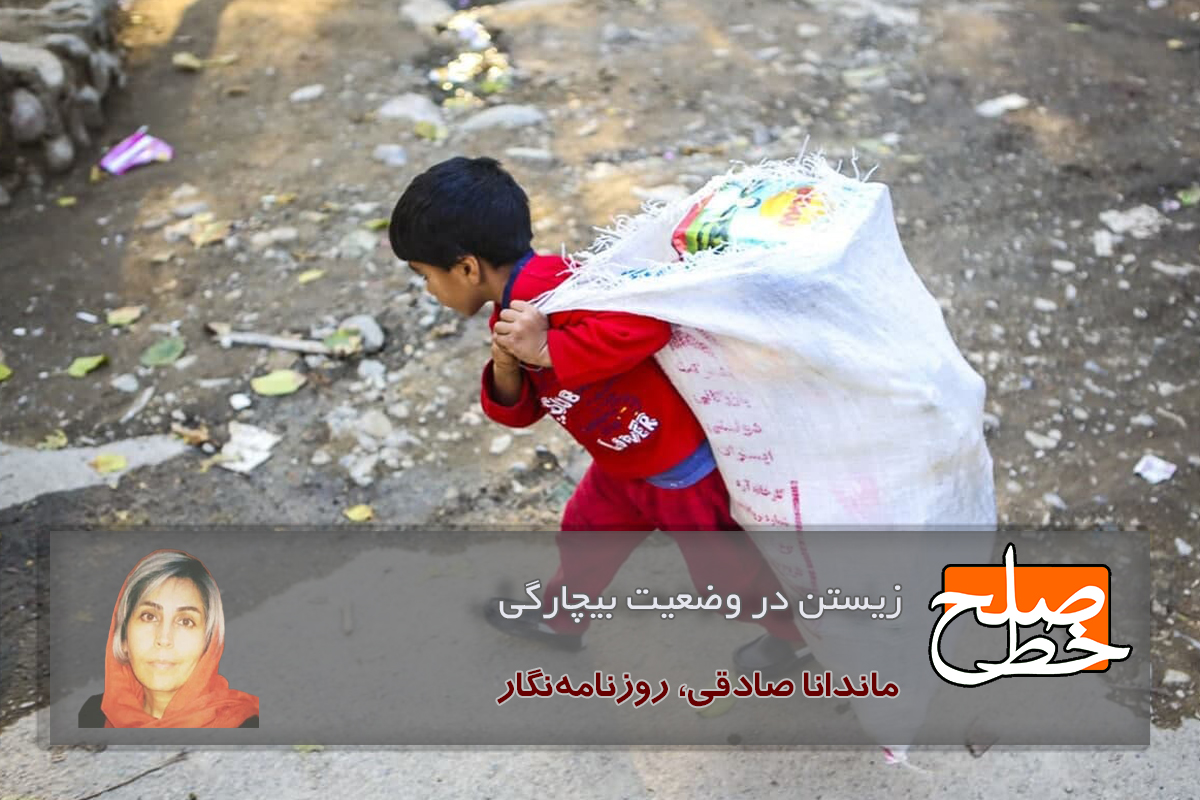
Living in a state of poverty/ Mandana Sadeghi
When talking about working children or garbage-collecting children, authorities immediately announce eighty or eighty-five percent of these children as illegal foreign nationals to the media and report on their living conditions, work, laws, or lack thereof, to prevent the employment of foreign nationals. Government institution statistics estimate the number of garbage-collecting children in Tehran to be between 4700 to 5000, and consider organized trafficking of foreign nationals from their origin (border) to the capital as the main factor in increasing this number. In most reports, the phenomenon of garbage-collecting children is evaluated only in the metropolis of Tehran, which is a good place for the disappearance of illegal immigrants, low-paying jobs, and unscrupulous contractors or gangs in the employment sector. However, the death of two garbage-collecting children in the “Malashiya” area of Khuzestan (Ahvaz-Khorramshahr road) in June 2020 showed that the phenomenon of
The growth of marginalization in Khuzestan (according to Hamshahri, Khuzestan is the second largest province in terms of informal settlements after Khorasan Razavi) shows the growth of inflation, alarming price increases, unemployment and poverty, while also accelerating changes in social classes, leading to the emergence of new occupations such as waste collection among Iranian families.
According to government statistics, in spring of 2020, approximately half a million jobs were lost. One hundred percent of these lost jobs were in the informal sector, which was the source of employment for lower classes of society. This change has not only pushed Iranian households in lower classes into absolute poverty (meaning they lack access to basic needs such as clean water, nutrition, healthcare, education, clothing, and shelter), but it also targets the most vulnerable groups within this class in a merciless manner.
It is certain that for 850,000 residents of Khuzestan, 537,000 residents of Kurdistan, and 1 million residents of Balochistan, earning income and choosing a job outside of the fuel and smuggling circle is not imaginable; however, waste collection in these areas is one of the emerging occupations that has been added to the list of informal jobs in these areas due to the intensification of government restrictions on jobs such as fuel and smuggling.
Children are among the first groups to be forced by families into the business world as non-productive and cost-generating forces. Under conditions where one out of every three Iranians is below the poverty line, they have no choice but to work in jobs such as garbage collecting.
Waste collection, known as “shouldering” by children in these areas, is one of the jobs that has arisen due to the alarming increase in prices. It is a job that not only exploits vulnerable children, but also serves to fill the pockets of corrupt contractors, taking advantage of government protection laws.
If the growth of waste management in Tehran or some other major cities is dependent on the government’s failure to implement proper migration policies, it is clearly linked to the economic conditions of families in provinces such as Khuzestan.
The cheap labor market for children, if before this, the rampant inflation was limited to jobs in workshops for tailoring, clothing, mechanics, etc., with the indifference of the country’s economic management, has now reached the exploitation of children and women; a profession that is considered one of the worst, lowest and at the same time, most dangerous informal occupations.
According to the contract “Immediate eradication of the worst forms of child labor”, which was approved by the Islamic Consultative Assembly and confirmed by the Guardian Council in 2001, child labor in 36 professions, including working in landfills, collecting, transporting and burying garbage, was prohibited. However, instead of taking the issue of child labor and waste management seriously, the government, by employing high-level managers, makes decisions for the livelihood of the people, who believe that the poverty line is four million tomans, and also suppresses and ignores the protests of teachers, retirees, workers, etc. on the streets, who are mostly protesting against their economic conditions, indicating that there is no will to improve the economic situation of the country’s social classes.
Unfortunately, in such circumstances, instead of the government’s economic plans leading towards fundamental solutions to lift poor families out of the trap of absolute poverty, they have moved towards the distribution and consumption of public resources, in the form of increasing subsidies. This path does not lead to a reduction in class differences or prevent social inequalities caused by poverty. Living in a state of destitution, deprivation, working in the lowest paying jobs, addiction, and unemployment each have the potential to ignite the flames of anger among marginalized individuals whose poverty is growing in both scale and scope (within the family). This anger may not necessarily result in breaking bank and store windows, but it can lead to self-immolation and harming others.
 Created By: Mandana Sadeghi
 January 21, 2022
Tags
Child labor Children garbage collectors False occupations Garbage collector Mandana Sadeghi Monthly Peace Line Magazine peace line Peace Line 129 Unemployment Waste management