


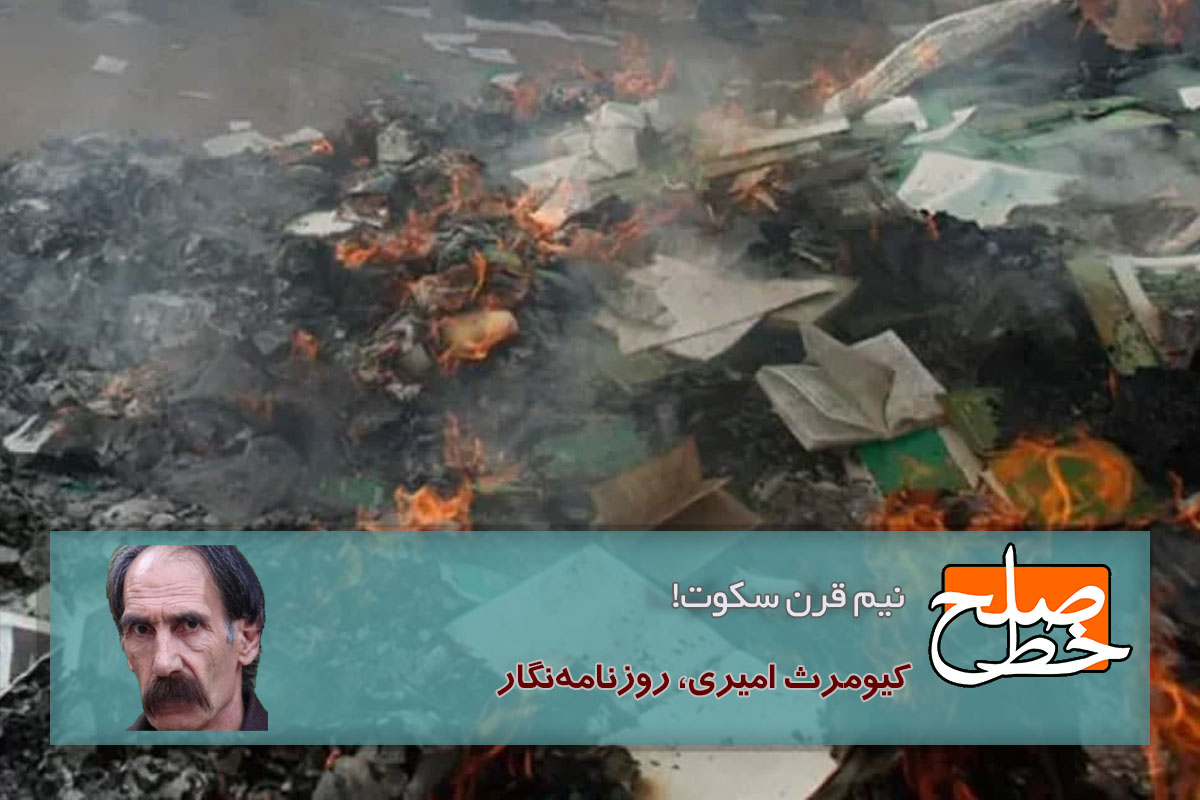
Half a century of silence! / Keyumars Amiri
The dynamic and active Iranian society, which has its roots in great and glorious civilizations throughout history, has nurtured numerous valuable elites throughout its existence and has been the cradle of precious civilizations. On the other hand, this society has also been one that its activists and artists have constantly faced severe oppression, harassment, and isolation.
In a brief look at the land of Iran, we find that this country is highly valued and respected among other nations due to its abundance of talented poets and writers and the valuable works they have created.
In the current era and from the year 1300 onwards, Iran has witnessed the growth and prosperity of valuable writers, poets, and artists who have created precious and remarkable works. This trend has been a progressive movement in all seven human arts, and during this time, dozens of valuable writers, poets, and artists emerged, and hundreds of valuable works were created. However, this dynamic and progressive trend faced a heavy setback and stagnation with the 1957 revolution.
With the establishment of the religious system of the Islamic Republic, a system in which its rulers desired everything according to their own will and did not tolerate anything else, unfortunately, the Iranian society has been stagnant in terms of literary and artistic movements and this stagnation and silence has continued for half a century. Along with it, the society has been faced with horrific intellectual and cultural suppression and unprecedented oppression. By preventing the activities of writers, poets, and artists, thousands of ideas, dreams, and fresh thoughts have been killed and no thought has been allowed to emerge and has been suffocated in its infancy. As a result, the field has been cleared for superficial and worthless works.
In this half-century, Iranian society and its elites did not synchronize with the world that they called “the other”. Many ideal cities of the mind and imaginary thoughts of intellectuals and thinkers were turned into ruins and destroyed. Many writers and artists became victims and their works were either stifled in the womb or lost in the chaotic censorship after production. Music was forbidden and musical instruments were declared forbidden, and half a century of silence was imposed as the ruling in the country.
A brief overview of art and literature in Islamic Iran.
There is no doubt that humans, when looking at civilizations and people from different eras, recognize them through their scientists, elites, poets, writers, and artists, and of course, through the literary and artistic works of those civilizations, and judge them.
It cannot be denied that throughout history, the ancient land of Iran, with its rich culture, has always been a cradle for intellectuals, writers, poets, and renowned artists. They have created valuable works in various literary and artistic fields, leaving a lasting legacy for Iranians and humanity.
Unfortunately, this bitter reality cannot be ignored that throughout its long history, this land and soil have always been faced with destructive and continuous currents of elite killings and opposition to intellectuals. Throughout the thousands of years of Iran’s history, there have been currents that have caused suffering, harassment, torture, imprisonment, exile, and destruction of elites, intellectuals, and their works during certain periods of the country’s political and social history. These currents have persisted throughout history and have caused great material and spiritual damages to the people of this ancient land and to humanity as a whole.
In pursuit of this continuous historical trend in the past half century, with the establishment of the Islamic Republic system, the approach of the ruling authorities towards writers and artists and their works has not only been unacceptable, but it has been a constant movement that has had the least compatibility with the thoughts of human beings today. It has become clear that the Islamic government, based on its religious ideology and the rulers’ view of society and humanity, has had no reconciliation or acceptance of intellectuals, artists, and their works. It does not tolerate the presence of non-religious thinkers and intellectuals in any way, and from the very beginning of the establishment of this system, it has been at odds with this group. For this reason, many elites, famous writers and artists have left the country. Some were imprisoned and some had their properties confiscated. Despite all these strict measures, some remained in the country, hoping that the situation would improve. This group sacrificed everything and chose to stay in their homeland and continue their work
Another major problem that writers and artists in the Islamic Republic have experienced during these years is the tragic and painful phenomenon of chain murders. Many prominent intellectuals, writers, and poets of the country, including Hamid Hajizadeh and his nine-year-old son Karoun, Saeedi Sirjani, Mohammad Mokhtari, Jafar Pouyandeh, and many others, were sent to their deaths. This group and another group of intellectuals were kidnapped and after being tortured and harassed by those who were working in the Ministry of Intelligence and Security, they were killed. These murderers, who were later referred to as “self-appointed individuals” by the regime, kidnapped intellectuals and after torturing and harassing them, brutally murdered them.
In pursuit of denying writers and artists in another incident that caused more disappointment than ever among the intellectuals of the country, twenty-two of the most prominent writers and poets of the country, who were supposed to travel to Armenia as a group through a pre-planned program, miraculously survived the intentional bus crash that was supposed to kill them all. This incident revealed to this group that this homeland has no place for them to stay and continue their activities, and one by one, against their inner desires, they left their homeland and sought refuge in other nations or withdrew from cultural and artistic activities and were forced into isolation and silence. This trend not only affected poets and writers, but also all those who had a hand in arts, literature, music, and other forms of art, in various obvious and hidden ways. It became clear that the Islamic Republic system wants everything to be religious and Islamic according to its religious beliefs and strongly opposes any non-religious thoughts and literary and artistic works, and deals with them
Unfortunately, in this regard, many artists had their musical instruments confiscated and destroyed because of the discovery of one instrument, and they themselves were harassed, abused, and imprisoned.
A bitter tale of a true story.
In one of the villages of Kermanshah, a group of people lived whose main occupation was playing music for the villagers. They were skilled in making and playing various instruments that were necessary for the villagers’ daily lives, such as the sorna, dhol, and dozaleh. These people were responsible for organizing traditional ceremonies, mourning and mourning ceremonies, and celebrations and weddings in the region, with the accompaniment of sorna and dhol, which formed the ancient customs and traditions of the people. These musicians passed down their art from generation to generation, and for many years they made a living in this way. The people would invite them and pay them for playing the sorna and dhol and organizing ceremonies at all happy and sad occasions.
Those who had lived for years in the villages surrounding the city of Kermanshah, when they realized that they were not allowed to use their art in any way due to the strict and new regulations of the Islamic government, they gathered together and decided to destroy and abandon all their musical instruments. On a bitter autumn night, they piled up all their instruments, including dozens of flutes, drums, dulcimers, and tambourines that had been a part of their lives for years, and set them on fire. Men, women, and children sat for hours, crying and watching their instruments burn in tears.
Only among the old man who loved his flute very much and had a special bond with it, did not give in to the group’s decision and took his flute and fled the village at night. From then on, they bid farewell to each other with music forever.
A brief look at the current state of storytelling literature in the shadow of the Islamic Republic of Iran.
In today’s modern world and in the field of literature, we are faced with phenomena known as short stories or novels, which first emerged in Europe in the 19th century and were created. Mohammad Ali Jamalzadeh introduced the collection of short stories in 1921.
Once upon a time, there was, there wasn’t.
This style of storytelling became popular in Iran.
Do not underestimate the fact that many writers in Iran have stepped into the realm of emergence and have created and published numerous valuable works in the field of narrative literature.
These works were met with great reception from the audience and had a positive impact on the awareness and knowledge of a large segment of society. Day by day, the number of writers in this genre of storytelling in Iran has increased, and this group has created enduring works that can be considered unprecedented in terms of quantity and quality in Iran. The audience for these works has also grown day by day.
Hundreds and even thousands of works were created in the form of collections of short stories or novels in the styles of realism, romanticism, and others, written by dozens of authors whose works also made them famous.
Sadegh Hedayat, Mahmoud Dolatabadi, Ali Ashraf Darvishian, Samad Behrangi, Simin Daneshvar, Ahmad Mahmoud, Ali Mohammad Afghani, Bozorg Alavi, Rasoul Parvizi, and many other writers were among the group of writers who each found a special place in the country by creating several works. During this period, various magazines were also published, which played an important role in introducing and critiquing these stories, and thus storytelling found a special place in this historical period of the country and led many young people towards reading and studying. These works were highly regarded compared to world literature and for this reason, many of them were translated into living languages of the world, and Iranian storytelling found a special place in the field of storytelling literature in the world.
Sadegh Hedayat with a collection of stories.
Stray dog.
, .
Three drops of blood.
, (comma)
Mrs. Alavi
And.
Buffalo.
That is considered one of the masterpieces of literary fiction, was able to take a big step in this field.
Mahmoud Dolatabadi has created dozens of works in the field of short stories, such as…
“O Father Almighty.”
, .
Desert layers.
, (comma)
Travel.
, .
Behavior/Conduct
Sorry, there is no text provided in Farsi to translate. Please provide the text so I can assist you with the translation.
Empty spot for the spoon.
And so on, in the end, he turned to novel writing and created a ten-volume novel.
Kaleidar.
He created a literary masterpiece in Iran; a work that has been repeatedly discussed for its potential to receive the Nobel Prize in literature. A novel.
Kaleidar.
This text talks about a part of the struggles of the farmers to break free from the oppression of feudal lords during a specific period of time. This period of Iranian history is depicted beautifully in a realistic novel through the true story of three brothers in Khorasan. The works of Samad Behrangi, such as…
Little black fish.
“And a long novel.”
Neighbors.
“Ahmad Mahmoud, a ten-volume novel.”
Cloudy years.
“Ali Ashraf Darvishian and dozens of short stories about him.”
From this province.
, .
Abshuran
And so on, there are works that remain. Mansur Yaquti with works such as…
A lantern on top of Madiankooh.
“And a large number of short stories, alongside many other writers, have provided great services to Iranian culture and literature throughout these years.”
Beside other tricks of the religious system of the Islamic Republic, the ability of Hojjat al-Islam Mortaza Motahhari, a student of the Qom seminary, in denying this literary work is remarkable. Motahhari, by writing and publishing a collection of stories with completely religious views and content under the title of…
The story of truth.
He tried to push the thoughts of the writers in that direction and replace the common style of storytelling with a religious and Islamic emblem, but he was not successful. Interestingly, not even one case of following his style of storytelling occurred.
A brief look at the fate of books in Iran from the past to the present.
A look at the history of Iranians and the mysterious land of Iran from ancient times until now is indicative of the fact that Iranians have always placed extraordinary importance and value on art and literature, and what is now known as the seven universal arts. Throughout history, talented and unparalleled writers and artists have emerged in Iranian society, creating original and enduring works, and sometimes sacrificing their lives for their creations, ideals, and thoughts. This trend has continued with ups and downs throughout the centuries.
During these years, with the establishment of the ideological-political system of the Islamic Republic, this historical, cultural, and artistic process faced new and great challenges in all dimensions. The country was faced with a record number of closures and cancellations of competitions in all seven fields of human arts, and everything was on the decline. Over the course of half a century, all arts, including literature, music, sculpture, theater, cinema, dance, and others, suffered irreparable damages and losses, and some of them were completely forgotten. During this time, neither renowned and prominent writers were given the opportunity to emerge, nor were lasting works created. Art and literature in all fields suffered from deficiencies, failures, or complete destruction.
Nostalgia is a cultural pain.–
Historical.
A journey through the political, social, cultural, and artistic history of Iran from centuries before the Arab invasion to this land is indicative of the fact that in Iran, there were remarkable libraries with valuable works ranging from classical literature to symbols of art and literature. These past works include…
Tansarnamah.
Letter of resignation.
, .
Divine Letter.
, .
Manual.
, (comma)
Kaleh and Demneh.
Thousands of stories, which later became known as the “One Thousand and One Nights” and were introduced and presented under the title of Arab literature, were only a very small part of the hundreds and perhaps thousands of works that were written on clay, animal skin, papyrus, and stone, and were kept in designated places or in libraries of that time. In addition to these, there were also many inscriptions and stone carvings, such as the inscriptions of Persepolis, the Behistun Inscription in Kermanshah, and others, which were among the works created by the elite and scholars of Iran in the fields of written literature, indigenous knowledge, and oral and written culture, and were considered valuable spiritual and material goods for Iranians.
Unfortunately, with the attacks of the Greeks and then the Arabs on Iran, these works were burned and completely lost. In the midst of this, the honor and determination of some Iranian scientists, poets, and writers who, after the occupation of Iran by the Arabs, tried to protect some of these works until they gave their lives, is astonishing and admirable.
Ibn Muqaffa, this Iranian patriot scientist and writer, whose father was from the bitter land of Takhistan and had been taken as a captive to Basra, began a project in the early second century of the Hijri calendar that cost him his life. As the invading Arabs had destroyed and demolished all the cultural and artistic works of the Iranians that were within their reach, in order to be forever forgotten, Ibn Muqaffa took it upon himself to preserve some of those works as a reference for the Iranian people, such as…
Tansarnama.
Tansarnama.
And.
Kaleela and Demneh.
These works were translated from Pahlavi to Arabic in order to preserve their authenticity, content, and message, and to save them from the attack of the Arabs and prevent them from being forgotten. It should be noted that the Arabs had forbidden speaking and writing in any language other than Arabic and severely punished those who did so. In a short period of time, he saved many works from this fate, but unfortunately, spies reported Ibn Muqaffa’s actions to the caliph and he ordered for this wise and patriotic man to be brutally punished and his bones to be burned in fire.
Bashar ibn Burd, the blind Iranian poet, was another educated figure who, through his poetry, defended the knowledge and culture of Iranians against the Arabs of that time. He mocked the caliph and as a result, he was also subjected to the wrath of the caliph. He was publicly whipped to death for his actions, and as a result, in the following years, many other scholars such as Zakariya Razi were killed for their pursuit of natural sciences, literature, poetry, music, and more, by the caliphs and rulers of the time. In general, this group of elites and intellectuals have always been the target of anger and oppression by the rulers and their agents. They have lived in poverty and misery, and many of them have been killed.
Iranians have always been known for their great intelligence and have had a great interest in music, art, literature, and human knowledge through the seven recognized arts. They have made efforts to create works that have preserved their indigenous knowledge and oral culture, such as myths, symbols, and proverbs, which are still present today. They have fulfilled their duty towards their society with honesty and righteousness, and have always strived to do good in every situation.
 Created By: Kiomars Amiri
 December 22, 2021
Tags
Fiction literature Kiumars Amiri Monthly Peace Line Magazine peace line Peace Line 128 The destruction of music The destruction of narrative literature.