


Renewable energies in the world and Iran / Hossein Aghamohammadi
The annual energy consumption growth in the world is three percent. With this calculation, global energy consumption is increasing day by day and with further increase in population, this amount may increase even more. The current methods of energy production in the world mainly rely on the use of fossil fuels. The consumption of this energy causes environmental pollution to the extent that, according to calculations, by 2050, the Earth may not be a suitable place for all human beings to live and half of the population may not have anything to eat or breathe. Fossil fuels are not replaceable and will eventually run out. In order to save themselves, humans are forced to move towards alternative methods other than using fossil fuels.
The most suitable method for using power plants with solar reactions is through the research center “CERN” in France, which has been working on accessing this energy for years. The mechanism of this energy is that by converting helium into two hydrogen atoms and then reacting and fusing the two hydrogen atoms to form a helium atom, energy is emitted; in fact, this reaction is capable of producing energy in both directions. Until this center reaches its conclusion, it is necessary for humans to also find other sources.
The methods that cause the least harm to the environment are renewable power plants. There is a wide variety of them, but the majority are wind, solar, thermal, geothermal, wave, and hydroelectric power plants.
Wind power plants do not have a significant presence in Iran. The oldest wind power farm in Iran is the Manjil farm, but as most people have observed, more than about thirty percent of its units are not rotating due to changes in wind conditions or changes in wind intensity and direction. With this situation, we cannot expect a special contribution from this type of energy to meet the country’s energy needs.
Such power plants are mostly used in shallow coasts, because they have a constant wind flow and, on the other hand, it is easier to install their foundations in the sea due to the shallow depth.
Geothermal units, ocean waves, and tides are generally considered complementary power plants; however, the land of Iran does not have the potential to produce a significant amount of this type of energy. The only research geothermal power plant is located in Ardabil, with a capacity of only a few kilowatts.
Hydroelectric power plants have been known for years and are used to their maximum capacity, but they do not meet the needs of humanity and in the best case, they provide twenty percent of the world’s total energy.
Among other renewable energies, the only type that is more accessible than all is solar power plants (of the radiative and photovoltaic type). On the other hand, let me remind you that all the energy on Earth comes from the sun’s light; so if humans can produce this energy cost-effectively, they can both save the environment and provide the energy they need.
Solar power farms of the reflective type operate by reflecting sunlight through a large number of concave mirrors onto a central collector. This concentrated heat acts as a boiler, producing steam which then passes through blades, causing a generator to rotate.
In solar power plants, using the photovoltaic method, direct sunlight is converted into electrical current in panels. Panels with dimensions of one hundred and eighty-five centimeters can produce an equivalent power of one hundred watts; which is equivalent to a light bulb. By placing multiple panels next to each other, a larger surface area is achieved and as a result, more power is produced.
The ease of this method has led to its use in the ceilings of homes. The current problem with this method is its high energy cost compared to conventional methods.
Since every invention and innovation has a low efficiency at the beginning and after passing its lifespan and abundance of usage, it reaches higher efficiencies, harnessing energy from sunlight is not an exception to this rule. Until recently, the cost of production through this method was so expensive that there was no interest in it, but after environmental discussions and especially the events of Chernobyl and Fukushima power plants, humanity is strongly determined to use this inexhaustible source. The growth of production of these energies is incomparable to previous years and the plans that governments have for its expansion show a promising future.
Despite the increase in efficiency of this method from a few tenths at the beginning to fifteen to twenty percent today, it still does not have the capability to compete seriously with fossil fuels and requires government support.
The price of electricity in different countries ranges from 10-15 cents per kilowatt-hour to 40-50 cents.
Unfortunately, due to the low cost – or if we can say, the affordability – of electricity in Iran (one third of a cent per kilowatt-hour), it doesn’t seem that fossil fuels will ever allow solar power to take the lead. What we hear about solar power plants in Iran is just propaganda and despite all the noise from different governments, they do not play a significant role in energy production; maybe just a fraction of a percent of the total.
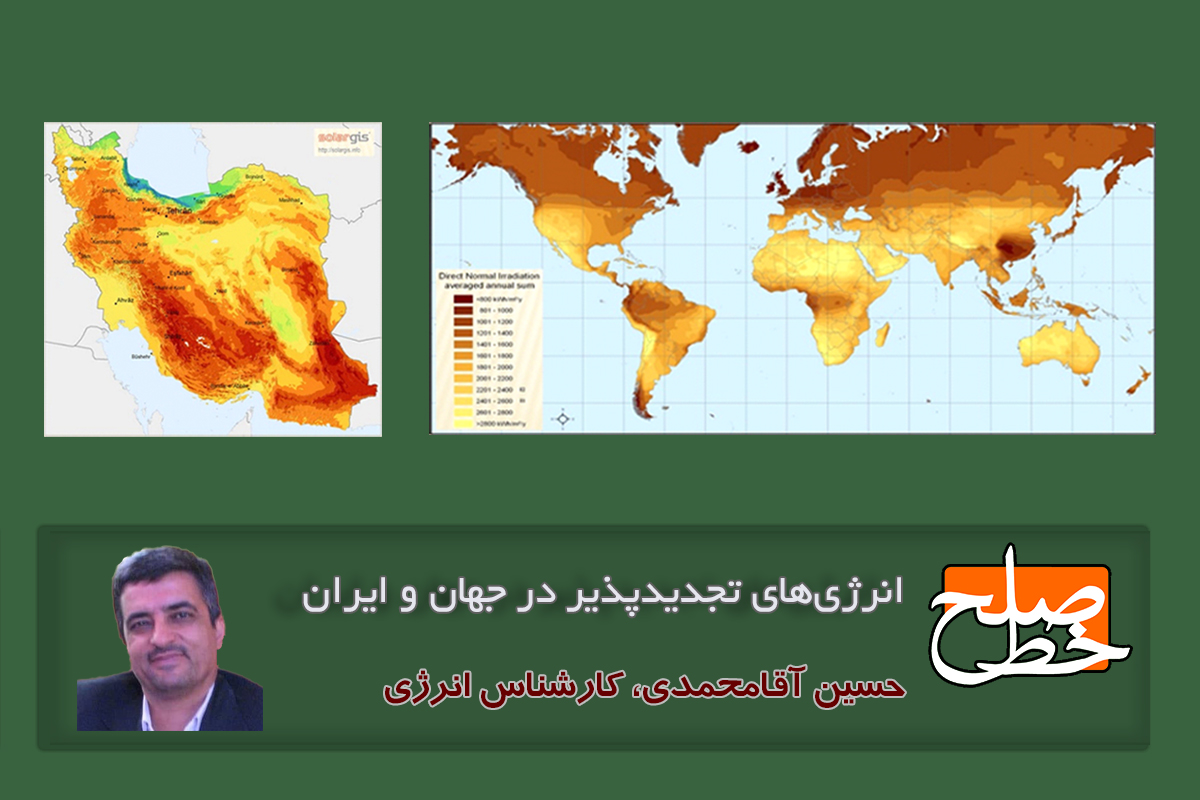
With a look at energy consumption in Iran, where we have witnessed about five to eight percent growth, we will definitely face serious problems in the near future in terms of domestic production needs. Looking at the power outages in previous winters and summers, it becomes clear to us that in order to have a less problematic future, we must move towards harnessing solar energy, which has the best conditions in this land.
By looking at the images below, one can discover the potential of Iran’s land for solar energy extraction.


The great potential of Iran’s climate for solar energy production, combined with the low cost of energy and the lack of attention and support from authorities towards the environment, reminds us that we must follow the following path to correct this mistake:
1- A serious determination should arise in all those involved and they should stay away from slogans and deception.
2- The electricity price should become realistic.
3- Financial support will be provided at the beginning of the work under any title (from the National Development Fund or strategic projects).
4- Let’s use modern technology and not pursue the invention of the wheel (as we have done in other cases and the cost has gone so high that it became uneconomical).
 Created By: Hossein Aghamohammadi
 October 23, 2021
Tags
Hossein Aghamohammadi Monthly Peace Line Magazine Peace Agreement Number 126 peace line Renewable energy Renewable energy 2 Solar energy