


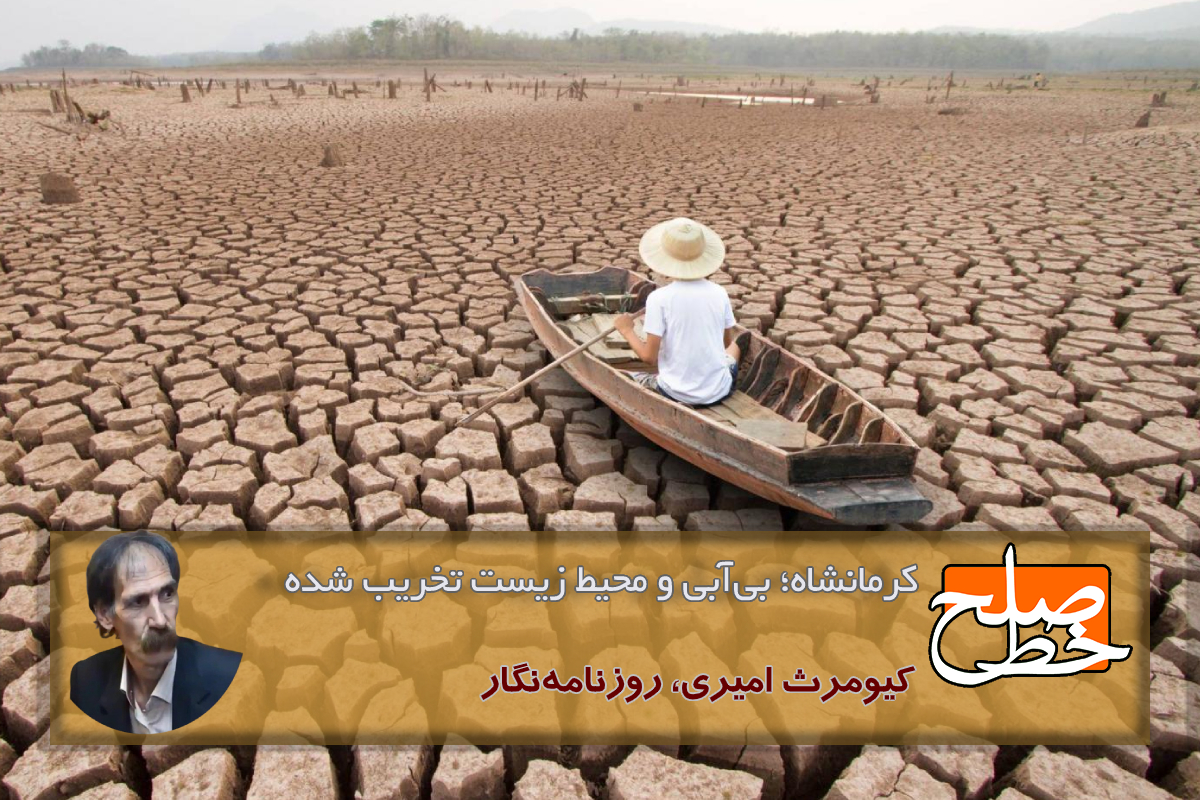
Kermanshah; Water shortage and environmental destruction / Keyumars Amiri
The vast province of Kermanshah, with an area of 25009 square kilometers, which is one and a half percent of the total area of the country, has been ravaged by the most merciless enemy, oppression and plunder, over the past 42 years and has been turned into a dry and barren land. Kermanshah is facing a severe water crisis and this problem is exacerbated by the fact that the environment of the province has also been destroyed.
All the rivers in the province have dried up and their ponds have evaporated and disappeared. The seven major rivers of the province, Qareh Su, Razavar, Garab, Marg, Gamasayab, Dinorab, and Simreh, have all dried up and there is no trace of their once beautiful and refreshing ponds. All that remains is dry soil and cracked pond beds. The famous ponds of Taghbestan, Khairalayas, Yavari, Khizrzandeh, and Niloofar, which were believed to have no end and were connected to the vast seas of the world, were thought by the locals to be the cup of the ancient Iranian world, thrown by Shirviah, the son of the righteous Khosrow, and never found again. Now they have dried up, and dust and dirt rise from their beds into the air.
With the drying up of rivers and lakes in the province and the major city of Kermanshah, it is soon to face the dangerous problem of water scarcity; because currently, a large portion of the city’s drinking water is supplied through the Gamsheh Kamyaran Dam and in case of water shortage in the dam, there will be no water for drinking in Kermanshah.
Throughout the province, there is no longer even a sturdy tree to rest your tired body under its shade and pass some time. The entire province, except for a few small areas that have managed to endure, is burning under the scorching heat and the dry, cracked soil that mars your view.
All this pain and suffering has not arisen except at the hands of incompetent officials and unqualified managers who, through ignorance and irresponsibility, have brought destruction upon this province. They disregarded its surface waters and emptied its underground water resources without any consideration for agricultural use. They left its vast natural forests unattended and unprotected, and abandoned all the planned environmental programs that were supposed to be implemented before the establishment of the Islamic Republic system, ultimately causing what should not have happened. This land, according to experts, will become uninhabitable in less than two decades. Although this situation has also occurred or is currently happening in many other provinces of the country, Kermanshah province bears its own unique suffering and compounded problems.
Kermanshah province is on the brink of a water crisis.
Kermanshah province, with a population of over two million people, is one of the relatively water-rich provinces with abundant fertile lands and plains. However, due to the incompetence and mismanagement of government officials in dealing with water and soil issues, as well as environmental problems in general, over the past four decades, the province has now become a dry and devastated region on the verge of a water crisis and land subsidence. This has been referred to as the disaster of the century.
Over the past forty years, due to wrong planning and ignorance caused by lack of foresight and discrimination between cities for political reasons, all surface waters of the province, including 7 rivers, dozens of springs and ponds, etc., have been neglected. Its waters have been taken out of the province and instead, over the course of four decades, all its underground water resources have been extracted through legal and illegal drilling of deep and semi-deep wells. Kermanshah province has turned into a region with dry and empty lands and is now on the verge of a major water crisis and land subsidence.
A look at the water situation in Kermanshah province.
The death rivers in Sarfirouzabad, the mysterious in Kamyaran, the crow in Ravansar, the Gamasiab in Bisotun, the Dinarab in Dinar, Qareh Su and Simreh in Kermanshah are 7 major rivers that flow in this province. All of these rivers originate from the great Karkeh river and eventually flow into the Hoor al-Azim. These 7 main rivers, along with many seasonal rivers, marshes, and hundreds of springs and ponds, have made the province lush, cheerful, and full of life.
Over the past four decades, despite the fact that precise scientific studies and implementation plans were in place for the proper and efficient use of surface water for irrigation purposes in the province, and the future water and soil outlook of the province was considered, with the establishment of the Islamic Republic system, all of those efforts, scientific studies, and proper planning were set aside. Unfortunately, the heavy volume of water from all 7 rivers in the province was directed towards unknown destinations and areas without even a drop being used within the province. The government encouraged and incentivized farmers in the province to dig deep and semi-deep wells and use groundwater, and not only that, but they also used groundwater sources to supply drinking water for cities and villages in the province.
This has caused the province of Kermanshah to face a huge crisis of water shortage and land subsidence after 40 years, and farmers and livestock breeders in this province to sit on black soil and migration from villages to cities to continue and expand, and cities to face a dangerous water crisis.
The inevitable fate of the hot spring in the white mountains of Kermanshah.
Before the Islamic Revolution, a diversion dam was built to irrigate the large plains of Mahidasht, the largest plain in Kermanshah province, including Sarfirouzabad, Sanjabi, Gouran, Qal’eh Khani, and Ravansar, in the south, southeast, and west of the province. More than 25% of the construction of the dam had been completed. By creating this diversion dam, which was planned to be built in an area known as Tang-e Garmab in the White Mountains, a portion of the Simreh River was directed towards Sarfirouzabad and flowed through its natural path. After irrigating the plains of Sarfirouzabad, Mahidasht, Koozaran, Sanjabi, Gouran, Qal’eh Khani, Ravansar, and others, the water flowed back to the Qareh Soo River, covering an area of approximately 1200 square kilometers
Unfortunately, with the establishment of the Islamic Republic system, this great and ambitious project was put aside. Instead, new projects were put in place for controlling the water of the large rivers of Simreh and Karkheh in the province of Kermanshah. According to these projects, no infrastructure was created for the people of Kermanshah to use surface water, and the farmers of the province were not given permission to use even the smallest amount of water from the 7 mentioned rivers. Meanwhile, the water from these rivers, after passing through the lands of the province and exiting from the Simreh river, was diverted through a total of 18 small and large dams on the Simreh and Karkheh rivers. Most of these dams have had disadvantages and problems, and have caused major disruptions to the ecosystem of the rivers for various reasons.
In addition to this major project, a plan for fencing natural resources in the province and reforestation in the heart of the natural forests of this part of Zagros was also implemented to preserve and nurture the natural ecosystem of the region. Unfortunately, with the establishment of the Islamic Republic, all of these plans and programs were abandoned. The diversion dam project for Garmab was forgotten and all of the fences were destroyed, their barbed wires stolen, and the young seedlings in the vast oak forests were all destroyed. Shepherds let their herds graze in the protected forests and there was no longer any concept of environmental preservation and conservation.
ند
The bulbs that have generally drained the underground water tables and turned the area into black soil over the course of four decades.
Instead of all the useful and studied projects, unfortunately the dangerous project of digging deep and semi-deep wells and reckless use of underground water resources has been put on the agenda of the Islamic Republic government, and has become a replacement. Based on this, in various plains of the province, both authorized and unauthorized deep and semi-deep wells were dug and more than ever before, permission was given to use underground water resources without any consideration.
Water pumps worked day and night and farmers competed and eyed each other, using all their efforts to extract as much groundwater as possible without any supervision. During this time, irrigation was done both traditionally and unfairly, wasting dozens of times more water than was available for irrigation. One or two decades later, semi-deep wells dried up and this time, the so-called “bottom-breaking” was allowed to deepen the wells. Encouraged and encouraged by the government and taking loans, farmers dug deep wells to bring up the last remaining drops of groundwater from the depths of the earth. As a result of this process, now, after four decades, there is no water left in the rivers, nor in the deep wells, and in some areas of the province, there is no water left at all, whether surface or underground.
The vast oak forests have dried up and there is no trace left of the abundant fruit gardens in the province. This trend is spreading to other areas. More than 80% of traditional livestock farms in the province have disappeared due to the loss of pastures and forests, and the lack of water and fodder for their animals. The remaining ones are struggling to survive; meanwhile, all industrial livestock farmers in the province have gone bankrupt due to wrong planning, rapid growth, and uncalculated inflation and high prices in the country, and their owners have either fled due to bank debts or have been imprisoned.
Currently, after more than forty years of turmoil, what remains for the province is scorching heat, dry land, and other harsh and destructive phenomena that continue to deepen and worsen the environmental disaster in the region and, of course, the human tragedy.
The flood of migrations towards cities, from areas where their water has run out and there is no shelter left for temporary residence, started a long time ago and is expanding so rapidly that it won’t be long until all the villages in Kermanshah province are emptied of their inhabitants.
 Created By: Kiomars Amiri
 August 23, 2021
Tags
Dam construction Dam construction and destruction of water resources Environment Kermanshah Kiumars Amiri Monthly Peace Line Magazine Number 124 peace line Water