


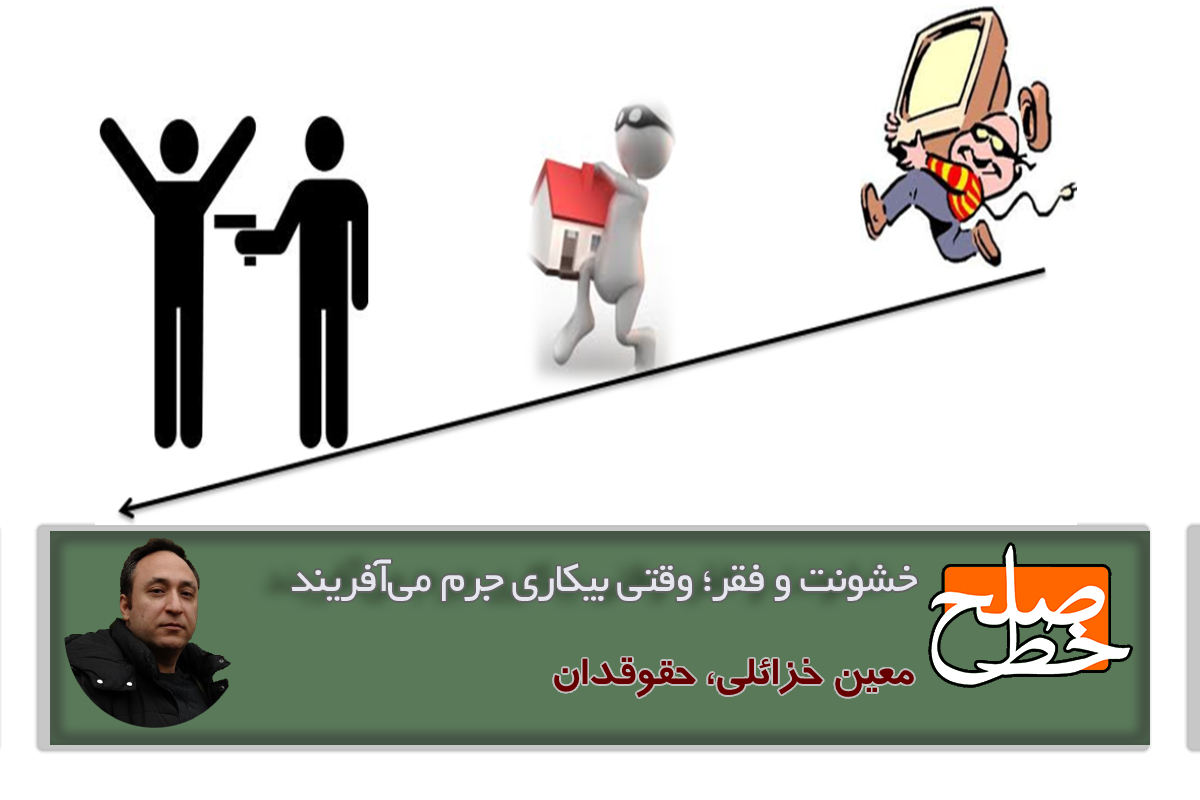
Violence and poverty; when unemployment creates crime. / Moein Khazaeli
The decrease in the general welfare level, especially the daily decrease in the household food basket in Iran, along with the increase in public dissatisfaction, is not the only effect of poverty, inflation, and unemployment. Sociologists and criminologists have been warning about the role of socio-economic factors in the emergence or at least increase of social abnormalities for years. Wandering through social networks in Iran shows that there is not a day that a video of a violent assault, armed robbery of stores using cold weapons, and purse snatching is not shared.
Among these, the statistics presented by the Statistical Center of Iran and the Strategic Statistics and Information Center of the Ministry of Labor indicate a significant percentage of 15 to 24 year olds in Iran are unemployed. Although it is not clear from these statistics what activities these individuals are engaged in, their unemployment confirms their lack of income. Additionally, overall statistics from the International Labor Organization show that the youth unemployment rate in Iran is twice the global average.
Among these, 15 to 24-year-olds are the most important group who are unemployed, meaning they are neither in school nor have a job, and play a significant role in social abnormalities. This age group, which has even been officially recognized by the International Labor Organization as NEET (Not in Employment, Education or Training), is more susceptible to criminal activities and committing illegal acts due to their age. As a result, their lack of involvement in society directly contributes to the increase in petty crimes such as shoplifting, pickpocketing, and phone theft, as well as more serious crimes such as assault.
The latest statistics from the International Labor Organization show that NEETs make up at least one-fourth of the population of 15 to 24-year-olds in Iran. This means that more than 25% of 15 to 24-year-olds in Iran, which is close to 3.5 million people, are neither employed, nor in education, nor engaged in any other productive activity such as skills training. To better understand this figure, it is enough to know that this special demographic group accounts for only 2% in Japan, 6% in Germany and Sweden, 9% in Australia, and an average of close to 10% in European Union countries.
The direct relationship between unemployment and poverty with the increase in crimes.
Last October, Farāmarz, the successor of the police detective of the law enforcement force, reported a significant increase in crimes, especially theft, by presenting statistics. According to him, in the first five months of 2020, theft from buildings increased by 29%, theft from shops by 26%, motorcycle theft by 14%, car theft by 10%, pickpocketing by 10%, and theft from homes by 5% compared to the same period the previous year.
After that, in Bahman of the same year, Mohammad Ghanbari, the head of Naja’s detective police, announced a 12% increase in the rate of pickpocketing and mobile theft in the first ten months of 99 and asked the people to increase their “self-control” to prevent being exposed to crime.
The sudden and significant increase in the number of non-professional and inexperienced criminals and their criminal activities is another result of the impact of socio-economic factors on the growth of social abnormalities. In situations caused by negative economic changes, individuals, due to the pressure of losing their fundamental social and economic rights, have no hope of achieving them through accepted social norms. As a result, they lack the motivation to maintain their social and moral status and are forced to resort to actions to compensate for their sudden and severe deprivation.
In this regard, the statements of police officials in Iran also indicate the existence of these conditions in Iran. In this regard, Alireza Lotfi, the head of Tehran’s intelligence police, had said in July of last year (1399) that more than half of the arrested thieves by the police that year had committed a crime for the first time. This clearly shows the impact of social and economic conditions on driving young people to commit criminal acts.
The research results published in Iran in 93 also show a direct relationship between crime rate and inflation and unemployment, and in case of an increase in the latter, the former also inevitably increases. This study has concluded by examining the crime rate with the unemployment and inflation rates between 1360 and 1390 that each unit increase in the unemployment rate practically leads to a two-unit increase in the occurrence of criminal acts, and each unit increase in the inflation rate has caused a one and a half unit increase in the crime rate in Iran.
The impact of economic pressure and unemployment on the emergence of social abnormalities is not limited to an increase in crime rates, but also generally increases the likelihood of violence in society. The pressure caused by financial problems, poverty, and the continuation of unstable trends, especially the lack of a clear future in economic issues, leads citizens to become time bombs that will only explode with a short spark.
In the workplace and in society, this situation has led to a significant decrease in the tolerance threshold of citizens towards daily encounters. As a result, what was considered normal until yesterday can now lead to a full-fledged conflict between citizens. The increase in the number of conflict and street fighting cases, especially in major cities, is proof of this claim. Statistics from the Legal Medical Organization in Iran show that from 2017 to 2021, the number of conflict-related cases in this organization has consistently increased, with an 8% growth in 2018 compared to the previous year.
This statistic is not specific to Tehran and other major cities have also not been immune to the negative effects of poverty on violence and crime. For example, in Mashhad, which is known as a religious city due to the presence of the eighth Shia Imam’s shrine in Iran, the statistics of street conflicts and clashes in the month of Mordad 1398 (July/August 2019) alone have increased by more than 50% compared to the same period last year. According to Mohammad Boostani, the head of the provincial police of Khorasan Razavi, this growth has led to a daily report of more than 200 conflicts, especially among young people, to the police.
The effects of economic pressure on violence in society in Iran are to such an extent that even the decrease in the population present in public places due to the coronavirus and, as a result, the decrease in the level of contact between citizens, has not been able to slow down its growing trend. According to official medical statistics, the number of conflicts in 1399 (2020-2021) has shown an increase of more than half a percent compared to the previous year, despite predictions.
Social damage caused by economic pressure, especially its emergence and prevalence in crime in Iran, has been officially recognized by judicial authorities in the country. In this regard, Mohammad Qasemi, the public prosecutor of Qazvin province, in April of this year (2021), directly referred to a group of young people who are introduced in Iran by the police and judicial system as “riffraff and thugs” and said: “These are individuals who are affected by social damage caused by economic issues and suffer from mental and psychological disorders.”
Prior to that, Alireza Lotfi, the head of Tehran’s police intelligence, had directly stated in October 2020 that there has been a significant increase in thefts in the first half of this year. He said, “Undoubtedly, various problems, especially economic problems, have had an impact on crime, and there has been an increase in petty thefts such as theft of car parts and mobile phones.”
The role of more police, futile effort to reduce crime.
Although the police and judicial system of the Islamic Republic of Iran do not deny the significant increase in crimes in recent years, especially among young people, the policies of the government have been limited to police and judicial actions in solving this serious social problem. From public shaming of suspects, or as the judiciary calls it, “criminal stigmatization,” to the increase in periodic police operations called “Thunder” to combat thieves and repeated requests from police officials for increased protection of the people, all indicate that in recent years, the fight against crime and criminal activities has not been carried out in a fundamental way, but rather as a mere show for society. Instead of addressing the root causes and factors behind the rise in crimes, the focus has been solely on superficially dealing with criminals.
The effort to solve the problem is also one of the methods that the police in Iran have taken to combat the crisis of increasing crimes caused by the serious social and economic situation. In this regard, Mehdi Hajian, the spokesperson for the Islamic Republic’s Law Enforcement Force, warned users in December 2018 that they do not have the right to publish images of theft and robbery on social media.
Citizens’ indifference to this warning, which in itself is a form of censorship, has led to the police taking action against individuals who, according to this force, share CCTV footage of theft and knife attacks on social media. Ramin Pashaei, the social deputy of the Cyber Police of the Police Force, had announced in April of this year (2021) the identification and confrontation of this police force with those who share footage of theft.
However, among all of this, what continues to grow without paying attention to these warnings and measures, is the crime rate. This rate, rather than being a sign of moral decay in society, is a sign of absolute poverty that is rapidly expanding among the layers of people and every day takes thousands of people under its wing.
 Created By: Moein Khazaeli
 July 23, 2021
Tags
45 Number 12345 German Moein Khazaei Monthly Peace Line Magazine peace line The daily problems of today's youth. The problems of young people Unemployment Youth