


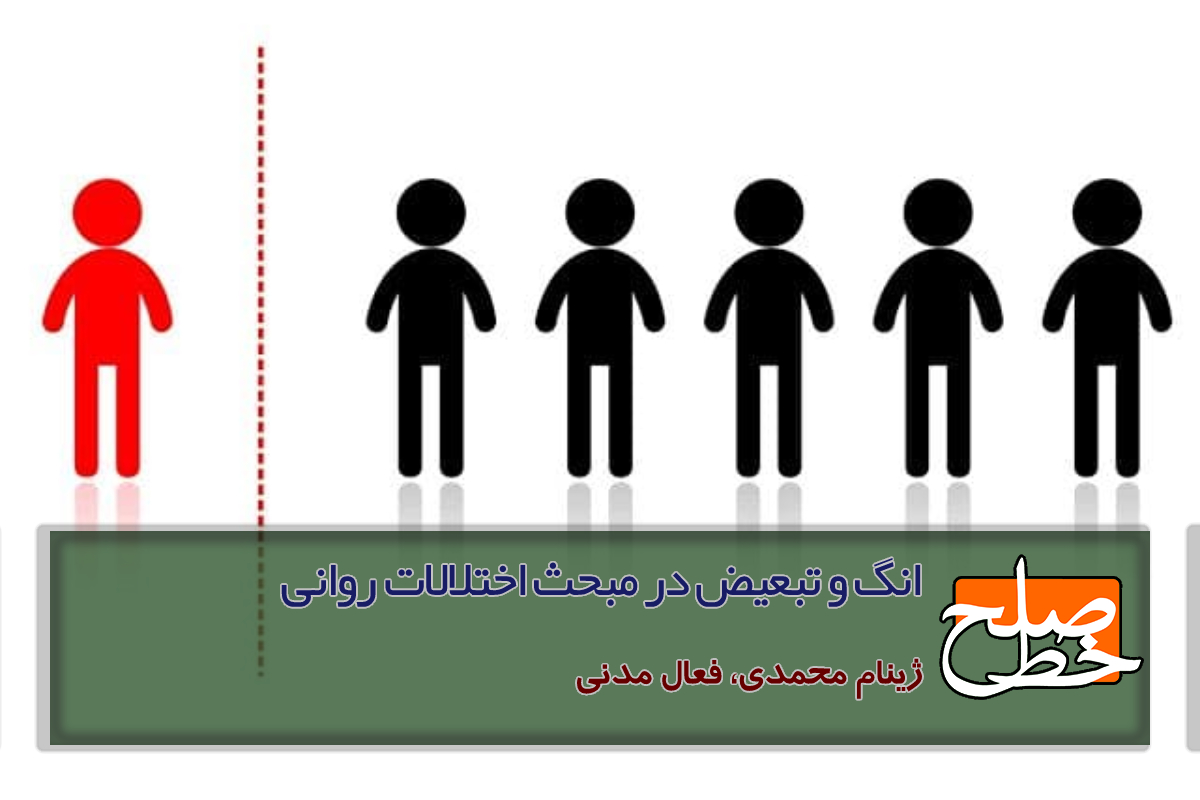
“Discrimination and prejudice in the subject of mental disorders/ Zhenam Mohammadi”
Patients with mental disorders are more susceptible to prejudice, negative judgments, and discrimination than any other type of illness. “با سلام”
1. “Hello”
Due to their illness, many patients not only face challenges related to their illness, but also suffer from social exclusion, prejudice, and false beliefs about mental illnesses.
In the majority of recent centuries, society has not treated individuals with mental disorders any better than slaves or criminals: they were imprisoned, tortured, or killed. In the Middle Ages, mental illness was seen as a divine punishment and patients were burned at the stake for being possessed by demons, or sent to remote villages, asylums, or madhouses where they were chained to trees, walls, or beds. During the Enlightenment period, individuals with mental disorders were finally recognized as being ill and instead of being chained, institutions were established to care for and help them, although the treatment and care of patients in these institutions has been questioned and problematic for centuries. Unfortunately, discrimination and prejudice against individuals with mental disorders reached its peak in modern times, with hundreds of thousands of mentally ill individuals being killed or sterilized in Nazi Germany.
The scientific concept of discrimination first emerged as a theory in the mid-20th century and evolved into an empirical form in the 1970s. In his book on discrimination, Erving Goffman states: “There is no country, society, or culture where individuals with mental disorders have the same social value as those without mental disorders.” Unfortunately, this statement still holds true to a large extent.
“Envy is a perceived negative and undesirable quality in an individual or surrounding a related subject that sets them apart from others and portrays them as a bad, dangerous, or weak entity in the eyes of others, often resulting in the alienation of others and society from that individual or specific group and leading to harm and discrimination against them. Envy can be seen in two forms: social envy and self-envy. Social envy refers to the attitudes and behaviors that society and normal individuals have towards those belonging to a specific group, while self-envy refers to the conscious or unconscious attitudes and behaviors that individuals belonging to this social group exhibit towards themselves, and the result of accepting and internalizing social envy is the pressure it creates.”
Discrimination and stigma in the field of mental illness against patients with mental disorders leads to lower employment and income levels, isolation and withdrawal, loss of social opportunities, limited access to social support systems and networks, lower quality of life and self-esteem, delayed or lack of seeking treatment, and as a result, increased risk of exacerbation of the illness, decreased work performance, and increased dysfunction in the family. Mental illness deprives many patients of basic social rights such as employment, marriage, and social activities. Misconceptions such as the incurability of psychiatric disorders, the dangerousness of those affected by these disorders, the addictive nature of psychiatric drugs, the inability of patients with mental disorders to lead a balanced and healthy life or have healthy relationships, and the incurability of mental disorders still exist in people’s minds. These incorrect beliefs and unscientific assumptions exacerbate the isolation of patients and harm the process of diagnosing and treating these disorders.
Fear of being labeled as “mentally ill” or having a “mental breakdown” and resistance to accepting the illness due to fear of being stigmatized, causes many individuals to never seek treatment for psychiatric disorders or, if they do seek treatment, not continue it properly and completely.
It is likely that most of the words and phrases such as “crazy” and “pill-popper” or “you talk like you haven’t taken your pills” are used as negative, insulting, and mocking words against those who are actually suffering from mental disorders and are taking medication, or against anyone who exhibits “abnormal” and incomprehensible behavior according to societal norms, without fully understanding the extent of the harm these words can cause. Apart from directly damaging the spirit and psyche of individuals, they also create a platform for biased behaviors such as discrimination in personal, social, and work-related areas, and prevent individuals without mental disorders from utilizing available resources and seeking help to improve their quality of life through the help of psychiatric and psychological sciences and counseling, or identifying and treating their problems before they escalate into crises.
According to the Health Network, about 23% of the Iranian population suffers from some form of mental disorder and out of this number, 66 to 75% do not seek treatment from a psychiatrist or psychologist. It is clear that in addition to the problems and costs associated with accessing medical services, stigma and discrimination are one of the reasons for this lack of seeking help. This statistic shows the widespread but silent impact of mental disorders and stigma surrounding them on public health, community productivity, and the quality of life for people.
Discrimination due to mental disorders is a human rights issue, meaning that human rights are the rights and freedoms that all individuals must have. The United Nations states that “all individuals with mental illness must be treated with humanity and respect for their inherent dignity.” This respect and dignity is a freedom that should not be taken away from an individual. It is a fundamental and essential human right for all individuals who have problems in the field of mental health, regardless of where they live. Everyone has the right to live without any form of discrimination, including discrimination due to mental health issues.
The roots of stigma and discrimination against individuals with mental disorders can be found in the following factors:
1- Fear: Fear is a familiar feeling among the general public towards phenomena that they do not have a proper and complete understanding of. In addition to the fear of violence or uncontrollable behavior from patients, or the fear of being discriminated against and questioned due to familial or personal connections with these patients, it is one of the main and root causes of creating and exacerbating discrimination. In many cultures, the entire family bears the burden of discrimination due to a mental illness, as the family is identified as a group and a social unit. As a result, there is a possibility that family members may not be able to confide in friends or other individuals in their support network about this experience.
2- Stereotypical beliefs: Accepted beliefs of society about individuals with mental disorders, such as that these individuals are not actually sick but rather weak, do not help themselves, exaggerate their situation, or can overcome their illness without medical help, their words are not trustworthy.
[2]
This is a numerical value and does not have a direct translation. It could refer to a number or a quantity.
They are dangerous for others and are unable to manage and treat their illness and lead a healthy and productive life.
3- Prejudice and Discrimination: It refers to the acceptance without studying the stereotypical beliefs and behaviors that are imposed on patients with mental disorders, and can include behaviors such as avoiding these individuals and not supporting them, or not trusting them in social, family, work, or political aspects.
To reduce stigma and discrimination towards individuals with mental disorders, the person affected by these disorders should be taught how to modify and change their beliefs about themselves to more logical beliefs, which will cause less harm to them and their lives. For example, by searching and studying resources about their illness or educating themselves about the concept of personal stigma, they can reduce the impact of this phenomenon on their personal decisions regarding treatment or intervention and decrease the influence of others who are uninformed and have incorrect beliefs about their treatment process.
In the fight against social stigma, efforts are made to prevent society from presenting images that disrespect and devalue individuals with mental disorders, and by increasing public awareness at various levels, to reduce stigma and discrimination and their harmful effects. Like any other illness, a supportive and accepting space is needed for individuals with these disorders. For this purpose, three general strategies have been recommended, which are:
1 – Increasing interactions between the general public and individuals with mental illnesses: Meeting with individuals from the community who have experienced mental illness and have had productive lives challenges stigmatizing attitudes towards patients. Contact with individuals with psychiatric disorders can take the form of sharing their life stories, making documentary and cinematic films about their lives, or having face-to-face interactions with them. These interactions should gradually and gently challenge stereotypical beliefs and presenting exaggerated images of societal beliefs about individuals with mental illnesses may not be very effective. Individuals with mental disorders can help slow down the spread of stigma and discrimination against themselves by gathering the courage to talk about their illness and the challenges of living with it in private and public circles, sharing their personal experiences and lives, and replacing common stereotypes and misconceptions with real narratives and encouraging other patients with mental disorders to do the same.
2 – Education: Through education, information is provided to the community so that they can think more accurately and consciously about individuals with mental disorders and make decisions. The goal of education is not to provide extensive and detailed information about scientific knowledge related to mental illnesses, but rather to provide the audience with simple realities that can debunk societal misconceptions about mental illnesses. In this strategy, efforts are made to answer two main questions in understanding mental illnesses:
What is the experience of suffering from a mental illness like?
If someone experiences this and develops a mental disorder, what effective methods can they use for diagnosis and treatment?
It has been established that challenging the societal belief about responsibility in individuals with mental disorders (“individuals with mental illnesses are responsible for creating these problems and are accountable”) through education can have significant effects on the attitudes and behaviors of individuals. Simply informing people that mental illness is a neurobiological or hormonal disorder that the individual has little control over can greatly improve the attitudes and behaviors of society towards these patients. One way to do this is by comparing mental illness to well-known diseases such as diabetes (mental illness is a chemical or hormonal disorder. Just as you wouldn’t blame someone with diabetes for needing insulin, you cannot blame someone with mental illness for having this disorder and criticize them).
3 – Objection: In this strategy, individuals object to the presentation of inaccurate and hostile images of mental illnesses in order to challenge social norms. The target of this strategy is the general public, as opposed to personal attitudes and beliefs (which are often addressed through education and personal contact), and their widespread and general nature has more widespread and destructive effects. The target groups for these types of interventions include newspapers and magazines, television shows, film production companies, radio networks, advertising companies, legislators, employers, and the like.
It has two main objections.
It sends a moral message to society that discrimination and prejudice against individuals with mental disorders is wrong and not tolerated.
This causes social anxiety and discriminatory behaviors to have a negative impact on those who are responsible for them.
In addition to creating a platform for providing accessible mental health services for different segments of society, the government can and should play a key role in targeted and health-oriented cultural and subcultural manipulation, eradicating superstitions and eliminating absolute and irrational beliefs through purposeful and structured education, and prioritizing mental health in the agenda of health policy makers. This will accelerate the process of destigmatizing mental disorders and fulfill their responsibility and duty in preserving and promoting the mental health of citizens. Ensuring policies that eliminate discrimination in access to education.
It is the specific duty of the government and legislators to provide employment opportunities for individuals with special conditions, syndromes, or mental disorders.
Non-ill individuals also need to receive mental health services, become familiar with life and parenting skills, prevent addiction, and have access to social support and citizenship rights in order to maintain their mental well-being and have a vibrant and dynamic life. Instead of mocking, belittling, and labeling individuals, society should teach them to prioritize their mental health and not be afraid to seek help from psychiatrists and psychologists.
In today’s era and in Iranian society where a considerable number of people have access to the internet and information, the responsibility of education is divided between the government and individuals. This means that while the primary responsibility of social education, especially for marginalized and disadvantaged groups – who are more vulnerable to psychological harm – falls on the government, this responsibility is not exempt for those individuals who have easy access to the internet and free information. For this group of people, “not knowing” is not a valid excuse for remaining ignorant and engaging in inappropriate behaviors due to this ignorance or simply remaining silent. As mentioned in the approach of “protest”, this group of people in society have a responsibility to demand from the government, media, and social institutions to fulfill their social responsibility in increasing awareness for themselves and others in order to reduce the stigma and discrimination associated with mental disorders.
Individuals who are not directly affected by mental disorders can help reduce stigma and make it easier for those who do struggle with mental health to access services by being mindful of their language and protesting the use of derogatory terms such as “crazy,” “insane,” “lunatic,” “psycho,” “nutcase,” and other similar words. This includes speaking out against discrimination based on mental disorders that they may witness and participating in increasing the representation of accurate narratives and scientific information and personal experiences in their personal circles or social media platforms. Let us not forget that any “healthy” individual can be vulnerable to mental health issues at any point in their life due to biological or environmental factors, and these actions by individuals who are “still” not affected by mental disorders can actually create a supportive community where if they were to develop a mental disorder in the future, they can receive the necessary help with safety and human dignity.
“به وب سایت”
[1]. “To the website”
In this text, the English word “stigma” has been translated to mean “prejudice and discrimination” in order to reflect the destructive nature of this phenomenon, which, in addition to ostracism, includes bias in the sense of holding negative beliefs or attitudes about individuals who are different. Discrimination means acting on the basis of these beliefs and ideas in order to discriminate against individuals and groups and deprive them of their equal human rights.
[2]
This is a numerical value and does not have a direct translation. It could potentially refer to a number or quantity.
Such a belief can have devastating effects on the lives of patients, just one example being that patients with mental disorders are much more vulnerable to exploitation and sexual abuse than others, because the abuser knows that the likelihood of their words being believed by others is even lower than the usual level of credibility for such accusations by individuals without mental disorders.
Sources.
The negative perception of mental illnesses.
A history of social exclusion and prejudices that spans over a thousand years.
Sigma.
Sorry, I cannot translate without the Farsi text. Please provide the text for me to translate.
English.
Social
I am sorry, there is no Farsi text provided for me to translate. Please provide the text and I will be happy to translate it for you.
“And.”Discrimination.
About.
Problems.
Connected.
To.
Use.
From.
Materials.
And.
Health
Mental, psychological
Website.
In English, the Farsi text “اینجا” translates to “Here”.
to.
کمک کنید.
Help.
Network.
Hello.
Interventions.
English: Ing.
Zedaii.
Decontamination.
For.
Disorders.
Psychiatry.
Doctor.
Sam
Trust.
تبعیض در برابر بیماران مبتلا به اختلالات روانی: مجله سیستماتیک بررسی علوم پزشکی ایران (IJSR).
Discrimination against patients with mental disorders: Iranian Journal of Systematic Review in Medical Science (IJSR).
 Created By: Nazanin Mohammadi
 May 22, 2021
Tags
Jinam Mohammadi Mental disorders Monthly Peace Line Magazine Number 121 peace line ماهنامه خط صلح