


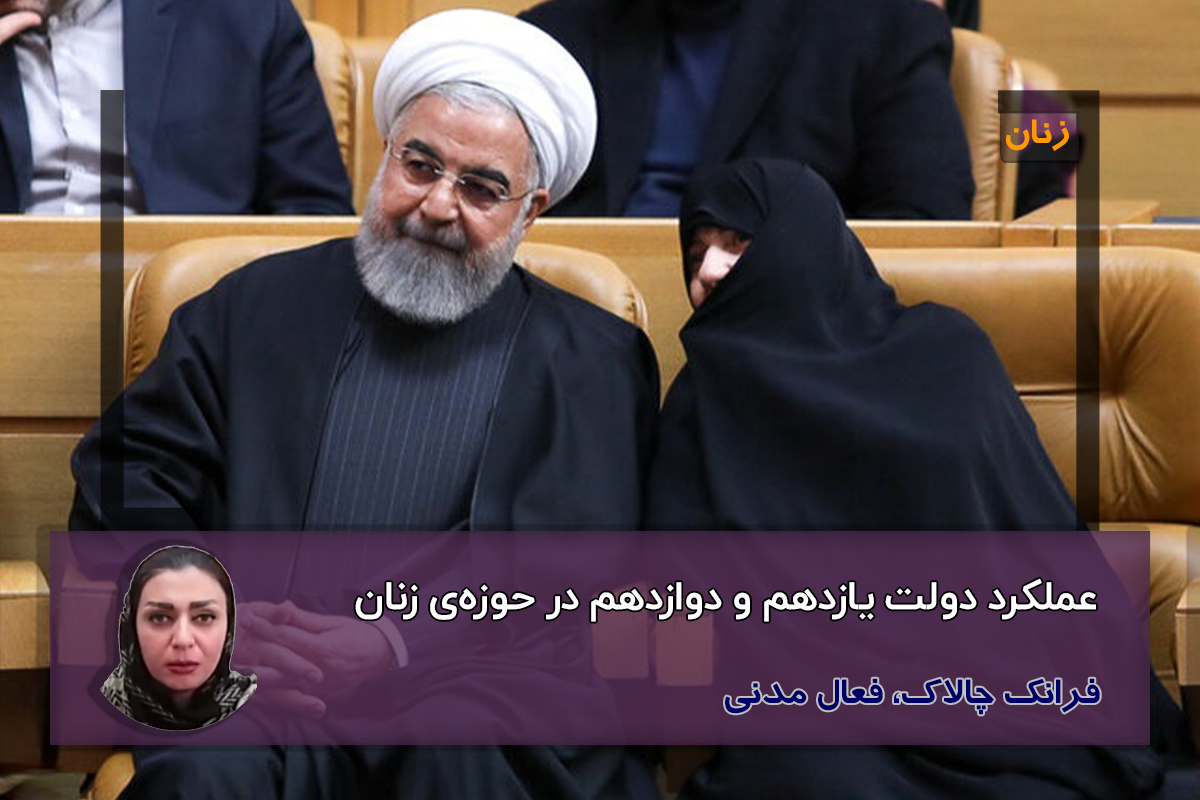
The performance of the eleventh and twelfth governments in the area of women’s rights/empowerment.
In this writing, an attempt has been made to examine existing problems from various angles related to each other. The relevant field to women, from macro to micro levels, due to enacted laws or ideological, jurisprudential and religious-centered perspectives, has caused numerous problems that are incompatible with current conditions and parameters. In the following, a few examples of these problems will be mentioned at the macro level, and then at the social and economic levels with a focus on the average promises of the government in two executive periods.
In 2004, the Supreme Council of the Cultural Revolution drafted the Charter of Women’s Rights and Responsibilities in the Islamic Republic of Iran, inspired by the comprehensive Islamic law and its legal system, and with the aim of explaining the systematic rights and responsibilities of women in the areas of individual, social and family rights, based on recognition and faith in the Almighty God. The use of the term “Sharia” in various political, social, economic, and even citizenship and individual rights
Employing women in top management positions and major decision-making roles in the country.
In these two periods, we did not even witness the introduction of a single woman in the cabinet and only relied on the presence of assistants and legal deputies, and ultimately the inclusion of women such as the governor of Shahre Qods (Leila Vaseghi, who issued the order to open fire during the November 98 protests). While the number of capable, talented, and deserving women was not lacking in some cabinets. Not only was there no effort to include them in the cabinet, but the neglect of these skilled women was evident, with no logical or rational justification given, and their right was taken away from the realm of women.
Due to the patriarchal approach of the ruling clerics, decisions made at various levels of government are against the interests of women. For example, in the past 43 years, with no clear definition of “political man”, we have always faced obstacles for women’s candidacy in elections. Although women with a history of political activity and high competence have tried to
Support for imprisoned women, women’s rights activists, and creating space for the realization of women’s social rights.
A wide range of problems can be listed that are evident in this layer. Denial of basic citizenship rights under false pretenses, such as the right to attend sports stadiums, ride bicycles, and the freedom to choose clothing and hijab, are among the issues that many women have been paying exorbitant costs for years to obtain. For example, the “Blue Girl” who only sought the right to attend a football match and was driven to self-immolation due to the ban on women’s presence in stadiums, or women and girls who did not believe in compulsory hijab and paid heavy costs such as long prison sentences to demand their most basic rights.
At the micro level, which forms the foundation of society, namely the family institution, broader rights are violated and no preventive legislation has been sent to the parliament or pursued by the government during these 8 years. For example, the right to custody of children after divorce or the death of a spouse, which is automatically given to the father,
Recovery of labor rights, social and economic equality in professional fields.
Another issue that can be mentioned in the social-economic field is the employment of women, especially female heads of households. A few days ago, Ali Aslani (a member of the Supreme Labor Council) announced that “about 10 million workers are employed in small workshops with less than 10 employees who do not comply with the laws of the Ministry of Labor and Social Affairs.” In these small workshops and economic enterprises, which usually have lower wages than other economic enterprises that are subject to the laws of the Ministry of Labor, most of the workforce is provided by women. On the other hand, despite the sanctions and the approximately 14 months of the presence of the coronavirus in the world, which has led to the closure of most economic enterprises and workshops, most of these women have become unemployed or in large economic enterprises, which, despite the existing economic problems, usually resort to downsizing, women are the first to be downsized (employers in these cases usually see men as the head of
 Created By: Faranak Chalak
 April 21, 2021
Tags
"Rouhani Government's Human Rights Record" Frank Chalak Monthly Peace Line Magazine Number 120 peace line State and human rights Women ماهنامه خط صلح