


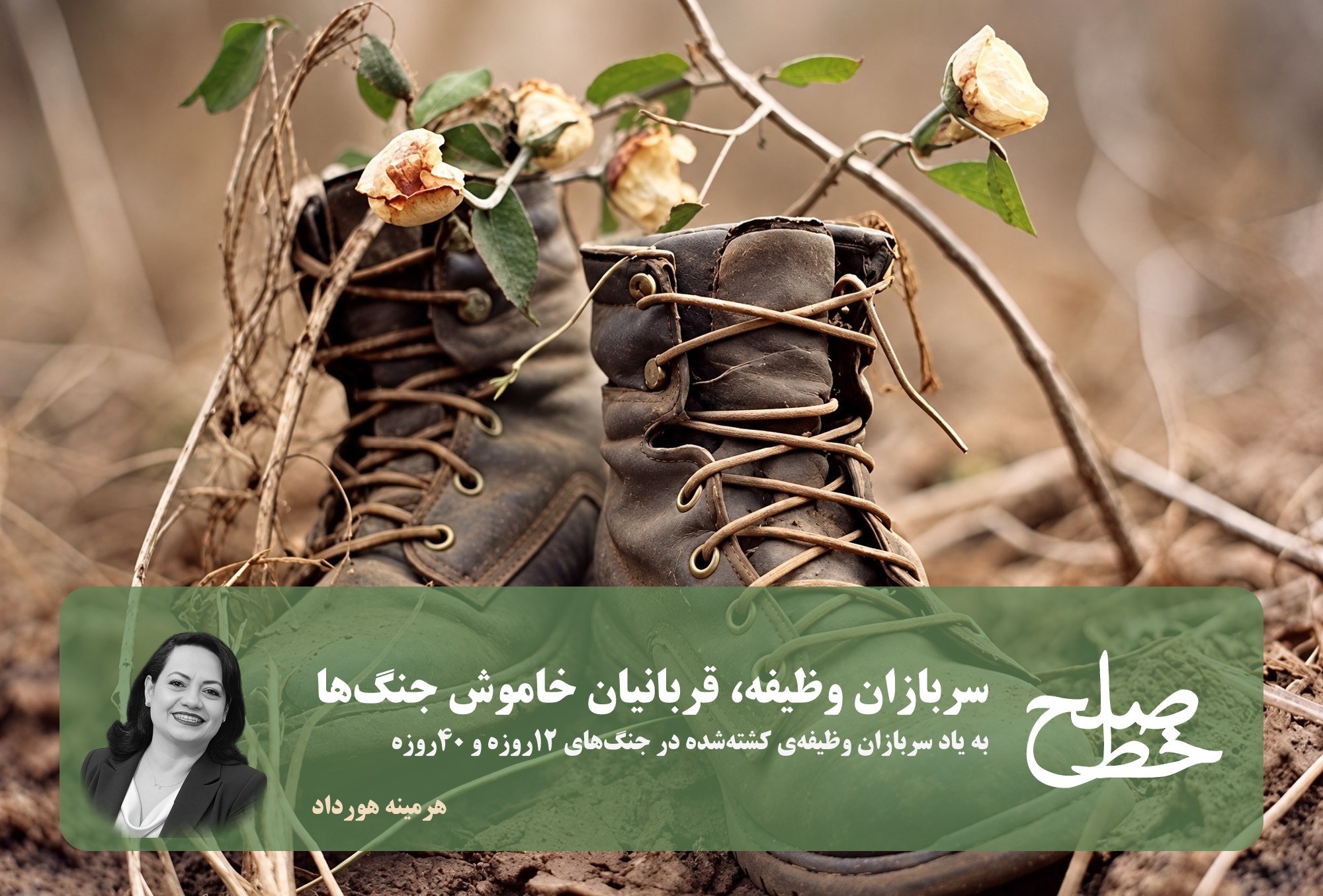
Conscripts: The Silent Victims of Wars / Hermineh Hordad
His military service had come to an end. Only a few signatures from his superiors remained to complete the administrative discharge process so that he could return home—to life, to work, and to the future he had envisioned for himself. To obtain those signatures, he went to his superiors’ post on the front line. After completing the administrative paperwork, he boarded a truck carrying several Iran-Iraq War combatants, including a few fellow conscripts, to return behind the lines. On the way back, a mortar shell struck the truck. All passengers were killed instantly.
He was the eldest son of the family—a family with a daughter and a younger son. His death was not merely the end of a young man’s life; it became a bitter turning point in the life of a family that had suddenly lost one of its core members. Yet the repercussions of that death did not remain confined to that single household. The lives of relatives, friends, neighbors, and everyone who knew him were altered in some way. His absence endured within the collective life of those who loved him.
In those days, I was a girl of seven or eight. That soldier’s mother was a family friend, close to my mother and grandmother, and his family were our neighbors. Today, more than forty years later, I still vividly recall many scenes from that period. Perhaps at the time I lacked a full grasp of the meaning of death, war, or military service, but I remember how the loss of a young person can transform the life of a family, and even an entire neighborhood. With the passage of time, this memory has not faded; on the contrary, as I reflect today on military conscription, war, and the state’s responsibility toward the lives of its citizens, it has taken on new meaning.
The inquiry of this essay begins with this very memory, though it does not end there.
Who is a conscript, and why must they be called up for military service? Does mere birth in a country and reaching a certain age grant the state the right to compel an individual to place a portion of their life and youth at the disposal of a military apparatus, and even place their life in jeopardy? Does citizenship mean relinquishing the right to decide over one’s own life and death to the government? And when a conscript is killed during wartime, who bears responsibility for this death? Military commanders, the political structures deciding on war, the legal framework of compulsory military service, or a combination of these factors?
The issue is not merely the number of conscripts killed in war; the fundamental question is why the lives of human beings whose career choice was not military service should be exposed to such danger in the first place. Who decides the likelihood and magnitude of this risk? Who is accountable for its consequences? And does an individual inducted into military service under legal compulsion possess the same agency and responsibility that a professional soldier accepted by consciously choosing that profession?
The point of departure for this article is not merely to examine casualty statistics, but to rethink the concept of compulsory military service, its foundational origins, and its relationship to the right to life and individual freedom. In this context, the article first examines the history and philosophy of the emergence of conscription globally and in Iran, and then situates this phenomenon within the political and historical context of the Islamic Republic, which has experienced three wars over the course of its existence.
Nevertheless, the core question transcends any single political regime: Do states have the right, in the name of national defense and security, to draft young people into compulsory service and expose them to mortal danger? If so, what are the boundaries of this authority, and what responsibility does the state bear toward the lives of conscripts?
To address this question, we must view the conscript as a human being before considering them a military title or a unit within the armed forces’ structure—a human being with a family, emotional ties, aspirations, career plans, and the right to a future; a person whose life must not disappear into military statistics, war reports, and broad casualty headings.
In ancient Iran, from the Achaemenid era to the Parthians and Sasanians, the army and military organization were central pillars of territorial defense and state power. In the Achaemenid Empire, professional troops and royal guards served alongside regional forces and individuals summoned during military campaigns. In certain regions, military obligation was linked to landownership and economic privileges. During the Parthian period, noble houses and local rulers played a significant role in providing troops, and in the Sasanian period, the army acquired a more centralized and organized structure. Nevertheless, none of these models can be considered equivalent to modern universal conscription, as military obligation in those eras was largely subordinate to social standing, economic status, and the individual’s relationship with the ruler.
In ancient Greece and Rome, military participation was also tied to the concept of citizenship and social status. In Athens, male citizens took part in defending the city-state commensurate with their economic means and resources; in Sparta, military training was an inseparable part of a male citizen’s life. In the Roman Republic, eligible citizens were called to arms when needed, but as the empire expanded, the military gradually became more professional and permanent. In medieval Europe, military mobilization relied primarily on feudal obligations, the loyalty of noble houses, and the hiring of mercenaries. From the sixteenth to the eighteenth century, with the rise of centralized states, standing armies, and the demand for broader human and financial resources, more systematic methods of recruitment and conscription took shape.
However, the turning point in the emergence of modern conscription occurred during the French Revolution. In 1793, facing foreign military threats, the revolutionary government enacted the mass mobilization policy known as the Levée en masse, placing various sectors of society in service of wartime needs. Subsequently, the Jourdan-Delbrel Law of 1798 institutionalized the principle of universal male military obligation within the French legal framework. From that point onward, national defense was no longer merely the duty of an army or a caste of soldiers; it became a statutory obligation under which the state could register and draft citizens. Thus, modern conscription was not an enduring, millennia-old tradition, but rather the product of the modern state’s emergence, the expansion of the concept of the nation, and the altered relationship between citizen and political power.
During the Qajar period, particularly beginning with Abbas Mirza in the early nineteenth century, a mechanism for raising military forces known as the “Bonicheh-ye Sarbaz” system took shape, whereby villages and agricultural regions were obligated to provide a specific quota of soldiers proportional to their economic capacity. This system was reformed and expanded under Amir Kabir, yet it never developed into a unified universal draft. In practice, affluent families could purchase exemptions or provide substitutes, leaving the burden of service largely on the shoulders of the rural and impoverished classes. A universal conscription system based on individual statutory obligation was ultimately established with the passage of the Conscription Law of 1925 (1304 AP). Under Reza Shah, the Universal Military Service Law was approved in June 1925 and implemented from 1926, subjecting Iranian men aged 21 and older to military service. The enforcement of this law met with resistance from segments of society, including merchant guilds, the clergy, and nomadic tribes. Reza Shah employed compulsory military service as an instrument to forge a centralized army, reinforce the central government, and unify the country. In this way, universal military service became a permanent legal requirement in the lives of Iranian men. From the Qajar period to the end of the Pahlavi regime, the Iranian state’s legal and organizational responsibility for the lives and well-being of soldiers gradually broadened; however, a significant gap always remained between the state’s formal responsibility and what was practiced on the ground. Under the Qajars, providing soldiers with pay, rations, clothing, training, and medical care suffered from systemic weakness, corruption, and disorder. With the enactment of the 1925 Conscription Law and the formation of a centralized standing army under Reza Shah, the state assumed broader responsibility for organizing and providing for military forces; nevertheless, the expansion of the military apparatus did not necessarily ensure the safety and welfare of soldiers. Historical studies on the Reza Shah era also reflect substandard service conditions and social resistance to conscription. During Mohammad Reza Shah’s reign, the army advanced significantly in equipment, training, and organization, but these developments could not be construed as a complete guarantee of conscripts’ rights. Overall, throughout these eras, the state appeared to define its role around supplying manpower for the armed forces, preserving sovereign authority, and advancing political and military objectives, rather than providing comprehensive safeguards for soldiers’ right to life, health, and security.
Yet the state’s responsibility for the lives of soldiers must not begin solely upon their deployment to the battlefield or after their deaths. A more fundamental question is whether governments exhaust all possible avenues to prevent war and resolve disputes peacefully before engaging in armed conflicts. Is safeguarding the lives of citizens and youth drafted by force genuinely a priority in regimes’ political and military calculations? From a human rights perspective, protecting the right to life encompasses more than merely attending to the wounded, recording casualties, and paying restitution to families; it also entails preventing armed conflict and refraining from decisions that imperil human lives. In its General Comment No. 36, the UN Human Rights Committee recognized efforts to avert war and settle disputes peacefully as among the foremost guarantees of the right to life. Therefore, the genuine responsibility of the state must be sought in the decisions that can forestall war and prevent the loss of human life, long before young people’s names are entered onto casualty lists.
The matter becomes all the more painful when we recognize that some conscripts lost their lives not on the front lines or in direct combat, but while asleep in their garrison quarters and barracks. During both the Twelve-Day War and the Forty-Day War, soldiers’ accommodation and resting quarters were targeted. For instance, in the 2025 attack on the Evin Prison complex, soldiers’ barracks were damaged and reports of conscript casualties were published. Likewise, on July 15, 2026 (24 Tir 1405), during the Forty-Day War, the garrison of the Army Ground Forces’ 388th Brigade in Bampur, Sistan and Baluchestan Province, was struck. According to reports from the Army of the Islamic Republic of Iran, in this attack—which occurred while troops were resting—seven service members, including five conscripts and two cadre personnel, were killed and 13 were wounded. These incidents raise a crucial question regarding the responsibility of the state and military commanders: In light of foreseeable attacks, what measures were implemented to safeguard the lives of young men compelled into service? Was it possible to relocate them to safer areas, disperse forces, or provide adequate shelters? And in the aftermath of these incidents, was any transparent investigation conducted into how the attacks occurred and whether the casualties were preventable? Unquestionably, the legal responsibility of the attacking party to comply with international humanitarian law is a separate issue; however, this does not absolve the state and military leadership of their obligation to take reasonable precautions to protect the troops under their command. A conscript who possesses virtually no choice in selecting their duty station or terms of deployment must not pay with their life for the absence of protective measures and preventable decisions.
Around the world today, the relationship between the state and the conscript is not defined uniformly. In some countries, peacetime military service is seen not as a mechanism stripping youth of basic rights and exposing their lives to unregulated peril, but rather as an interval for training, skill acquisition, social experience, and even an opportunity to receive economic and educational support. In Sweden, for instance, conscripts receive a daily allowance of 20 euros alongside free accommodation and meals, emergency medical and dental care, insurance, free travel during leaves, and a completion bonus. Furthermore, individuals accepted into university prior to their service retain their academic standing.
In Norway, conscripts similarly receive free meals, clothing, lodging, and healthcare, and in addition to a monthly allowance, provisions exist for financial support toward education and fixed living expenses, including housing rent. Upon completing their service, they also receive an end-of-service bonus.
This approach is not confined to Europe. In Singapore, the National Service framework is accompanied by financial support packages, life and personal accident insurance, healthcare coverage, and programs tied to housing and education.
None of these systems, of course, implies the total elimination of military hazards or an absolute guarantee of soldiers’ safety; the fundamental difference is that alongside demanding service, the state has established clear, enforceable mechanisms to protect the individual’s rights, health, future, and security. Under such conditions, military service can become a productive, advantageous experience in a person’s life trajectory. This comparison raises a serious question regarding Iran: What tangible support, and what guarantees for health, security, and the future, does a young person compelled into military service receive in exchange for the time taken from their life and the dangers they endure?
A government that is constantly embroiled in military tensions and regional conflicts, yet fails both to protect its human capital and younger generation and to provide reliable safeguards for their lives during military service, gradually faces a profound rift with its citizens. This divide is especially evident among young men who must dedicate vital years of their lives to compulsory service—youth who are expected to build the country’s future, pursue education, establish careers and families, and contribute to society’s development. But when these young people feel that the government drafting them imperils their lives through its military policies and decisions, while remaining unaccountable for the fallout, the relationship between citizen and state is fundamentally altered. In such an environment, serving one’s country is no longer necessarily equated in the minds of the youth with serving the regime; the very government charged with safeguarding their security and lives may even be perceived as an active threat to their survival and future. It is here that compulsory military service ceases to be a mere legal requirement and becomes a profound question of public trust, political legitimacy, and the fundamental right of citizens to their own lives and futures.
Under such circumstances, it is only natural that every young person, commensurate with their resources and life conditions, seeks to avoid this path—some through emigration, some by pursuing legal exemptions or deferments, and others by finding ways to stay clear of the draft. Yet not everyone possesses such means. Those with no other choice are inevitably drawn into a path where they not only surrender a portion of their youth and life opportunities to the government, but their lives and futures are placed at risk by decisions in which they had no voice. For this group, conscription effectively turns into an involuntary gamble with life and death—a gamble where one side holds a person’s youth, dreams, and future, and the other holds decisions they are powerless to influence. An examination of the other personal, social, psychological, and economic harms of conscription is the subject of separate inquiry and lies outside the scope of this essay. The focus here rests upon a more foundational issue: the right to life, and the responsibility of a government that places its citizens in harm’s way by force.
The precise number of conscripts who lost their lives in the Twelve-Day and Forty-Day Wars remains unknown due to the lack of official, comprehensive, and disaggregated data. However, available accounts indicate that several of them were struck not on the battlefield or in direct engagements, but in the most vulnerable circumstances imaginable: resting and sleeping in their barracks and military quarters. These were young men who had been forcibly conscripted and possessed virtually no means of self-defense against aerial bombardment. Therefore, while it cannot be stated with certainty how many conscripts were killed, we can speak to the conditions under which some of them perished—conditions that raise profound questions about the government’s responsibility to protect the lives of these young men and its accountability to their families.
 By: Hermineh Hourdad
 November 22, 2026
Tags
12-Day War Compulsory military service Conscripts Hermine Hordad peace line Peace Line Monthly Peace Mark 187 State responsibility the 40-day war The war between Iran and Iraq War Casualties