


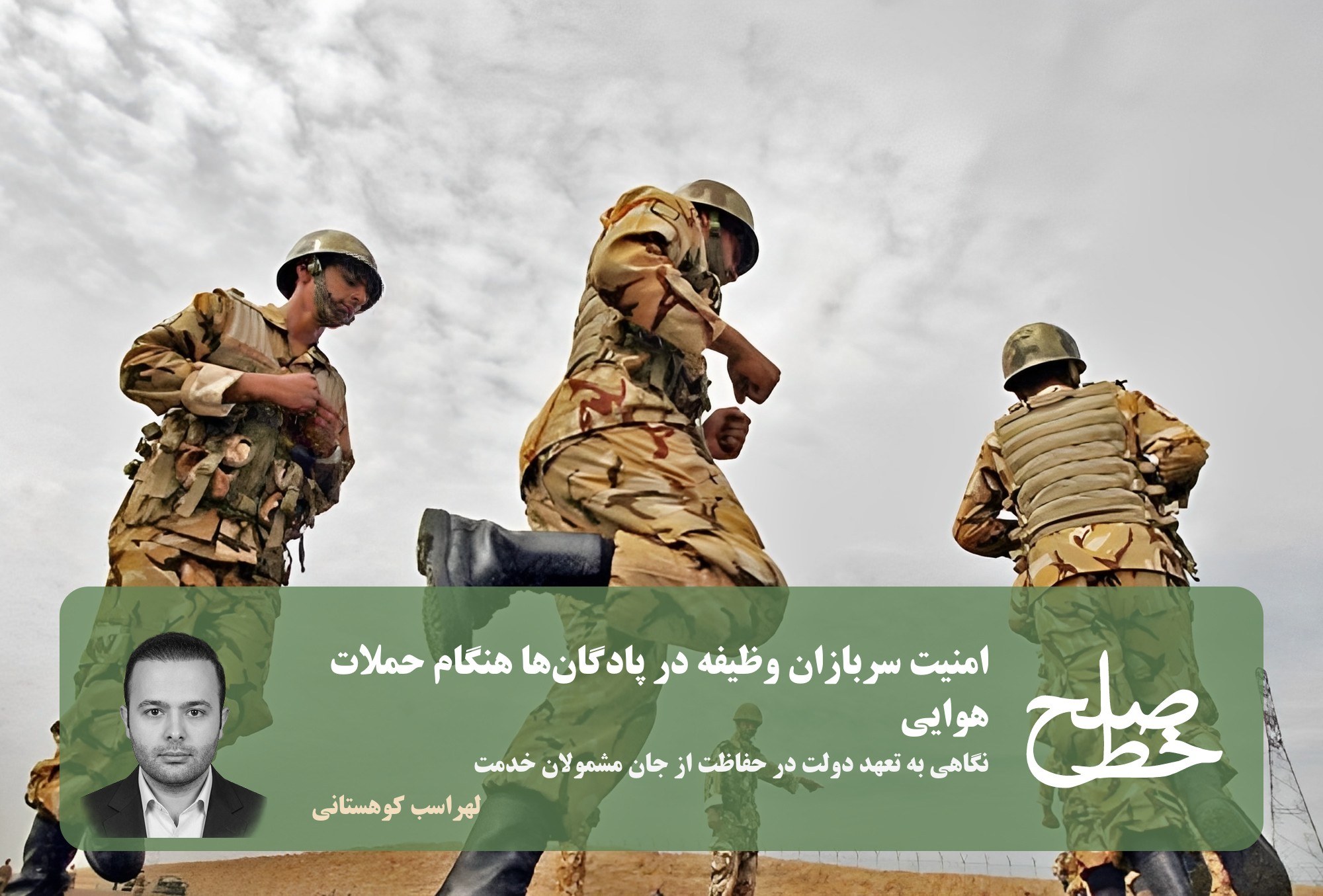
The Safety of Conscripts in Barracks During Airstrikes / Lehrasb Kuhestani
When security in wartime is discussed, attention is usually directed to military equipment, defensive capacity, and operational outcomes. Meanwhile, a question that is raised less often is how the situation of conscripts—who, by law, spend their period of service in barracks—should be addressed under conditions of airstrikes. This question is neither about a specific incident nor about the performance of a particular institution; it is a legal and managerial question that can be posed in any legal system and in any period, and answering it will benefit all stakeholders, including the military structure itself.
A conscript, unlike professional forces, has not begun their presence in service on the basis of an employment relationship or a career choice. Performing compulsory public service is a legal obligation that every eligible person, regardless of personal inclination and usually at an age when they are still at the beginning of their professional and family life, is required to fulfill. This feature makes the state’s responsibility to protect these individuals’ lives and health more pronounced. Military service inherently involves accepting risks, and no one expects those risks to be eliminated entirely; however, accepting risk is different from disregarding safety requirements. What is expected of the state is not the complete removal of risk, but the adoption of customary and proportionate measures to reduce it.
The legal foundations of the state’s obligation to protect life
In domestic law, Article 22 of the Constitution deems individuals’ lives to be protected from violation and, except in cases permitted by law, not subject to infringement. Although this principle is addressed to all members of society, it provides a suitable basis for arguing that protecting life is one of the fundamental duties of the legal order. At the level of ordinary legislation, Article 11 of the Civil Liability Act (1339) distinguishes between damage arising from the personal act of employees and damage arising from defects in an agency’s equipment, and places compensation for the latter on the relevant agency or institution. In its final part, the same article exempts acts of sovereignty under certain conditions. Merely invoking this article does not mean establishing state liability in every military incident; applying it to a specific situation requires a careful analysis of the boundary between sovereign acts and administrative operations, and an examination of the circumstances of each case, and no general ruling can be issued here. (1)
At the international level, Article 6 of the International Covenant on Civil and Political Rights recognizes the right to life and deems its legal protection mandatory. Iran acceded to this Covenant in 1354, and pursuant to Article 9 of the Civil Code, the provisions of ratified treaties have the force of domestic law. (2) The Human Rights Committee, as the body overseeing implementation of the Covenant, explained in General Comment No. 36 (2018) that states’ obligations are not limited to refraining from arbitrary deprivation of life, but also include a positive obligation to protect individuals’ lives against threats that are generally foreseeable. The Committee also emphasized that states must establish a protective legal framework and exercise due diligence and care in this regard. While this interpretation is not itself binding, it is regarded as an authoritative reference for understanding the content of the Covenant’s obligations. (3)
From a comparative perspective, one may also refer to the case law of the European Court of Human Rights. This jurisprudence is not binding on Iran and is purely interpretive and comparative, but it shows that the state’s obligation to protect life is interpreted in a similar manner across different legal systems. In Osman v. the United Kingdom, the Court accepted that whenever authorities knew or ought to have known of a real and immediate risk to an individual’s life, they have a duty, within the scope of their powers, to take reasonable measures to prevent it. In Öneryıldız v. Turkey, the Court applied the same logic to activities that fall under the supervision and responsibility of public authorities, and held the state responsible for preventable risks. Mentioning these examples does not mean drawing a direct analogy between events; it only shows that expecting protection of the lives of those under the control and supervision of public bodies is a recognized expectation in comparative law. (4)
Humanitarian values and principles of crisis management
International humanitarian law, which governs armed conflicts, primarily regulates relations between the parties to the conflict, and a large part of its protective rules concerns civilians. Nevertheless, one of its well-known principles is taking precautions against the effects of attacks, reflected in Article 58 of Additional Protocol I of 1977 and Rule 22 of the ICRC’s study on customary international humanitarian law. (5)
Since these rules were originally established to protect the civilian population, and Iran has not ratified that Protocol, citing them in this article does not mean their direct application to conscripts. These provisions are recalled only insofar as they illustrate the philosophy of precaution: observing safety considerations, to the extent compatible with operational requirements, is a recognized value in the international legal order. The Human Rights Committee has also emphasized that the right to life remains in force even in situations of armed conflict, and that humanitarian law rules play a role in interpreting it. (3)
From the perspective of crisis management as well, preparedness before an incident is more important than reaction afterward. The Sendai Framework for Disaster Risk Reduction (2015–2030), welcomed by a UN General Assembly resolution, emphasizes upfront investment in preparedness, early warning, training, and strengthening response capacity. (6) Within this framework, one can refer to designing suitable shelters, anticipating emergency evacuation routes, periodic training of personnel, holding regular drills, providing rescue and first-aid equipment, having warning systems, and assigning clear responsibilities in emergencies. Regardless of whether war occurs, these measures are part of well-known crisis-management principles and are accepted as customary standards in many public and critical organizations and facilities. The greater the number of people under an institution’s responsibility, and the broader that institution’s authority over where and how they are stationed, the greater the expectation that it will observe these standards.
Assessing what facilities exist in a specific barracks, or what arrangements have been anticipated, is a specialized matter dependent on field information, and it is not possible to comment on it without access to reliable information. Accordingly, this piece makes no claim about the actual situation of any particular military unit. Nevertheless, independent of the conditions of any given barracks, the principle of the necessity of planning to protect personnel’s lives is a legal and managerial matter, and discussing it does not require classified information.
Inevitable risk, preventable risk, and responsibility
Many conscripts are young people who have come to the barracks solely to fulfill their legal obligation. Their families also reasonably expect that, as far as possible, safety standards and measures to protect their children’s lives will be observed. This expectation is neither a political demand nor inherently in conflict with security considerations; rather, it is part of the relationship of trust between citizen and state—a relationship in which the citizen fulfills their duty and, in return, expects the state, within its capacity and resources, to discharge its responsibility toward them. Strengthening this trust, in turn, contributes to social cohesion and the morale of the forces.
It is also necessary to distinguish between inevitable risk and preventable risk. No legal system can guarantee that, in wartime, no harm will befall military forces, and no fair-minded person expects that. But the law can and should insist that preventable risks not be increased due to lack of planning or negligence. In liability law, the usual standard is precisely this: responsibility begins where harm results from a failure to take customary and reasonably expected measures, not merely from the occurrence of an incident. The conduct of institutions is assessed not on the basis of the final outcome, but on whether, in those circumstances, what would ordinarily be expected of a prudent and informed manager was done or not.
Addressing this issue is less about criticizing the performance of a particular institution than about recalling a fundamental legal principle: the greater the state’s authority and control over individuals, the heavier its responsibility. During service, a conscript is subject to the military structure’s decisions regarding their place of deployment, time of activity, and a significant part of their way of life, and this situation increases the expectation that customary safety standards and life-protection measures will be observed. For this reason, asking about protective arrangements for conscripts is neither doubting the necessity of defending the country nor disregarding the hardships of war; rather, it is a question about the limits of legal obligations toward individuals who, by force of law, are placed under the state’s authority.
At the same time, no legal system can guarantee that, in wartime, no harm will befall military forces, and such an expectation is not realistic. What the law demands is the observance of customary and proportionate measures to reduce foreseeable risks.
Therefore, the mere occurrence of an incident does not, in itself, mean liability; and, on the other hand, invoking wartime conditions alone does not by itself negate any potential responsibility. The essential question is whether, in light of available resources, existing information, and time constraints, all measures that could ordinarily be taken to reduce risk were anticipated and implemented.
Answering this question is possible only through a specialized review of each incident and its field information. Moreover, even assuming negligence is established, legal responsibility can be attributed only when a causal link between that negligence and the damage suffered is also established; that is, when it can be shown that, had customary safety measures been taken, the likelihood of harm or its severity would have been significantly reduced. From this perspective, protecting conscripts’ lives is not merely a managerial or ethical recommendation; in appropriate cases, it can also be subject to legal assessment—an assessment whose standard is not the outcome alone, but the degree to which customary duties of precaution and protection were observed in the circumstances of each case.
Footnotes:
1. Constitution of the Islamic Republic of Iran, Article 22; Civil Liability Act (adopted 1339), Article 11.
2. International Covenant on Civil and Political Rights (1966), Article 6(1); Iran’s Civil Code, Article 9. Date of Iran’s ratification of the Covenant: 1354.
3. United Nations Human Rights Committee, General Comment No. 36 (2018) on Article 6 of the International Covenant on Civil and Political Rights: The right to life, document CCPR.C.GC.36, adopted October 30, 2018 (final edited version published September 3, 2019), paras. 7 and 21.
4. Osman v. the United Kingdom, European Court of Human Rights (Grand Chamber), Application no. 23452/94, October 28, 1998; Öneryıldız v. Turkey, European Court of Human Rights (Grand Chamber), Application no. 48939/99, November 30, 2004.
5. Protocol Additional to the Geneva Conventions of 12 August 1949 (Additional Protocol I), adopted 1977, Article 58; Jean-Marie Henckaerts and Louise Doswald-Beck (eds.), Customary International Humanitarian Law, Volume I: Rules, International Committee of the Red Cross and Cambridge University Press, 2005, Rule 22.
6. United Nations Office for Disaster Risk Reduction, Sendai Framework for Disaster Risk Reduction 2015–2030, endorsed by UN General Assembly Resolution 69/283 (2015).
 By: Lohrasb Kouhestani
 November 22, 2026
Tags
Airstrikes Barracks security Civil Liability Act Conscripts Human Rights Committee International Covenant on Civil and Political Rights Mountain Lahrasb peace line Peace Line Monthly Peace Mark 187 Right to life State responsibility