


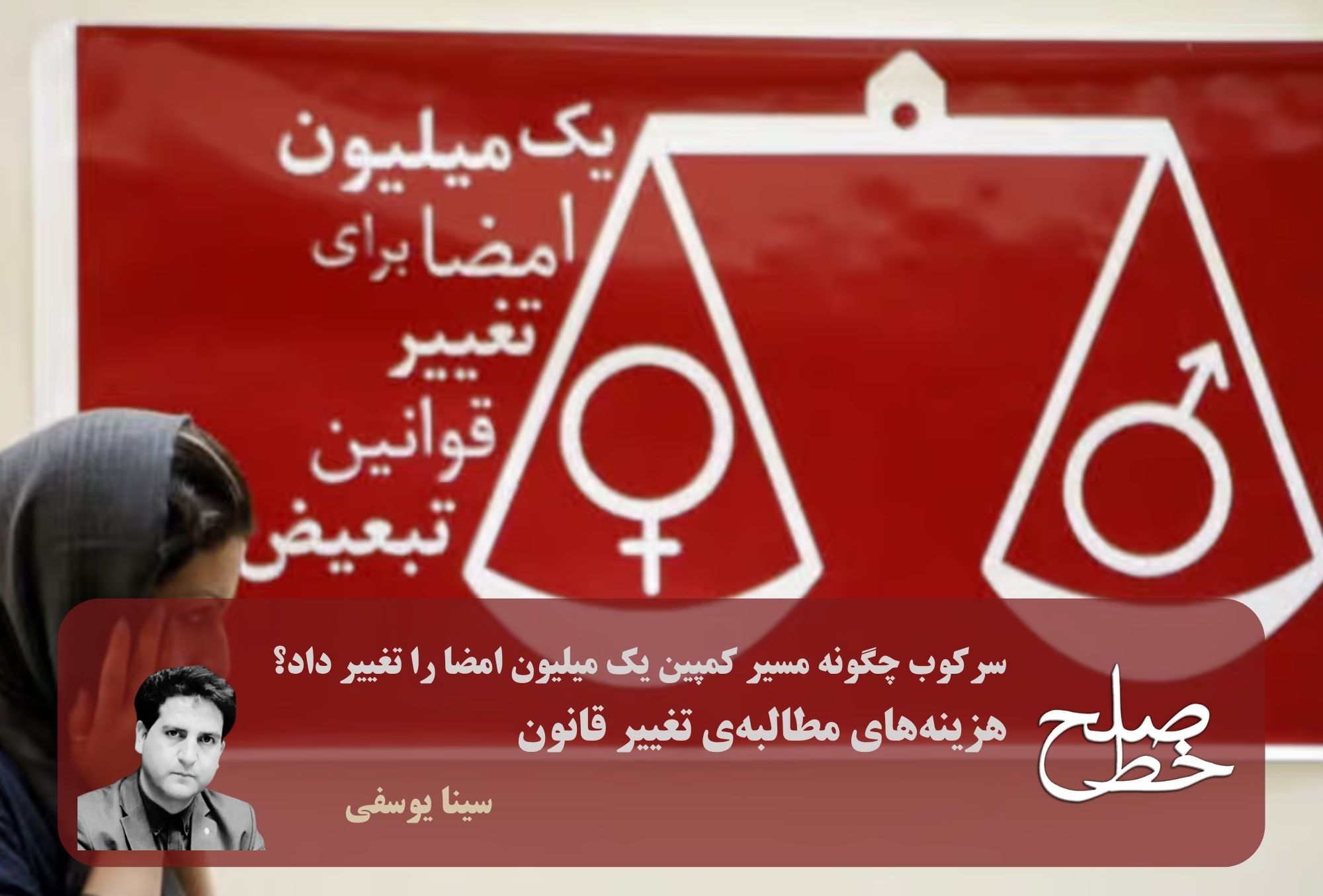
How Did Repression Change the Course of the One Million Signatures Campaign?/ Sina Yousefi
The twentieth anniversary of the One Million Signatures Campaign provides an opportunity to revisit one of the most important experiences of Iran’s women’s movement. It was an experience that, in the mid-2000s, sought to move the demand for legal equality from the realm of specialized discussions and limited circles of activists into the sphere of everyday life and direct citizen participation. Relying on dialogue, legal education, face-to-face communication, and the collection of signatures to change discriminatory laws, the campaign sought to demonstrate that gender inequality was not merely an individual or cultural issue, but was connected to the structure of law, public policy, and power relations. The significance of this experience was not limited to the number of signatures or the geographical scope of its activities; rather, the campaign established a form of activism in which legal awareness, social communication, and civic advocacy were interconnected. Nevertheless, from the very beginning, the campaign took shape in an environment in which the government regarded women’s independent and organized activities not as a legitimate part of civic life, but as a security matter and a potential threat. Security and judicial measures, summonses, arrests, pressure on activists, restrictions on communications, and filtering gradually affected the possibility of public activity and the expansion of the campaign’s network. From this perspective, the history of the campaign cannot be explained solely by reference to its initiatives, achievements, and internal limitations; rather, it must be examined in relation to a structure of repression that sought to increase the cost of civic participation and transform the demand for legal change into a security issue. In this process, repression was not merely a series of isolated actions against a handful of activists; it was a factor that affected organization, trust, methods of communication, and the ways in which experience was transmitted within the campaign, ultimately changing the course of its activities.
Arrests, summonses, and the opening of judicial cases were among the first tools the government used to restrict the scope of the campaign’s activities. Activists who peacefully called for legal reform through dialogue and legal education encountered measures that effectively exposed their civic activities to heavy security and judicial costs. Summonses by security agencies, interrogations, temporary detention, judicial sentences, and requirements to provide written undertakings did not target only the individuals detained; these measures also sent a message to other members of the network that participation in a lawful demand could have consequences extending far beyond ordinary civic activity. Under such circumstances, security pressure gradually affects an atmosphere of trust. Campaign members are forced to exercise greater caution regarding their methods of communication, the people they trust, the locations where meetings are held, and even the content of educational activities. This situation makes recruitment and the transmission of experience more difficult and redirects some of the activists’ energy—which could otherwise have been devoted to expanding advocacy—toward managing risks, following up on legal cases, and supporting those under pressure. Through these measures, the government deliberately blurred the boundary between civic action and security threats and subjected demands for legal reform to labels that were incompatible with the peaceful and rights-based nature of the campaign. The result of this approach was not merely the restriction of the activities of a few prominent figures; rather, a network founded on direct communication and mutual trust was forced to respond to a policy aimed at eroding the possibility of independent organization and preventing women’s civic participation from becoming normalized.
Alongside direct security and judicial measures, internet filtering and restrictions on communication also played an important role in changing the course of the campaign. The One Million Signatures Campaign depended to a considerable extent on broad communications, the dissemination of educational materials, public access to legal information, and the ability to connect activists in different cities. Websites and blogs were important tools for introducing the campaign’s objectives, publishing experiences from the field, providing legal education, and reflecting women’s demands. Restricting these spaces made it more difficult for audiences to access the campaign’s content and affected communication between activists and society. In this context, filtering was not merely the blocking of a few pages or websites; it was part of a broader policy aimed at controlling the independent circulation of information and the emergence of public dialogue concerning legal discrimination. As a result, activists were forced to turn to alternative methods such as individual communications, smaller networks, informal tools, and decentralized forms of communication. Although these changes in some cases helped preserve connections and continue activities, they simultaneously increased the cost and difficulty of activism and diminished the campaign’s public and visible capacity. By restricting communication tools, the government effectively sought to push the demand for equality out of the public sphere and limit the possibility of open discussion about discriminatory laws. In this way, the online sphere, which could have served as a platform for education, participation, and the expansion of legal awareness, became another arena of political and security control.
Taken together, these pressures gradually changed the form of collective action within the campaign. The reduced possibility of public activity, the increasing difficulty of holding meetings and in-person educational sessions, restrictions on communications, and the growing risks faced by activists moved the campaign away from its initial model of network expansion and direct presence within society. Some activities were necessarily transferred to smaller circles and lower-risk forms of communication, while others continued through such activities as producing and disseminating legal content, raising awareness, documenting discrimination, pursuing judicial cases, and advancing demands in specialized forums. Of course, this transformation cannot be attributed solely to repression; social developments, changes in the political environment, accumulated experiences within the women’s movement, and the emergence of new forms of activism also played a role. Nevertheless, security and judicial pressures severely restricted the range of choices available to activists and increased the cost of every form of independent organization. Under such circumstances, continuing the work no longer necessarily meant preserving the same original structure, the same communication network, or the same initial tactics. The campaign was forced to strike a balance between maintaining connections and avoiding putting individuals at risk, between public activity and less visible forms of activism, and between advancing public demands and pursuing them through specialized channels. This situation demonstrates how repression can transform the form in which a social demand is expressed, its organizational capacity, and its ability to transmit experience without completely eliminating the demand itself. By restricting spaces for participation, the government in practice targeted not only particular activists, but also the possibility of creating a lasting culture of independent advocacy.
Despite these restrictions, the experience of the One Million Signatures Campaign demonstrated that repression does not necessarily mean the end of a social demand, although it can profoundly alter its forms of organization and its ability to appear publicly. By securitizing civic activity, the government was able to place activists under pressure, erode communication networks, and increase the cost of participation for many individuals, but it was unable to erase the demand for equality from women’s collective memory and lived experience or permanently marginalize questions about the legitimacy and persistence of discriminatory laws. In subsequent years, the campaign’s legacy continued through the spread of the language of legal advocacy, greater awareness of legal inequalities, the development of a generation of activists, and the linking of individual experiences to public demands. The significance of this legacy lies in demonstrating that the continuation of a movement does not always mean preserving its original name, structure, or methods of activity. At times, a social demand moves beyond the form of a specific campaign and is reproduced through other legal, media, cultural, academic, and civic activities. For this reason, any assessment of the campaign’s record must simultaneously take two realities into account: on the one hand, repression restricted women’s independent organization and imposed heavy costs upon it; on the other, it failed to eliminate the issue of equality and criticism of discriminatory laws from collective memory and the public sphere. What becomes particularly clear in this context is the ineffectiveness of an approach that, instead of responding to citizens’ legal demands, seeks to eliminate the possibility of advocacy through arrests, judicial case-building, filtering, and intimidation.
 Created By: Sina Yousefi
 September 23, 2026
Tags
"Million Signature Campaign" Civil society Networking Peace Line 185 Security charges Sina Yousefi Suppression Women's rights