


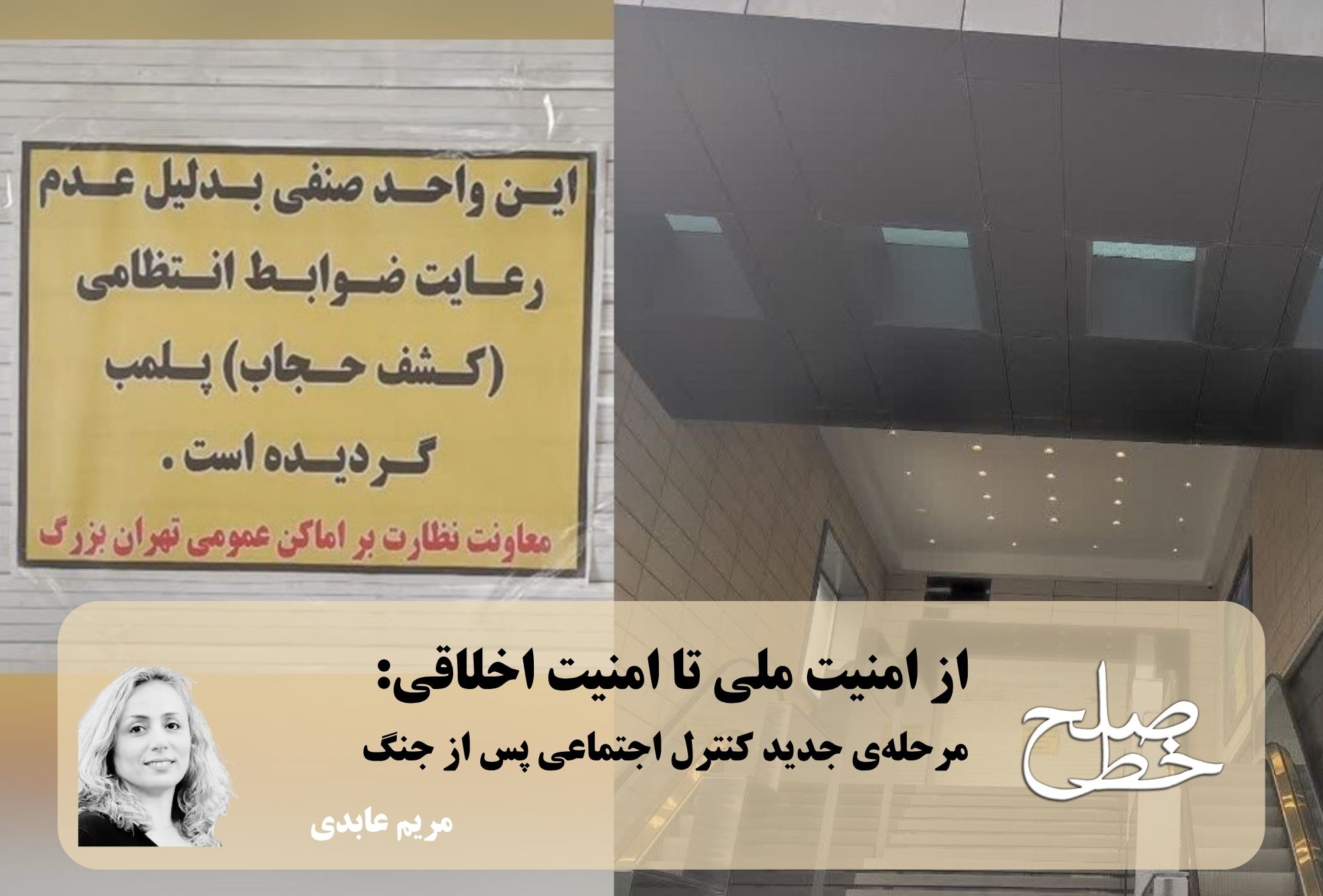
From National Security to Moral Security: The New Stage of Post-War Social Control / Maryam Abedi
In recent months, as the war has subsided, what has been seen on the streets, Instagram, and cyberspace is the return of the focus of governance from Iranian soil to the city; from the sealing of cafes and book cafes in Sana’i and Iranshahr to the crackdown on tourist tours and the blocking of bloggers’ and online businesses’ pages, this synchronicity is not accidental. HRANA’s report for the period from July 10 to August 1405 shows that we are not faced with a scattered collection of corporate violations, but rather with a new phase of social control policies that require functional analysis. (1)
According to the same report, in a period of approximately three weeks, at least 72 popular pages were blocked, the administrators of at least 21 pages were required to publish a commitment letter, and 23 trade units were sealed. The report emphasizes that these numbers are the bottom of the truth, not the top. In fact, due to the removal of content and limited access to official information, the figures announced are only the minimum number of cases that can be verified, not the full picture of the encounters. As the report itself states, these three numbers are not three independent cases and overlap; for example, a trade unit may have its page blocked, its commitment letter published, and its place of business sealed at the same time. Therefore, their total should not be added up as the number of cases. In addition, the report mentions the cleaning of 56 Instagram pages in Qazvin and the removal of 3,258 pieces of content from 32 trade units in Rasht, which were not included in the main statistics due to the lack of accurate identification. (1)
The main question is: Why has this wave intensified “now” and for “what purpose”?
Anatomy of a Procedure; Different Institutions, Similar Patterns
According to announcements, blocking messages, commitment letters and interviews reviewed by HRANA, several parts of Faraja have been involved in the recent clashes. However, the available information is not sufficient to prove the existence of a formal and predetermined division of labor between these entities. What can be observed is the simultaneous presence of different law enforcement and security agencies and a significant similarity in the methods of confrontation.
A) FATA Police – Cyberspace Police: In a number of accounts collected by HRANA, page administrators reported receiving a phone call from FATA police and then being summoned to a specific location. According to some of these individuals, after the call, their mobile phones were checked and in some cases, the officer used the individual’s phone to log into the account, delete the content in question, and require the page administrator to sign a commitment letter and publish a text stating compliance with the regulations. However, this method was not the same in all cases, and some individuals said that the order to delete content, publish a commitment letter, or refrain from repeating the objected activity was communicated to them simply through a phone call.
The role of the FATA police cannot be generalized to all cases of page blocking. In cases such as Nima Tekido, the report reports that the pages were blocked by order of a judicial authority and by Faraja, and in the case of the Dalahu travel agency, what can be specifically verified is that the page was blocked by order of a judicial authority. Therefore, the mere inclusion of the phrase “This page was blocked by order of a respected judicial authority” cannot be considered a sign of FATA police intervention alone.
B) Police monitoring public places – the link between cyberspace and the trade union unit: In another part of these encounters, the names of the police monitoring public places and the deputy for monitoring virtual businesses are seen. The HRANA report shows that the role of these units is not limited to monitoring the physical location of businesses, and their names or logos are also included in some messages related to virtual pages.
One notable example was the crackdown on at least seven cafes and restaurants on Sanaei and Iranshahr streets in Tehran on July 19, including Joe Cafe, Cafe 1401, and Sam Cafe. These establishments were sealed for reasons including not observing the mandatory hijab and what were called “Islamic ceremonies,” and at the same time, the Instagram pages of a number of these guilds were also inaccessible by order of the judicial authority. A few days later, reports were published about the destruction of tables, gardens, platforms, and seating areas in front of cafes on Sanaei Street and the collection of benches on Iranshahr Street. The fact that these measures coincided with the sealing of cafes raises the possibility that the scope of the restrictions did not only target the economic activities of guilds, but also affected informal spaces for citizens to gather.
c) Faraj Intelligence Organization – Presence in the process of obtaining commitments: Another institution whose name and logo are seen in these encounters is the Faraj Intelligence Organization. According to the HRANA report, in a significant number of cases, the commitments published have had the logo of this organization and have used similar phrases about “obeying the laws,” “not repeating,” “reminding and guiding,” and refraining from publishing the content being objected to. The similarity in the text and format of these commitments could indicate the use of predetermined patterns in dealing with page administrators.
Of the 21 pages whose administrators were required to publish a commitment letter, nine were in the field of fashion, clothing, modeling, and beauty services, four in the field of sports and coaching, three among bloggers and producers of everyday and social content, and five in other professional and trade fields. In some of these cases, publishing a commitment letter was accompanied by blocking the page or deleting content. For example, Maison Seville announced the removal of more than 800 items of content from its page on the orders of the security police.
The simultaneous use of multiple approaches can be clearly seen in some cases. For example, in Semnan, a crackdown on a business unit’s virtual page resulted in the removal or modification of content, a commitment from the administrator, and the sealing of the business premises. Such cases show that controlling online content and dealing with a business’s physical activity can be linked in a single case.
The reports illustrate that it is not possible to speak with certainty of a single, centralized policy with public guidelines, but the similarity in implementation methods and common literature suggests a common practice. The development of this practice at the present juncture has four functions.
1. Political function: filling the post-war vacuum
In times of war, the discourse of external security coheres and silences society. As it subsides, a discursive vacuum is created. Cafes, tourist tours, sports clubs, and bloggers’ pages are informal spaces for rebuilding social bonds. Dealing with them is preventing the rebuilding of civil society in the post-war period. The contradiction of August 23 and 24 mentioned in the report – the news of “organizing and insuring virtual activists” by Ershad Kohgiluyeh and its denial a day later by the Secretariat of the Supreme Council for Cyberspace – testifies that the government still does not have a positive narrative for virtual space, so it resorts to the most negative means.
2. Social function: control through the body and lifestyle
According to the Mabna report, a significant portion of the cases are related to “compulsory hijab, optional clothing, and vague concepts of transgression and violation of modesty.” Cafes and tours are places where different lifestyles become visible. The closure of Caspian in Tonekabon after a video of a football match was released, or the closure of Mohseni Mansion in Behbahan due to the presence of customers wearing optional clothing and playing music, shows that the goal is to regulate the visibility of lifestyles in the public sphere.
3. Economic function: making independent businesses dependent
Blocking at least 19 pages belonging to professional, commercial and service businesses, along with 23 seals, is no small number. Cafes, maisons, clinics and travel agencies are part of the micro and non-governmental economy, many of which depend on Instagram for their livelihood. By blocking a page and sealing it simultaneously or in close proximity, both online and offline activity are restricted. In some cases, continuing the activity is also accompanied by a commitment, content removal and acceptance of restrictions. This model turns independent economic activity into a conditional activity.
4. Security function: Testing the three-layer model
The new phase is also new in terms of suppression techniques. Filtering or just sealing is no longer an option. The three-layer model seen in Semnan, content removal combined with commitment and sealing, is a complete cycle: removal of voice, obtaining a public digital confession, and economic punishment. This cycle greatly increases the cost of resistance and is a model that can be generalized to future protests.
When you are told that your page was closed due to a violation of the rules, you do not understand exactly which post, which photo, or which word was the offense. When the offense is not clear:
– The case number and the name of the judge are not announced. So you don’t know where to appeal.
– It has no legal basis. So a lawyer cannot defend you.
– Covers every taste. Today a blogger, tomorrow a cafe owner, the day after tomorrow a travel agency; all are tied together by a common label.
This is what the reports indicate: in many cases, even the authority issuing the order and the means of protest have not been announced.
In fact, with this stretchy language, the government turns the law from a clear text into a taste. There is no longer any need to prove a crime; it is enough to stick a general title to both close the page, seal the shop, and also get a commitment from you.
The contradiction mentioned in the documentary reports is the best example of this deliberate disorder: on August 23, an official announced the organization and insurance of virtual activists, and a day later, on August 24, the secretariat of the Supreme Council for Cyberspace denied the same news, saying that no meeting had been held at all. In other words, even the system itself does not want to say exactly which law and resolution it is acting on.
The result of this ambiguity is beneficial to the government: the citizen does not know what to protest, so instead of protesting, he is forced to obey and self-censor.
According to the documents in the HRANA report, what has happened in recent months is a return to the social control policies that preceded “Women, Life, Freedom,” but with more up-to-date tools and a more precise division of labor. If in the past one institution did one job, today three institutions complement three tasks to control both the page, the shop, and the individual’s future: “FATA” cuts off access, “Places” cuts off livelihoods, and Faraj Information takes the future hostage with a pledge.
From a legal perspective, what makes this cycle problematic is not simply the severity of the treatment, but its departure from the principles of due process. As the reports received and based on them themselves state, in many cases neither the exact nature of the accusation, nor the case number, nor the authority issuing the order, nor the means of appeal have been announced. This practice conflicts with three fundamental legal principles:
1. The principle of legality of crime and transparency : Titles such as norm-violating, psychological security of society, and harmful content do not have precise and measurable definitions in the computer crime law and the trade union law. When the crime is vague, the law is not predictable.
2. The principle of proportionality and separation : According to Articles 27 and 28 of the Guild System Law, sealing a guild unit should be the last resort and after a warning, not the first resort, along with blocking the page, simultaneously closing Instagram, which is a source of income, and physically sealing the shop, which is a double punishment for a single behavior.
3. Principle of legal action : When the content is deleted from the person’s mobile phone by the officer himself and the page is deactivated, the evidence of the crime is effectively destroyed and the person is deprived of the possibility of legal defense. For this reason, the recorded figures are only the bottom of what can be verified, and the real dimensions are much wider.
The continuation of this cycle in the coming weeks and months, in addition to the legal consequence of invalidating judicial orders and reducing trust in professional institutions, also has a cumulative social consequence: latent anger.
When a small business whose life depends on Instagram is forced to remain silent without clear warning, without an objectionable vote, and with a mandatory pledge, the damage is not just economic. The sense of injustice and humiliation resulting from the forced publication of a pledge with an official seal remains in the collective memory. From a data-driven analysis of the day, a system that seals and filters the problem rather than solving it, from tourism to cafés, lowers the cost of control in the short term but accumulates the cost of dissatisfaction in the medium term.
That is why the Mabna report emphasizes that this trend could lead to further restrictions on businesses and public spaces; restrictions that, if not accompanied by legal transparency and effective means of protest, will themselves become a new source of distrust and social anger.
Footnote:
1- From blocking pages to sealing cafes; a new wave of pressure on cyberspace and the public sphere, HRANA News Agency , August 1, 2021.
 Created By: Maryam Abedi
 August 23, 2026
Tags
Cyber Police Cyberspace Police Faraja 2 Islamic affairs Maryam Abedi peace line Peace Line 184 Plumb Cafe Seal Sealing the bookstore Social control Tourist tour Unveiling Unveiling/Uncovering/Removal of the Hijab Violation of norms Virtual space ماهنامه خط صلح