


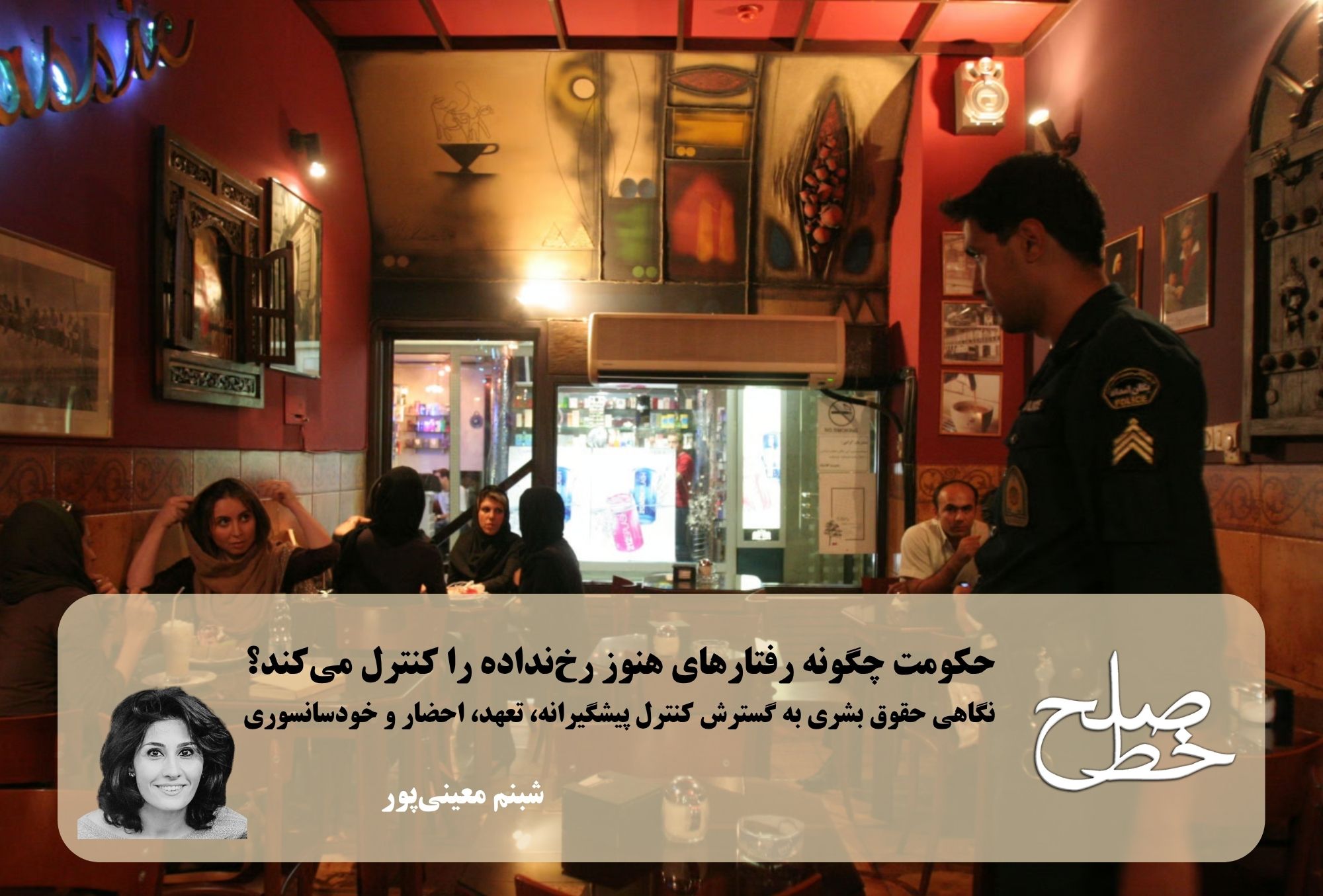
From Punishment to Prevention: How the Islamic Republic of Iran Controls Conduct Before It Happens/ Shabnam Moinipour
A Human Rights Perspective on the Expanding Use of Preventive Control, Written Undertakings, Summonses, and Self-Censorship
When examining state action against citizens, attention usually focuses on the final stages of the process: arrest, prosecution, sentencing, or the closure of a business. Yet much of what is happening in Iran today takes place before matters reach that point. Summonses and warnings, demands for written undertakings, threats of closure, temporary blocking of social media pages, forced removal of content, and making continued activity conditional on compliance with instructions about future conduct are all measures whose purpose is not necessarily to punish something that has already happened. Sometimes, the primary objective is to make the individual behave differently from that point onward.
In recent weeks, as pressure on cafés, businesses, gyms, and social media users has intensified once again, numerous examples of this pattern have been reported. In some cases, permission to resume activities or the lifting of restrictions has been made conditional on providing a written undertaking. These measures have also extended beyond hijab and dress codes to online activity, businesses, gatherings, and cultural spaces. The use of written undertakings, summonses, and warnings has a long history in the Islamic Republic. The issue, then, is not the sudden emergence of an entirely new instrument. The more important question is whether the scope and function of these longstanding tools are changing. Are methods once used in isolated cases or particular areas now being employed more extensively to regulate citizens’ everyday conduct and deter acts that have not yet occurred? If so, what we are seeing is more than an intensification of enforcement. It points to a change in the exercise of power, from punishment after the fact toward controlling conduct before it occurs.
When control begins before the conduct occurs
Prevention is not inherently incompatible with human rights. Under certain circumstances, states may take measures to avert a real and imminent threat, and legal systems recognize various preventive and precautionary measures. The problem begins when prevention restricts individual freedoms in the absence of a specific threat, a clear legal basis, or effective oversight. The distinction between these situations is fundamental. A competent authority may have specific evidence of an imminent threat, and the law may authorize a restrictive measure for a defined period under judicial supervision. In such a case, at a minimum, the necessity and proportionality of the decision can be scrutinized and challenged.
Consider a different situation. Someone is summoned because of a social media post, the way customers at a café are dressed, an event they organized, or conduct described as violating “social norms.” They are then required to undertake that, in the future, they will observe certain “standards” or “codes of propriety.” No one may explain precisely what conduct the undertaking covers. At the same time, the person knows that repeating whatever the summoning authority considers objectionable could lead to a longer closure, legal proceedings, or some other restriction. At that point, the state is no longer merely responding to past conduct. Past conduct has become the basis for controlling future behaviour. This is precisely where the human rights concern arises because the reach of state intervention expands from acts that have actually occurred to acts that may occur in the future.
The line between prevention and punishment
Preventive control can create a contradiction because without any criminal judgment being issued, it may produce consequences resembling punishment. For a café owner, even a few days of closure can cause substantial financial loss. For an online business, blocking its main social media page may disrupt access to customers. For a blogger, forced content removal or loss of access to an account may directly affect their livelihood. For an event organizer, a summons or warning may be enough to ensure that the next event never takes place. From the perspective of the person subjected to these measures, calling them an “official warning,” a “preventive measure,” or an “enforcement action” does not necessarily alter their practical consequences.
This raises a fundamental rule-of-law question. Can the state impose a measure that is punitive in effect without observing the safeguards required for punishment? Iran’s Code of Criminal Procedure requires criminal proceedings to have a basis in law and recognizes the presumption of innocence. Article 4 provides that measures restricting liberty or intruding upon privacy must be authorized by law, carried out in accordance with legal procedures, and subject to judicial supervision. Article 5 affirms the right to be informed of the nature and grounds of an accusation and to enjoy the rights of the defence. At the international level, Article 17 of the International Covenant on Civil and Political Rights protects individuals against arbitrary or unlawful interference with their privacy, family, home, or correspondence and requires legal protection against such interference. This standard becomes particularly relevant when state control extends to the inspection of mobile phones, personal accounts, online content, or other aspects of private life. These protections reflect a broader principle under which state authorities cannot impose any restrictions they deem appropriate merely because they believe an individual might engage in undesirable conduct in the future.
The same logic is reflected in international human rights standards. Restrictions on rights, including freedom of expression, must have a clear basis in law, pursue a specified legitimate aim, and satisfy the requirements of necessity and proportionality. General references to concepts such as “public order,” “security,” or “morality” are not, by themselves, sufficient to justify any form of state interference. A preventive measure can, therefore, be assessed through a series of straightforward questions. What precisely is the conduct at issue? Which law prohibits it or authorizes preventive intervention? What specific threat is the measure intended to avert? Why is the restriction necessary? Could the same objective be achieved through a less restrictive measure? How long will the decision remain in force? Which authority can review it, and how can the individual challenge it? The less clear the answers, the greater the likelihood that lawful prevention has given way to arbitrary control.
Written undertakings, consent, and the limits of state authority
Written undertakings are among the clearest examples of this shift from responding to the past to controlling the future. On the surface, an undertaking relates to conduct that has already occurred and for which the individual has been summoned. Yet its terms are generally forward-looking. The individual promises not to “repeat” certain conduct, to comply with certain rules “from now on,” or to change the way they operate. The central question about such documents is, therefore, not simply whether the individual’s signature appears at the bottom. It is on what legal basis, and within what lawful authority, the undertaking was demanded.
Iran’s Code of Criminal Procedure defines judicial officers as officials who act under the supervision and instructions of the prosecutor and “in accordance with the law” in detecting crimes, collecting evidence, conducting preliminary investigations, and implementing judicial decisions. Their functions are legally defined. Nothing in those provisions establishes a general and unlimited power to prescribe citizens’ future conduct. Iran’s Law on Respect for Legitimate Freedoms and Protection of Citizenship Rights likewise requires judicial officers to act on the basis of law and clear judicial orders and to refrain from arbitrary action and abuse of power. It also emphasizes respect for defence rights and the avoidance of unnecessary or unlawful measures. If an undertaking merely restates an obligation already imposed by law, it creates no new legal duty. The legal obligation remains whether or not the individual signs the document. But if the undertaking goes beyond what the law requires, a different problem arises. A citizen’s signature cannot confer on an officer or executive body an authority that the law itself has not granted. Put simply, an undertaking cannot fill a gap where legal authority is absent.
The problem becomes more acute when the undertaking does not concern clearly defined conduct but instead invokes concepts such as “norms,” “propriety,” “values,” or “standards.” In such circumstances, the individual may have no clear idea what conduct could later be treated as a breach of the undertaking, leaving much of the boundary-setting to the discretion of the enforcing authority. Nor does a signature alone establish that the undertaking was accepted freely and without pressure. Consider a business owner forced to choose between signing an undertaking and reopening or refusing to sign and facing continued closure or restrictions. Formally, there is a choice. But this cannot be equated with an agreement between parties of equal power.
The crucial question is what refusing to sign would cost the individual. If a person must sign in order to regain access to a social media page, reopen a business, avoid the initiation of legal proceedings, or bring an existing restriction to an end, the voluntary nature of that consent becomes seriously questionable. The issue goes beyond the formal legal validity of the undertaking. More fundamentally, a state body may be able to turn a restriction it has itself imposed into leverage for extracting a commitment. The individual is first placed in a vulnerable position, and the end of that situation is then made conditional on accepting demands about future conduct. In those circumstances, the signature does not necessarily demonstrate genuine agreement. It may simply show that, among the available options, the individual chose the least costly one.
The issue is not confined to criminal procedure. Iran’s Constitution also protects individuals’ rights, dignity, property, and occupation from interference except where authorized by law. Article 36 provides that the imposition and execution of punishment must be based on law and ordered by a competent court. Even within Iran’s domestic legal framework, then, questions remain about how far an executive body or judicial officer can go in imposing conditions on a person’s future conduct outside a clear and reviewable legal order.
From a defined offense to an undefined risk
Criminal law usually begins with the question of whether a person has committed a prohibited act. The logic of preventive control asks a different question, namely whether this person might, in the future, engage in conduct that the state considers undesirable. The distinction matters. An “offense,” at least in principle, must be defined by law. “Risk” can be far more fluid. A person may be treated as someone likely to cross prescribed boundaries again because of their past conduct, the nature of their work, their audience, or simply the assessment of a supervisory body. In such circumstances, the state does not wait for the next act. It seeks to reduce the likelihood that it will occur. A written undertaking can serve that purpose. So can a summons. A temporary closure can likewise communicate that continued operation depends on changing how the individual conducts their activities.
The problem becomes more serious when the boundaries themselves are unclear. If citizens know precisely what is prohibited and what is permitted, they can conduct themselves up to the limits set by law. But if they do not know how terms such as “norm-breaking,” “unconventional behaviour,” or “failure to observe propriety” will be interpreted the next time authorities intervene, they may restrict their conduct far beyond what the law expressly requires in order to avoid possible consequences. This is where the principle of legal foreseeability becomes critical. In General Comment No. 34 on Article 19 of the International Covenant on Civil and Political Rights, the UN Human Rights Committee stresses that restrictions on freedom of expression must be provided by law, pursue a legitimate aim, and meet the requirements of necessity and proportionality. A law restricting expression must also be formulated with sufficient precision to enable individuals to regulate their conduct accordingly and must not confer unfettered discretion on those responsible for its enforcement.
This is not merely a technical question about the quality of legislation. If the limits of permissible conduct cannot be foreseen, citizens are forced to make decisions based not on the law, but on what they imagine may trigger the authorities’ attention. Under the rule of law, the question is: “Is this prohibited?” Under a system governed by uncertainty, the question becomes: “Will this get me into trouble?” That shift is one of the most consequential effects of controlling future conduct.
The chilling effect and the expansion of self-censorship
To understand how this model works, it is necessary to look beyond those who are directly summoned or restricted. Suppose a café owner signs an undertaking after a short-term closure. Other café owners hear what happened and begin assessing their own exposure, even though none of them has been summoned. A social media user may alter their content after a colleague’s page is blocked. A tour organizer may cancel a program. The manager of a cultural venue may reconsider inviting a particular person, or an athlete may decide not to post a photograph. None of them has yet been directly targeted. Their behaviour has nevertheless changed. It is at this stage that preventive control can become most effective. The exercise of power no longer depends solely on direct intervention by state agents. Part of the work of surveillance is transferred to individuals themselves. Before acting, each person tries to anticipate how the authorities might respond.
In human rights discourse, the concept of a ‘chilling effect’ is used to describe one aspect of this phenomenon, where fear of punishment or restrictions causes individuals to refrain even from some forms of lawful and legitimate conduct. Producing such an effect does not require a formal prohibition to be issued against every individual. The existence of a serious but uncertain risk may itself reduce the extent to which people exercise their rights in practice.
This form of self-censorship is not confined to speech or online content. A business owner may begin monitoring customers or employees. A café manager may change how an outdoor area is used. A cultural organization may cancel an event. A tour organizer may warn participants about their dress or conduct. The state body is then no longer regulating only the individual it initially targeted. Part of the enforcement function is transferred to others. The business owner is effectively made responsible for monitoring customers, the manager for monitoring employees, and the event organizer for monitoring participants. From a human rights perspective, this matters because it expands behavioural control without requiring the constant and direct presence of state agents.
Compelled publication of an undertaking can reinforce the same effect. When an individual is required to publish the undertaking, or a statement conveying the same message, on their own page, the issue is no longer only one of restricting expression. It also raises concerns about compelled speech. Publication extends the effect of the undertaking beyond the person who signed it. Others who see it become aware not only of the restriction imposed on that individual, but also of the message that similar conduct may have consequences for them as well.
From isolated measures to a mode of governance
Direct social control is costly. If every instance of undesirable conduct requires an officer to intervene, a case to be opened, and formal proceedings to take place, considerable resources are required. Controlling future conduct can reduce some of those costs. A single summons may alter a person’s behaviour for a long period. One closure may make dozens of similar businesses more cautious. A publicly disclosed undertaking may cause many other users to reconsider what they post. Under such a system, success is not necessarily measured by the number of convictions. A low or declining number of formal cases might itself be regarded as a sign of effectiveness if people change their conduct before official enforcement becomes necessary.
Written undertakings, summonses, warnings, and temporary closures are not legally or operationally identical, but they can serve a similar function by signalling that continued activity depends on changing future behaviour. Another, less visible consequence is the creation of a record. A person with no criminal conviction may, after being summoned and required to sign an undertaking, be recorded in an administrative or security file as someone who has previously “received a warning” or “undertaken not to repeat” certain conduct. The language of “non-repetition” is significant. Repetition ordinarily presupposes that an initial violation has been validly established. Yet an undertaking can create the appearance of a “first offense” without any conviction. In a later encounter, the individual may be reminded that they were previously warned and had already signed an undertaking. Over time, the circumstances in which the original undertaking was obtained may disappear from the account, while the document itself remains. An administrative or security record may, therefore, come to function in a way similar to a judicial record, without necessarily being subject to the same procedural safeguards.
Written undertakings, warnings, summonses, and threats of harsher measures in the event of repeated conduct are not new in the Islamic Republic. What matters today is not the novelty of these tools but the apparent expansion of their use and the role they may increasingly play in shaping citizens’ future behaviour. Recent reports suggest that such measures are being used across a wider range of settings, from commercial and cultural activity to sport and online spaces. Establishing the existence of a single, nationwide policy would require more information about directives, chains of decision-making, and the persistence of the pattern over time. Publicly reported cases alone are not enough to establish the existence of a centralized order. Still, if undertakings, warnings, and temporary restrictions are repeatedly used to compel changes in future conduct, if the lifting of restrictions depends on accepting particular conditions, if those conditions go beyond clearly defined legal obligations, and if action against a small number of people produces self-censorship among a much wider group, then a written undertaking can no longer be understood as merely an administrative form. What emerges is a form of preventive control aimed not only at responding to conduct that has already occurred, but also at narrowing the range of conduct that may occur in the future.
From fear of punishment to self-regulation
Perhaps the most important effect of this approach is visible not in the files of those who have been summoned, but in the behaviour of those who never are. The most effective system of control is not necessarily one that intervenes directly whenever undesirable conduct occurs. It is one that induces people to regulate their own behaviour, even when the boundaries they are expected to observe are not clearly defined. In such circumstances, citizens are no longer simply complying with the law. They are managing risk. The distinction matters. When the law is clear, people can know where their freedom ends. But when the relevant standard becomes the anticipated reaction of state authorities, the boundaries of freedom are constantly shifting. Few people are willing to test an undefined red line and bear the cost of discovering where it actually lies. Seen in this light, the central issue raised by compulsory written undertakings is not simply the legal validity of a document. An undertaking is one of several instruments that can operate within a broader structure, one that shifts from punishing past conduct toward shaping and constraining future behaviour.
The human rights standards for assessing such interference are clear. Any restriction must have a clear, accessible, and foreseeable legal basis, pursue a specified legitimate aim, be necessary and proportionate, and be subject to effective review and challenge. When those safeguards give way to opaque summonses, vague undertakings, and fear of future consequences, the citizen’s relationship with the law changes as well. The question is no longer simply what the law prohibits. Instead, people are forced to guess what the state will tolerate. It is precisely at that point that control over future conduct moves beyond an isolated measure and becomes a mode of governance.
 Created By: Shabnam Moinipour
 August 23, 2026
Tags
Shabnam Moinipour