


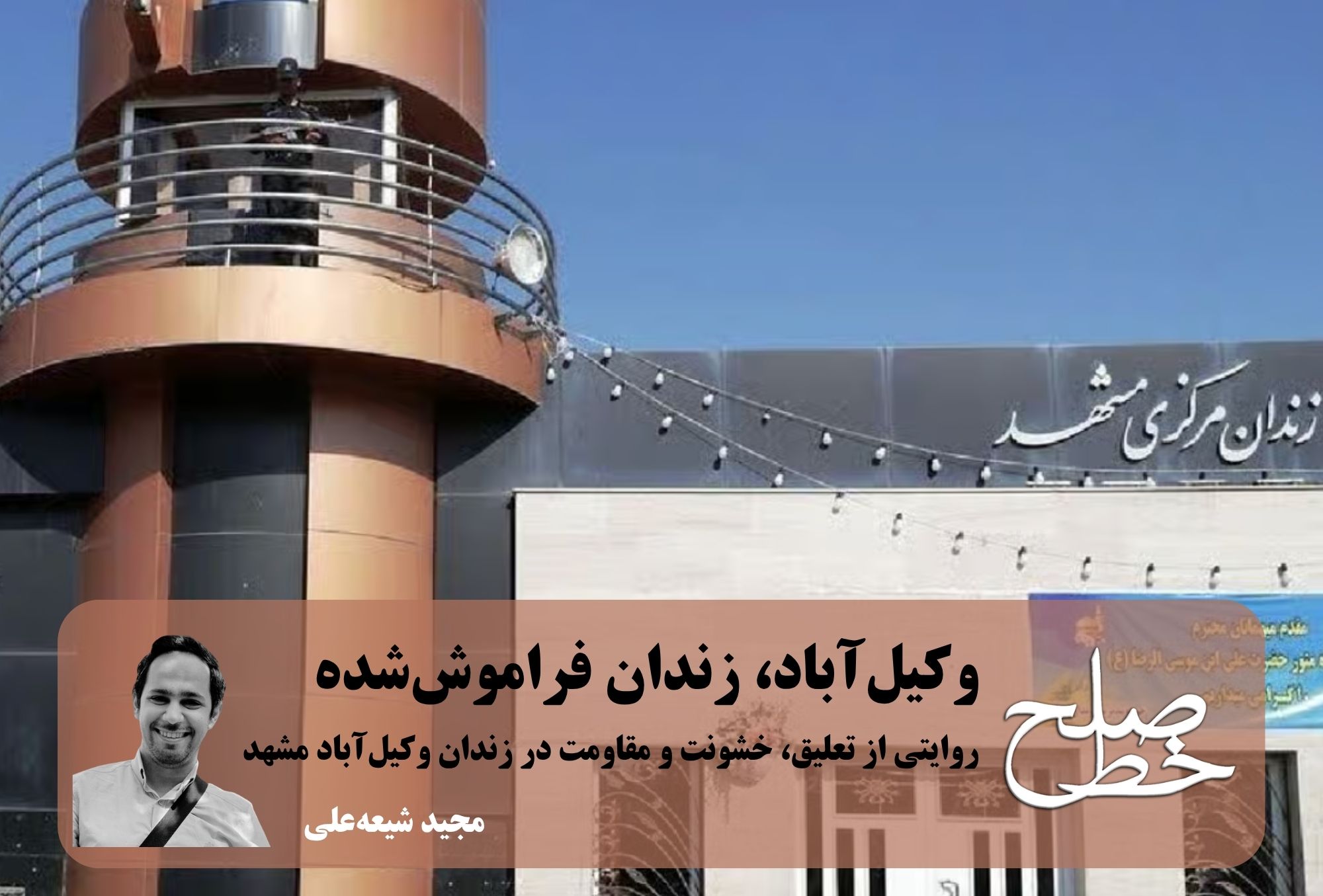
Vakilabad, the Forgotten Prison/ Majid Shia’ali
Last July, events occurred in Vakilabad Prison in Mashhad that have had little precedent in the history of this prison. The detainees of the protests of last January are still present in this prison in large numbers. Although the number of detainees has decreased from more than a thousand to about four hundred during this period, the judicial process of many of them has not progressed and they have experienced a suspension of several months in prison; cases that in many cases have held the threat of spending the entire youth of the individual in prison like the sword of Damocles over their heads.
The fact that suspension is more difficult than severe pain is confirmed not only by the shared experience of detainees, but also by simple scientific experiments. In a simple study, when people are presented with the two options of waiting or using a shock device, after a few minutes they decide to experience the immediate and certain pain instead of waiting. This is why the time limit for temporary detention is considered one of the rights of detainees. This limit in Iranian law is one year; in practice, this period of time leaves the investigator and the judiciary far more free to exert pressure on detainees than is necessary, and on the other hand, in many cases this same limit is violated in practice.
The only unjustified suffering of these several hundred protest prisoners – who are generally young people from the lower economic deciles – is not the long-term suspension; they are also restricted from using the obvious tools that are usually used by ordinary prisoners in Vakilabad Prison. The large number of detainees and the concern of the prison security services have led them to consider the communication of prisoners as a threat and prohibit the communication of rooms in the same hall with each other. In addition, communication between halls is also prohibited, and therefore, access to the air is cut off in order to prevent such communication. To enforce these strict rules, the quarantine ward managers selected prisoners with non-political convictions who have a high level of violence in their behavior as ward guards. The violence of these individuals in dealing with protest prisoners has led to numerous and repeated beatings during this period.
The issue escalated last month when one of the detainees was attacked by security forces in the middle of the night in a way that affected all his peers. This attack led to the prisoners of Vakilabad going on a mass strike; an action that is not very common in this prison. Their strike, which continued until midnight the next day, succeeded in forcing the ward authorities to remove the security forces and senior prisoners from them. Although this process ultimately led to security clashes with some of the detainees, it is considered a major achievement in gaining the rights of Vakilabad prisoners.
The importance of such an experience did not lead to widespread media attention for the prisoners of the Vakilabad protests. Previously, the widespread violations of the rights of many prisoners of Vakilabad had failed to attract the attention they deserved. These appalling conditions in Vakilabad prison and the lesser attention to them are not limited to those detained in the recent protests. In March of last year, when I was chatting with my cellmates in the best ward of this prison, their experience caught my attention. They were two brothers who were thieves. The two brothers had started robbing in the south of the country and were robbing from city to city. They were on their way back to Mashhad when they were arrested in Kerman and eventually transferred to Vakilabad prison, where they were able to reach the best ward of this prison after a while. But when they talked about their experience, they were eager to return to Kerman prison. By summarizing the experiences of other prisoners, they introduced Vakilabad as one of the most secure prisons in the country.
Perhaps one of the reasons for this situation is the smaller presence of political and conscientious prisoners and, as a result, the weaker struggle for the rights of prisoners in recent decades. Their limited number has allowed Vakilabad officials to implement a highly security-intensive, but unwritten, policy. Except during the Mahsa and January protests, they practically distribute political and conscientious prisoners among the wards in such a way that no significant loop is created in any of the wards. Political and conscientious prisoners are usually distributed between wards three, four, and six-one. Conditions in ward six-one are harsher. Instead of being held in a ward with large halls, they are kept in small suites with a limited number of prisoners, and access to telephones and visits is limited and in some cases even prohibited. Prisoners of conscience and security prisoners in this ward are held in special suites of two or three. In other wards, the number of political and conscience prisoners does not reach double digits, and they are usually held together from movements where the possibility of conflict and disagreement between them is at the highest possible level.
Such conditions not only violate the rights of prisoners and violate the rule of separation of crimes, but also make it more difficult to inform about the conditions of prisoners and also limit the opportunity for their collective action to improve the conditions of imprisonment for all prisoners. Of course, with the increase in the number of political and ideological detainees on the one hand, and the increased awareness of detainees of their rights on the other, the possibility of further struggle for the realization of these rights increases.
As seen in the experience of prisons like Evin, the large number of political and ideological prisoners and their struggle for their rights has been able to make the prison experience easier for other prisoners. However, this is a high cost for a limited achievement. Ultimately, the conditions of prisoners in the best prisons in Iran are not comparable to those in developed countries. In one study, participants were shown pictures of prisons in Nordic countries alongside pictures of five-star hotels and asked to distinguish a prison from a hotel. The high rate of errors by participants showed how different prison facilities can be.
The story of a convicted murderer who used a chainsaw to commit murder but has access to the same chainsaw for gardening may be a stark contrast to the experiences of prisoners who have limited access to mirrors or who cook using can lids. More important, though, is the number of prisoners per thousand citizens. While many weak governments also have low numbers on this index, reflecting their inability to deal with criminals, developed countries such as Japan and the Nordic countries also rank high on this index.
The low capacity of prisons, along with the high number of this indicator, makes the situation even more critical; this provides one of the main sources of suffering for prisoners. Crowding is the main source of suffering. For example, more than a thousand detainees were held in a hall with four hundred beds in January. This crowding not only resulted in many prisoners sleeping on the floor and in corridors (not only do they not have beds, but they also do not fit in the room space), but also reduced access to toilets, telephones, space to store supplies, and other things to such an extent that prisoners spend the entire day in long lines.
The path to improving the level of respect for prisoners’ rights should not be achieved only through the struggle of imprisoned political and civil activists, but should be the concern of all citizens. This concern of citizens should not be limited to the conditions of political and ideological prisoners, especially in the main prisons of the country, but should include all prisoners in all prisons. Experiencing such suffering does not only harm a specific group, but also confronts all segments of society with serious challenges. Among them, a large number of prisoners and a harsh prison mean a higher cost for risk-taking, and the suppression of risk-taking reduces development opportunities. Such conditions increase violence in society and fuel many social crises. However, none of these components should be the main factor in paying attention to prisoners’ rights, but rather the emphasis on citizenship rights should be considered as our main motivation for respecting prisoners’ rights and we should resist to realize it.
 By: Majid Shia’ali
 July 23, 2026
Tags
Mashhad Mashhad Central Prison Prisoners Prisoners' harassment Prisoners' rights Vakilabad Prison