


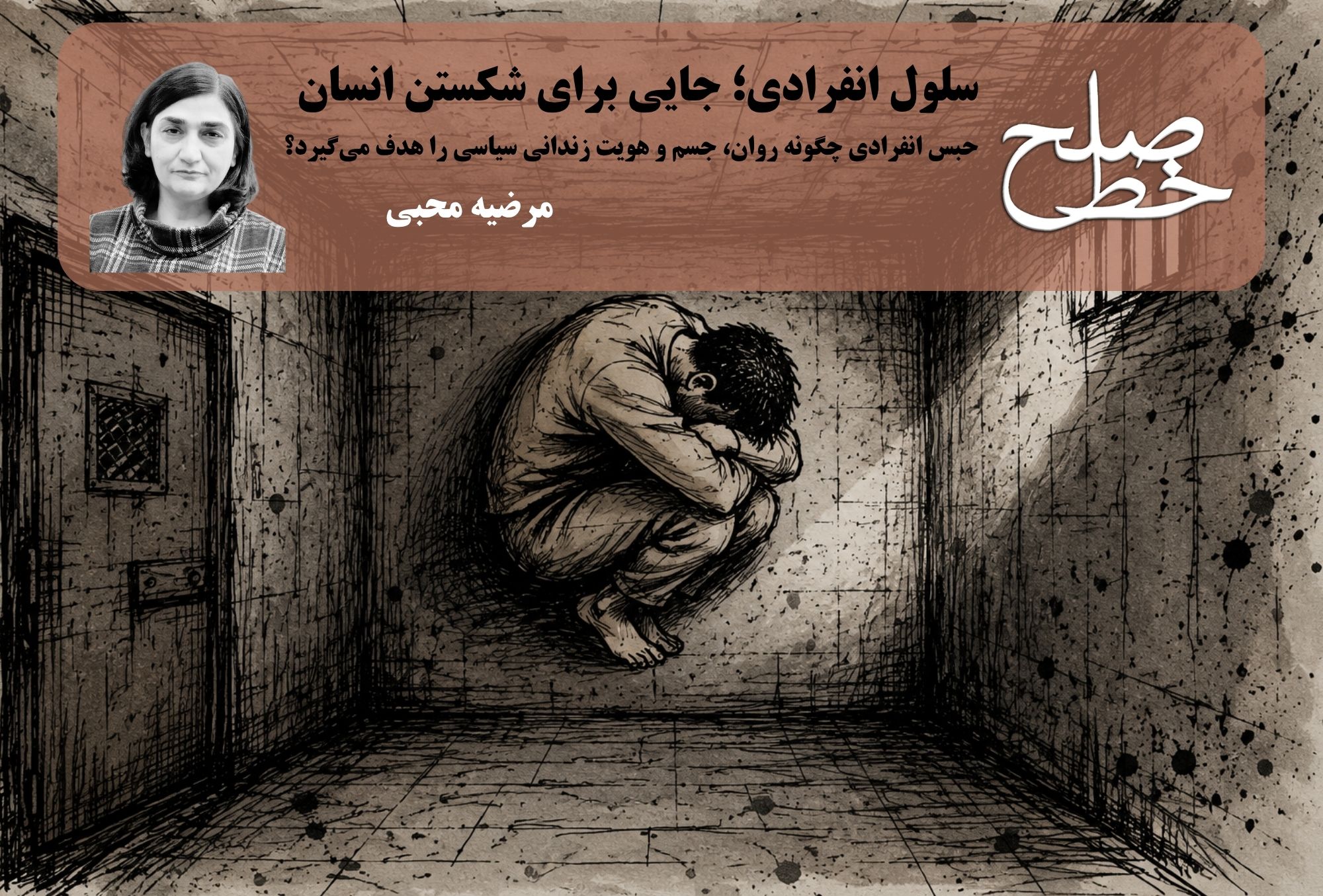
Solitary cell: A place to break a person/ Marziye Mohebbi
What is solitary confinement, what are its conditions, is it essentially torture or punishment, and how does it debilitate a prisoner and cause his psyche to go into turmoil?
How does loneliness and disconnection from the world destroy humanity, and why does the Islamic Republic, in its unparalleled and advanced set of physical and mental tortures, torture its opponents with solitary confinement above all else?
According to Rule 44 of the Nelson Mandela Rules (the United Nations Standard Minimum Rules for the Treatment of Prisoners), solitary confinement is defined as the confinement of a prisoner for 22 hours or more per day, without meaningful human contact. And prolonged solitary confinement is defined as more than 15 consecutive days of solitary confinement. According to Rule 43 of the same document, the use of prolonged or indefinite solitary confinement is prohibited and constitutes torture or cruel, inhuman or degrading treatment.
Some jurists consider solitary confinement to be a punishment, while others consider it to be a form of torture. It seems that solitary confinement has a different nature at different stages of the trial; if it is applied at the preliminary investigation stage and before a final verdict is issued, it is an example of torture and is usually carried out to intimidate the accused or force him to confess or cooperate with information. If such oppression is inflicted on the prisoner during the execution of the final verdict, it is considered a punishment that has been applied to the prisoner without a trial and a legal verdict. The General Board of the Administrative Court of Justice, in its ruling on the request to annul the section of the Prisons Organization’s regulations that prescribed solitary confinement as a punishment for prisoners, argued: “Given that the legislature has not enacted a provision regarding solitary confinement, and its implementation, which deprives the prisoner of meetings and conversations with other prisoners and causes mental anguish and unbearable consequences, is a clear example of the severity of the practice in the manner and quality of the implementation of the prison sentence” (Vote No. 435 dated 10/28/1382 of the General Board of the Administrative Court of Justice).
But what does living in absolute solitude and violence do to a person, and why does the Islamic Republic throw political defendants into black holes of solitude?
Solitary confinement is an impenetrable, gapless cage that suddenly cuts off all connections between a person and the world and humanity, creating an unbearable feeling of abandonment, loneliness, and helplessness; especially since interrogators usually cut off the prisoner’s means of communication with his relatives during the period of detention and falsely convey disappointing news about them to the prisoner.
In a bare concrete cell, usually no more than four square meters in area and constantly illuminated by a harsh white light, there is no color, no sound, no human speech, no breeze, and no sense of time; day and night blend together and time flies. And thus the brain, which receives no stimuli, is stuck in processing information and automatically begins to produce stimuli. The prisoner may hear sounds, see shadows, or even smell a certain smell that is unreal. His perception of the passage of time is lost. Moments are anchored to the concrete walls, and the hours become heavier than the day, and the days stretch on and never end. The prisoner loses the ability to concentrate on a simple subject, recall past memories, and sometimes even utter ordinary words, and is immersed in the devastating wilderness of loneliness, disconnected from tension, and delusion takes over his existence. The longer the period of solitary confinement, the more the prisoner loses himself in these delusions and loses his identity, individual capabilities, and fighting spirit.
But solitary oppression is not only imposed on the psyche; the body also reacts to chronic stress and environmental conditions. The lack of a night-day cycle and constant anxiety lead to insomnia, interrupted sleep, and endless nightmares. Heart palpitations, cold sweats, and severe fluctuations in blood pressure begin. The brutal narrowness of space makes exercise or normal walking impossible, atrophies muscles, and intensifies bone and joint pain. A severe loss of appetite, nausea, stomach pains, and subsequent severe weight loss arrive after a while, making existence difficult and painful to bear.
As a result, solitary confinement is a silent crime against the mental and physical integrity of a person and a way to dehumanize the prisoner, completely subjugate him, and diminish his faith, ideals, and principles.
Iranian political prisoners, who are excluded from the scope of the political crime law and are called security suspects in order to be deprived of the privileges of being political, are deprived of a lawyer, the right to defense, the right to information and contact with family, and other rights arising from the implementation of the Criminal Procedure Code. In addition to all of this, they must endure a wide range of inhuman torture, including imprisonment in solitary confinement.
In the perspective of the Islamic Republic’s judicial system, a political prisoner is a helpless prey who must be turned into an object for the regime’s media to exploit by applying the maximum possible torture. International human rights authorities have repeatedly warned the Iranian government about violating the Mandela Rules, but neither they have the tools or guarantees to implement them, nor does the Iranian government shrink from tyranny.
Despite all this, however, political prisoners in Iran protect themselves from the devastation of solitary confinement with a fierce resistance. A political prisoner has a storehouse of words and a liberating faith with which he can connect the minutes; he can speak and produce theory; he can keep the brain alive and active, through his own efforts; he can create color and music with words; and he can prove that man still stands on the high ground of society and that what is humiliated is the torturer system.
We need to pay tribute to Vahid Afkari, a political prisoner in Shiraz, who, after the murder of his brother Navid, conquered all the difficult fortresses of solitary confinement by heroically enduring 1,679 days of solitary confinement, stayed and continued to fight.
 Created By: Marziye Mohebbi
 July 23, 2026
Tags
Individual cell 2 Mandela's Rules Navid Afkari Physical torture Prisoners' harassment Vahid Afkari White torture